

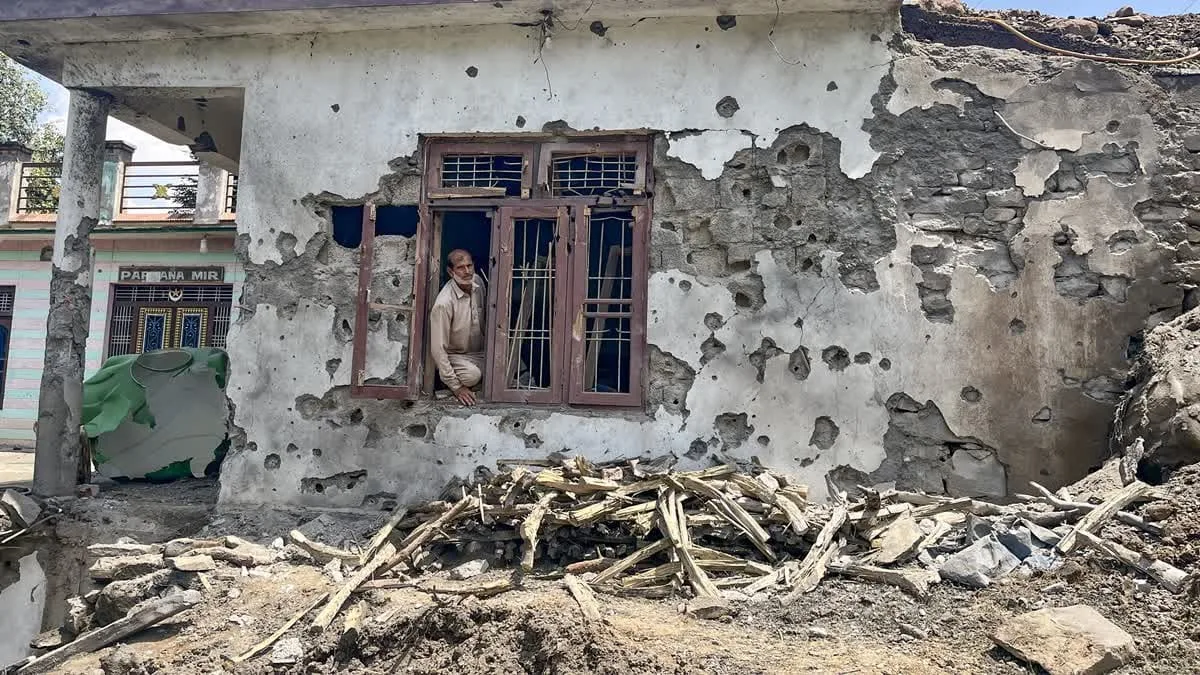
Seventy-seven years after partition, the Kashmir valley remains the principal victim of a single country’s incurable territorial fixation: Pakistan. What began in October 1947 as an armed invasion orchestrated by Pakistan Army officers has mutated into a permanent, low intensity war waged by proxies, yet the objective has never changed. Islamabad knew that it cannot seize Kashmir by conventional means, so it has chosen to prevent Kashmir from ever knowing peace. The human cost of this strategy is measured not in battalions destroyed or positions captured, but in millions of ordinary lives suspended between hope and dread.
The most visible damage is inflicted on those who live closest to the Line of Control. In the frontier districts of Kupwara, Baramulla, Uri, Karnah and Gurez, families have grown accustomed to sleeping fully clothed during winter nights because a sudden barrage can force evacuation in minutes. Community bunkers built by the Indian Army dot the landscape like grim reminders that normal life requires concrete shelters. Children here can identify the calibre of incoming artillery by sound alone. Livestock, often the only savings a household possesses, are obliterated in hours. When the guns fall silent, landmines planted by infiltrators supported from across the border ensure that even peace remains lethal. These villages are not collateral damage in somebody else’s war; they are the chosen battlefield of a neighbour that has never accepted the accession of Jammu and Kashmir to India.
Yet the deeper tragedy is that geography offers no protection. A fruit grower in Shopian, a houseboat owner in Srinagar, a medical student in Anantnag and a carpet artisan in Pulwama live a hundred kilometres or more from the nearest Pakistani forward post, but their futures rise and fall with decisions taken in Rawalpindi. Whenever Pakistan activates its terror infrastructure, whether by pushing fresh batches of Lashkar or Jaish cadres across the LoC or by orchestrating a spectacular strike, the whole life in Kashmir enters into turbulence. The houseboat owner sees his season’s earnings evaporate as tour operators cancel bookings, the saffron grower sees its prices drop into a spiral and the artisan discovers that the buyers who were scheduled to visit from Delhi have been scared away by fresh travel advisories. Pakistan fires no bullet into these homes, yet it destroys them all the same.
The cruelty of this arrangement becomes stark when one considers how quickly the Valley had begun to recover after the constitutional changes of August 2019. With the removal of Articles 370 and 35A, the legal distortions that Pakistan had exploited for decades to claim perpetual “dispute” were eliminated. Investment announcements crossed eighty thousand crore rupees, tourist arrivals surpassed two crore annually, new expressways and rail links shortened distances dramatically and infiltration numbers fell to their lowest since records began. For the first time in three decades, young Kashmiris spoke of start-ups and civil service coaching classes rather than shutdown calendars. Schools remained open for full academic sessions, college campuses buzzed with cultural festivals and the apple crop fetched record prices in mainland markets. Pakistan watched this normalisation with ill concealed alarm. A stable, prosperous Kashmir integrated with India represents the strategic death of the very narrative on which generations of Pakistani generals have built their domestic legitimacy.
The response was entirely in character. On 22 April 2025, a squad armed and trained across the border executed the massacre of twenty-six tourists in the meadows of Baisaran near Pahalgam. The targeting was deliberate: predominantly Hindu visitors picnicking in one of the Valley’s most idyllic spots. Within forty-eight hours the fragile recovery of 2023–24 lay in ruins. Tourism bookings collapsed by more than seventy percent, hotels laid off staff en masse and the Government of India was compelled to vacate the tourists in the middle of a peak season that punished the entire population for the actions of a
handful of killers guided from Muzaffarabad and Muridke. Pakistan achieved in an afternoon what it could never achieve through open war: it reminded every investor, every visitor and every young Kashmiri that normalcy remains revocable so long as Islamabad retains the power to press the detonator.
This is the essence of Pakistan’s continuing war: it does not need to win Kashmir; it only needs to ensure that India cannot win peace. Every delayed school examination, every unsold crate of apples, every shuttered hotel, every young graduate who chooses despair over opportunity is entered into Islamabad’s ledger as a strategic success. The human rights reports that Pakistan sponsors at international fora never acknowledge this central truth: the gravest and most sustained violation of Kashmiri rights is committed by the very state that claims to be their champion.
India has demonstrated remarkable restraint and generosity toward a population that has been subjected to systematic subversion by a hostile neighbour. Billions have been invested in infrastructure, education and health despite the constant risk of sabotage. Security forces operate under rules of engagement that would be unthinkable in any other counter terrorism theatre. The people of Kashmir are not asking for charity; they are asking for the simple right to live without the shadow of Pakistani terror dictating whether their children attend school or hide in bunkers, whether their fruit reaches the market or rots on the highway, whether their daughters plan weddings or postpone dreams.
Until the terror training camps across the Line of Control are permanently dismantled, until the Pakistan Army is forced to abandon its use of jihad as state policy and until the international community finally holds Islamabad accountable for the longest running sponsorship of terrorism in modern history, the Valley will remain trapped in a cycle that is neither war nor peace. The responsibility for breaking that cycle does not rest with the mother in Sopore who teaches her son to duck at loud noises, nor with the teenager in Pulwama who wonders whether his examinations will be postponed again this year. It rests squarely with the state that has spent seven decades ensuring that neither mother nor son will ever know a life unmarred by its malice.
Kashmir’s tragedy is not that it is loved too much by India; it is that it is hated too much by Pakistan. Until that hatred is confronted and defeated, the Valley’s children will continue to pay with their futures for a conflict they did not start and cannot end.

