

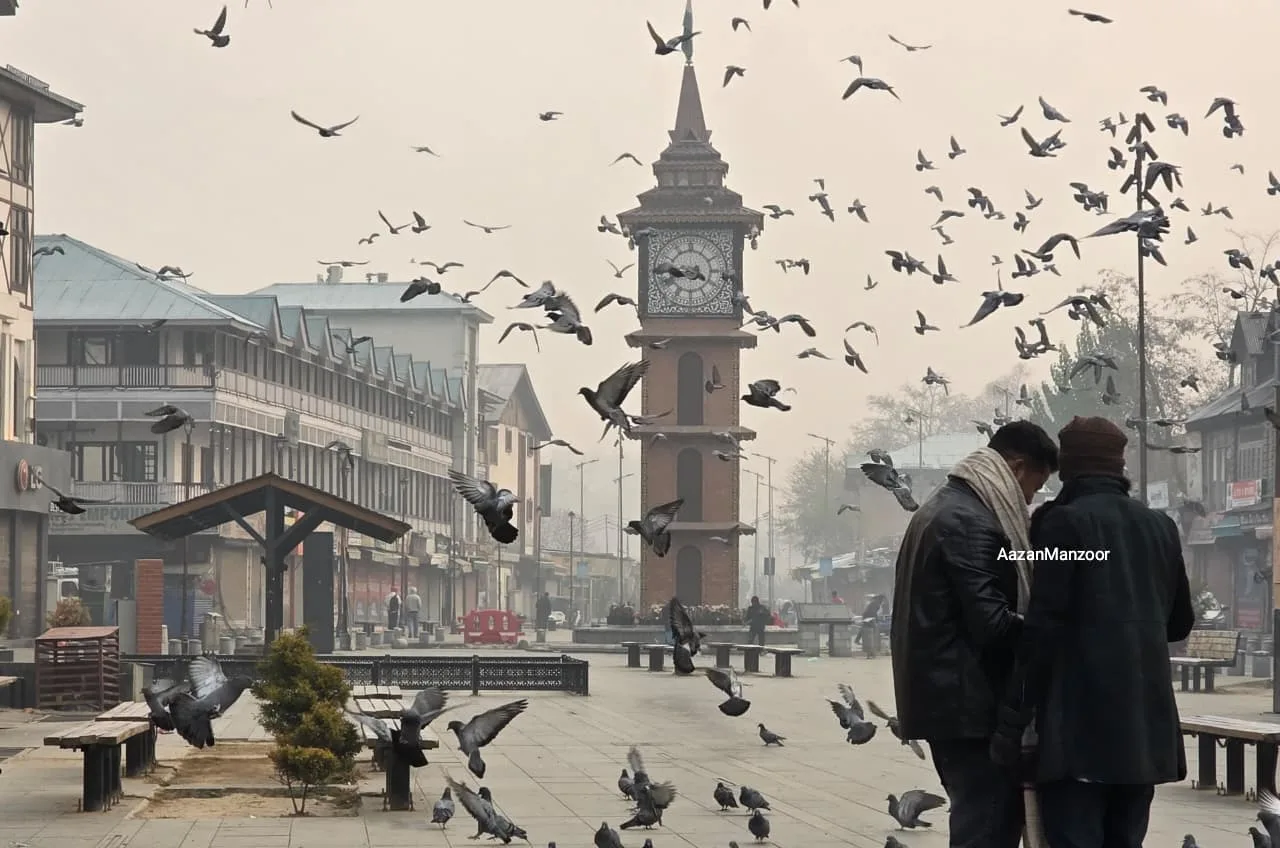
Srinagar, Dec 13 (JKNS): Air across large parts of Jammu and Kashmir has turned dangerously polluted, with several districts recording unhealthy to severe Air Quality Index (AQI) levels, exposing residents to sustained toxic air.
Latest AQI readings from AQI.in, accessed by news agency JKNS, show Baramulla at 178, Handwara 173, Bandipora 172, and Kulgam 158, all falling in the “Unhealthy” category. Banihal/Banhore recorded an AQI of 132, classified as “Poor”.
Meanwhile, Jammu city crossed into the “Severe” zone with an AQI of 223, signalling extremely hazardous air conditions.
The scale of pollution becomes starker when measured against cigarette exposure.
In Srinagar, pollution levels are even more alarming. The city’s average PM2.5 concentration has remained close to 80 µg/m³, with a mean AQI of about 168, according to AQI.in data. While AQI touched 180 and PM2.5 peaked at 96 µg/m³ over the past 24 hours, the cigarette-equivalent calculation is based on average exposure, not peak spikes.
Using Berkeley Earth’s rule of thumb, where 22 µg/m³ of PM2.5 over 24 hours equals one cigarette per day, breathing Srinagar’s air for a single day amounts to about 3.6 cigarettes. Over a month, that adds up to approximately 109 cigarettes, even for people who have never smoked.
This means residents are effectively being pushed into passive smoking by the air they breathe. Even brief episodes of extreme pollution can leave lasting damage, and cleaner days do not fully offset the harm caused during high-pollution spells.
The data lays bare a harsh reality: in parts of Jammu and Kashmir, taking a breath has begun to carry risks comparable to lighting up, and the exposure remains largely unavoidable.
Speaking to JKNS, weather expert Faizan Arif Keng said that air pollution in Kashmir intensifies during winter due to a combination of meteorological and geographical factors.
“Falling temperatures lead to frequent temperature inversion, while calm winds and weak atmospheric circulation prevent pollutants from dispersing,” he said.
He added that the Valley’s bowl-shaped topography further traps polluted air near the surface. “The situation has been aggravated by the absence of rainfall or snowfall, which usually helps cleanse the atmosphere. With dry weather expected to continue for at least another week, there is little scope for immediate improvement, and residents are likely to remain under prolonged exposure to poor air quality,” he added. (JKNS)

