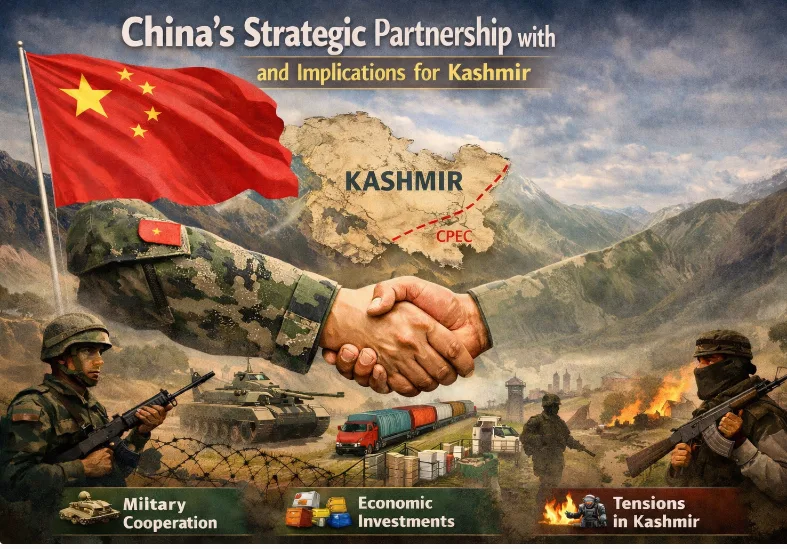
China’s strategic partnership with Pakistan has long ceased to be a mere diplomatic alliance and has transformed into a deep, almost existential entanglement that directly undermines India’s sovereignty, territorial integrity and security, particularly in Jammu and Kashmir. From the moment the People’s Republic of China and Pakistan signed their boundary agreement in 1963, under which Pakistan ceded the Shaksgam Valley, an integral part of the former princely state of Jammu and Kashmir, to Beijing, the message was unmistakable. China was willing to accept territorial concessions from Pakistan in a region whose final status remains disputed, thereby legitimising Pakistan’s illegal occupation of a portion of Indian territory. India protested then and continues to protest now, yet Beijing has never renounced its claim over the ceded land nor shown any willingness to revisit the agreement until the “sovereign authority” over Kashmir is settled, a formulation that cleverly keeps India permanently out of the conversation.
That single transaction in 1963 laid the foundation for what has become a multi decade pattern of collusion. Whenever India has faced Pakistan in war or crisis, China has stood behind Islamabad with diplomatic cover, military hardware and economic lifelines. The partnership deepened through the 1970s and 1980s with covert nuclear and missile cooperation that gave Pakistan the ultimate deterrent against India. It matured in the 1990s and 2000s through a steady flow of conventional arms that equipped Pakistan’s military for both symmetric and asymmetric warfare. And in the last decade it has acquired an entirely new dimension through the China Pakistan Economic Corridor, a flagship project of Beijing’s Belt and Road Initiative that deliberately routes billions of dollars of infrastructure through Gilgit-Baltistan, a territory that is illegally occupied by Pakistan.
India has consistently maintained that no third country has any locus standi in Jammu and Kashmir, yet China has inserted itself physically, financially and militarily into the disputed region. Roads, tunnels, hydropower projects and fibre optic cables now crisscross Gilgit-Baltistan under Chinese financing and increasingly, Chinese protection. Special economic zones are planned, mineral resources are being surveyed by Chinese companies and the upgraded Karakoram Highway offers Beijing a direct overland link from Xinjiang to the Arabian Sea. Every kilometre of asphalt laid in these areas amounts to a fresh consolidation of Pakistan’s illegal control and a fresh violation of Indian sovereignty. New Delhi’s protests are met with the same bland formulation: these are purely economic projects with no political implications. The presence of Chinese security personnel guarding their nationals and assets in Gilgit-Baltistan gives the lie to that claim.
The economic asymmetry between the two partners has now reached a point where many in Pakistan openly describe their country as a client state, if not an outright colony, of China. Islamabad’s external debt to Beijing stands close to thirty billion dollars and the repayment schedule for CPEC related loans has become a chokehold on Pakistan’s finances. When terrorist attacks target Chinese workers, as they frequently do in Balochistan and Khyber Pakhtunkhwa, Beijing demands and receives extraordinary security arrangements that sometimes look indistinguishable from a foreign military presence. Pakistan’s army, already the real power behind the civilian facade, finds itself answerable to Chinese concerns to an unprecedented degree. In this unequal relationship, Pakistan’s leverage over Kashmir policy has effectively been mortgaged to Chinese strategic interests.
Those interests are not difficult to discern. A permanently weakened and distracted India serves China’s larger goal of regional primacy. By keeping the Kashmir pot simmering through sustained support to Pakistan’s conventional forces and its terrorist proxies, Beijing ensures that a significant portion of India’s military remains tied down on the western frontier. This complements the pressure China itself applies along the Line of Actual Control in Ladakh, where Chinese troops have maintained a build-up since 2020 and continue to build dual use infrastructure at a furious pace. The China Pakistan axis thus creates a classic two front problem for India.
The military dimension of this partnership has become especially alarming in the past few years. China has emerged as Pakistan’s largest arms supplier by a wide margin, providing everything from fourth generation fighter jets and air defence systems to submarines and drones. Much of this equipment has been battle tested, regrettably, in Jammu and Kashmir. Indian security forces regularly recover Chinese origin weapons, ammunition, communication sets and explosives from terrorist hideouts in the Valley and along the Line of Control. The sophistication of the recovered material has grown steadily: night vision devices, thermal imagers, encrypted radios and even components of man portable air defence systems have surfaced in recent operations. When Indian forces launched Operation Sindoor in May 2025 to destroy terrorist launch pads across the Line of Control in retaliation for the Pahalgam massacre, Pakistan’s response relied heavily on Chinese supplied platforms, including J-10C fighters armed with PL-15 beyond visual range missiles and HQ-9 surface to air missile batteries. Debris recovered from the skirmishes bore unmistakable Chinese markings, confirming what Indian intelligence had long alleged: Beijing is not a neutral supplier but an active participant in the conflict by proxy.
This pattern of arming both state and non-state actors serves multiple Chinese objectives simultaneously. It advertises the reliability of Chinese military technology to potential customers around the world. It keeps India bleeding in a low intensity conflict that drains resources and international goodwill. And it ensures that Pakistan remains strategically dependent, unable to contemplate any genuine rapprochement with India that might threaten Chinese investments or influence. The nuclear umbrella Pakistan acquired with Chinese assistance in the 1990s has further lowered the threshold for conventional and sub conventional aggression, secure in the knowledge that India’s response options are constrained by the risk of escalation.
Perhaps the most insidious aspect of China’s involvement is the permanent alteration of facts on the ground in Pakistan-occupied Kashmir. Demographic changes, large scale infrastructure and the integration of Gilgit-Baltistan into the CPEC grid are all creating new realities that will be extraordinarily difficult to reverse through diplomacy or even military means. Beij…

China’s Strategic Partnership with Pakistan and Implications for Kashmir