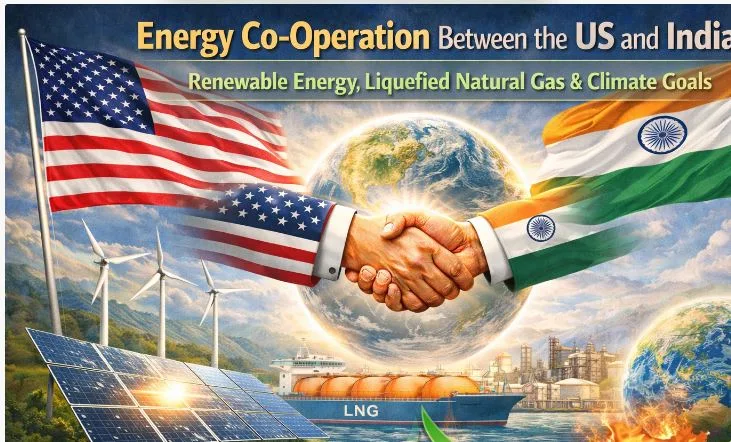
Energy cooperation between the United States and India has evolved from a polite diplomatic footnote into one of the most consequential bilateral relationships of the twenty first century and from an Indian perspective it is no longer merely desirable but indispensable. At the heart of this partnership lie three intertwined strands: the explosive growth of renewable energy collaboration, the strategic embrace of American liquefied natural gas as a bridge fuel and the shared yet asymmetrically burdened pursuit of climate goals. For India, a nation that must lift hundreds of millions into modern prosperity while facing the brutal realities of climate change, this cooperation is not charity or concession but a hard-headed alignment of self-interest that allows New Delhi to reconcile its developmental imperatives with its global responsibilities.
The renewable energy story is the brightest thread in this tapestry. India has already installed more than 200 gigawatts of non-fossil capacity by the end of 2025, a figure that would have seemed fantastical even a decade ago and American technology, finance and policy support have been quietly indispensable to that achievement. Whether through the early risk sharing loans of the U.S. Export-Import Bank that seeded Gujarat’s solar parks, the joint research under the Partnership to Advance Clean Energy that brought down the cost of battery storage or the more recent commitments under the Strategic Clean Energy Partnership that are funding grid-scale pumped hydro and green hydrogen pilots in Rajasthan and Tamil Nadu, the United States has consistently appeared as a partner that understands India’s need for speed and scale. When the International Solar Alliance moved from vision to headquarters in Gurugram, American membership and technical contributions signalled that Washington saw India not as a recipient of climate aid but as a co-architect of the global energy transition. The 2025 groundbreaking of the ACME Group’s integrated solar to green ammonia facility in Texas, with its assured offtake for Indian fertiliser and refining industries, perfectly illustrates the maturing reciprocity: Indian entrepreneurial ambition meeting American project finance and land availability to create a clean molecule corridor across the Pacific.
Yet no honest Indian assessment can pretend that renewables alone will meet the country’s voracious energy appetite in the coming two decades. Coal still supplies roughly seventy percent of electricity generation and even the most optimistic scenarios show it retaining a substantial share until at least 2040. This is where American Liquefied Natural Gas has emerged as the unlikely hero of India’s energy security narrative. From near zero imports in 2017, the United States now routinely ranks among India’s top three suppliers of liquefied natural gas, often overtaking traditional West Asian partners during periods of tight global supply. The numbers tell a compelling story: in the fiscal year 2024-25, India imported close to ten million tonnes of American Liquefied Natural Gas, a volume that displaced dirtier coal in power plants and heavier fuel oil in industries while simultaneously helping narrow India’s trade deficit with the United States. The first structured long-term LPG contract signed in November 2025, covering more than two million tonnes annually, marks the transition from opportunistic spot purchases to strategic partnership. For Indian planners, American Liquefied Natural Gas offers three priceless advantages: diversification away from choke point vulnerable Middle Eastern routes, relatively lower methane leakage compared to some other suppliers and the comforting knowledge that no single supplier can weaponise energy against India as long as Washington and Moscow remain geopolitical rivals. In an era when energy has once again become a tool of statecraft, the ability to play one great power’s molecules against another’s is not cynicism but prudent statecraft.
The climate dimension, however, introduces the most delicate balancing act. India has voluntarily pledged to reach net zero emissions only by 2070, a target that reflects both scientific realism and the moral argument that historical emitters must bear the heavier burden. The United States, having re entered the Paris Agreement and then partially distanced itself again under a new administration in 2025, sends mixed signals that Indian negotiators have learned to read with wary pragmatism. Yet the bilateral climate engagement has proved remarkably resilient. The US-India Climate and Clean Energy Agenda 2030 Partnership continues to channel finance into offshore wind mapping along the Tamil Nadu coast, while the newly announced Energy Storage Task Force addresses the single biggest bottleneck in India’s renewable push. American institutions have mobilised billions of dollars through blended finance instruments that crowd in domestic capital at tolerable interest rates, something multilateral development banks alone have struggled to achieve at the required velocity. When Climate Action Tracker labels India’s policies “highly insufficient”, many in New Delhi hear an echo of the old developed country habit of moving goalposts after the game has started. The Indian counter narrative, patiently articulated in every G20 and COP setting, is that per-capita emissions remain a fraction of American levels, that coal phase out without affordable alternatives would condemn millions to continued energy poverty and that the richest nation in history has both the capacity and the responsibility to transfer technology without strings that compromise strategic autonomy.
This is why the most encouraging developments are those that sidestep ideological posturing and focus on tangible co-development. The decision to jointly explore geologic carbon storage in the Deccan basalt formations, the collaboration on small modular nuclear reactors that could finally operationalise the long delayed civil nuclear agreement and the quiet but steady expansion of the Mineral Security Partnership to secure lithium and cobalt processing in India all suggest a partnership maturing beyond rhetoric. Even the recent tensions over possible US tariffs on refined products from Russian crude have not derailed energy trade; instead, they have accelerated the search for American molecules and molecules produced with American technology. India has demonstrated that it can increase imports from the United States while simultaneously expanding its energy ties with Russia, Iran and the Gulf, a multi alignment that frustrate critics in Washington who seek exclusivity but delights strategists in South Block who prize options.
Looking ahead, the true test of this energy cooperation will be its ability to withstand domestic political swings in both countries. In the United States, protectionist voices may demand restrictions on clean technology exports or higher tariffs on Indian solar panels manufactured in India. In India, coalition politics and state level resistance could slow down land acquisition for transmission lines or dilute methane regulations for the sake of short term growth. Yet the underlying drivers remain inexorable: India needs energy at scale and at speed, the United States needs markets for its gas and leadership in the clean energy race against China and both nations need each other to prevent the worst outcomes of climate change. When Prime Minister Modi and President Trump announced the Comprehensive and Progressive Agreement for Trans-Atlantic and Trans-Pacific Partnership (COMPACT) framework in February 2025 with its explicit energy pillar aiming for half a trillion dollars in bilateral trade by 2030, they were acknowledging a reality that bureaucrats and CEOs had already internalised: in an increasingly fractured world, the US-India energy corridor is one of the few axes of stability.
For India, the ultimate measure of success is not how many gigawatts of American solar panels adorn its rooftops or how many Liquefied Natural Gas carriers flying the stars and stripes dock at Dahej and Hazira. It is whether this cooperation enables the country to provide reliable, twenty-four-hour electricity to every village school and urban hospital, whether it allows Indian industry to decarbonise without de industrialising and whether it strengthens rather than erodes India’s strategic autonomy. Judged by that standard, the partnership is delivering more than sceptics predicted and less than optimists hoped, which is perhaps the most one can expect from great power relations in a time of poly crisis. The renewable sun that rises over Gujarat’s solar parks and the LNG that steams across the Pacific are not merely commodities; they are building blocks of a modern India that refuses to choose between prosperity and planetary responsibility. In that refusal lies the deepest convergence between New Delhi and Washington, a convergence built not on sentiment but on the clearest eyed recognition of mutual need.

Energy Co-Operation Between the US and India: Renewable Energy, Liquefied Natural Gas & Climate Goals