

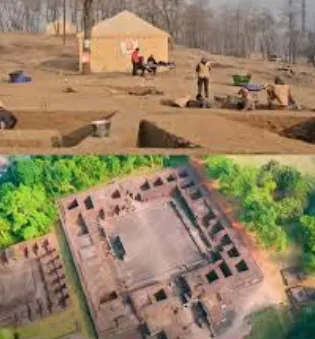
When archaeologists began excavating the unassuming mounds of Zehanpora in north Kashmir’s Baramulla district, few anticipated that the soil would speak so eloquently to global history. What initially appeared to be ordinary land formations revealed themselves as remnants of a vast Kushan-period Buddhist complex stupas, structural foundations and artefacts nearly two thousand years old. This discovery has reopened an essential but long-neglected question: How central was Kashmir to the making of Buddhism as a world religion? The answer, increasingly supported by archaeology, textual evidence and trans-Asian historical research, is unequivocal. Kashmir was not a peripheral recipient of Buddhist ideas; it was a crucial intellectual, institutional and geographical launchpad from where Buddhism was debated, refined and transmitted across Asia.
The association of Buddhism with Kashmir dates back to the Mauryan period, traditionally linked to Emperor Ashoka. Ancient sources credit Ashoka with founding Srinagar and establishing monasteries and stupas across the Valley. Kashmir’s strategic location at the crossroads of the Indus-Gandhara region and the Himalayan corridors leading into Central Asia made it uniquely positioned to act as a bridge between the Indian heartland and the wider Asian world.
While popular memory anchors Buddhism to four sacred sites Lumbini, Bodh Gaya, Sarnath and Kushinagar, however religions do not become global through sacred geography alone. They spread through word of mouth, humane actions, teachings, translation, debates and institutional networks. In this deeper story of transmission, Kashmir and Ladakh occupy a vital but under-acknowledged place.
Early Buddhist chronicles and later Sanskrit sources consistently refer to Kashmir as Sharada Pitha a seat of learning. The Valley emerged not merely as a site of devotion, but as a centre of rigorous intellectual engagement. Buddhist thought in Kashmir was analytical, dialectical and scholastic, contributing decisively to the systematisation of doctrine. If the Buddha’s message was born in the Gangetic plains, its philosophical refinement found fertile ground along the banks of Vitasta(Jhelum).
This intellectual legacy reached its zenith during the Kushan period. Under Emperor Kanishka, Buddhism received unprecedented royal patronage. Tradition holds that Kanishka convened the Fourth Buddhist Council in Kashmir, presided over by the scholar Vasumitra and attended by luminaries such as Ashvaghosha. This council proved pivotal in the consolidation and spread of Mahayana Buddhism, a tradition that emphasised compassion, the Bodhisattva ideal and universal liberation.
From Kashmir, Mahayana ideas travelled westward through Gandhara to Kabul and Bactria and eastward into Central and East Asia. In this sense, Kashmir was not on the margins of Buddhist history, it stood at its centre, shaping the form of Buddhism that would eventually take root in China, Korea, Japan and Tibet.
Material evidence reinforces this historical role. The Gilgit Manuscripts among the oldest surviving Buddhist texts in the world reveal Kashmir and its neighbouring regions as custodians of Buddhist knowledge. Written in Sanskrit and Prakrit, these manuscripts underscore the Valley’s function as a repository, translator and transmitter of Buddhist philosophy at a time when ideas travelled along monastic and mercantile networks rather than modern borders. The recent excavation at Zehanpora adds a crucial archaeological layer to this narrative. The site’s scale and sophistication suggest a thriving institutional centre rather than an isolated monastery further evidence of Kashmir’s role as a hub of learning and exchange.
Addressing the 129th episode of Mann Ki Baat on December 28, Prime Minister Narendra Modi highlighted the rediscovery of the Baramulla Buddhist complex as a moment of national pride. He recounted how the mystery of the Zehanpora mounds was unlocked through modern scientific methods, including drone-based aerial photography and systematic land mapping. Remarkably, a blurred, decades-old photograph preserved in a museum archive in France proved instrumental.
The image, showing three Buddhist stupas in Baramulla, helped researchers confirm the historical identity of the site. Thousands of kilometres away from Kashmir, this forgotten visual record bridged time and geography, allowing history to be reclaimed through global cooperation. The Prime Minister noted that the complex dates back nearly two millennia, reaffirming Jammu and Kashmir’s role as a centre of learning, spirituality and cultural exchange. He emphasised that preserving such heritage connects present generations with their civilisational roots and strengthens collective cultural confidence.
Kashmir’s Buddhist legacy did not vanish with the decline of institutional Buddhism in the region. Its philosophical emphasis on the Middle Path the rejection of extremes left a lasting imprint on later spiritual traditions. The Sufi-Rishi movement, particularly the teachings of Lal Ded and Sheikh Noor-ud-din Noorani, echoes this ethic of moderation, compassion and inner discipline. These traditions emerged from a shared cultural soil shaped by centuries of Buddhist, Shaivite and Sufi thought, forming the foundations of Kashmir’s syncretic composite culture often described as kashmiriyat.
For decades, Kashmir’s global image has been dominated by narratives of conflict, terrorism and political instability. This narrow framing has obscured the region’s deeper civilisational identity. Discoveries such as the Zehanpora excavation invite a necessary rethinking not of Kashmir as a land perpetually seeking peace, but as a region that once shaped the moral and philosophical vocabulary of half the world. Buddhism did not pass through Kashmir in silence. It argued, evolved, translated and transformed here. The Valley served as a crucible where ideas were tested before being carried across mountains and deserts to distant civilisations. Recognising this legacy is not merely an academic exercise; it is an act of historical correction. To understand global Buddhism without Kashmir is to read only half the story. The Valley was not just a witness to history, it was one of its makers.

