

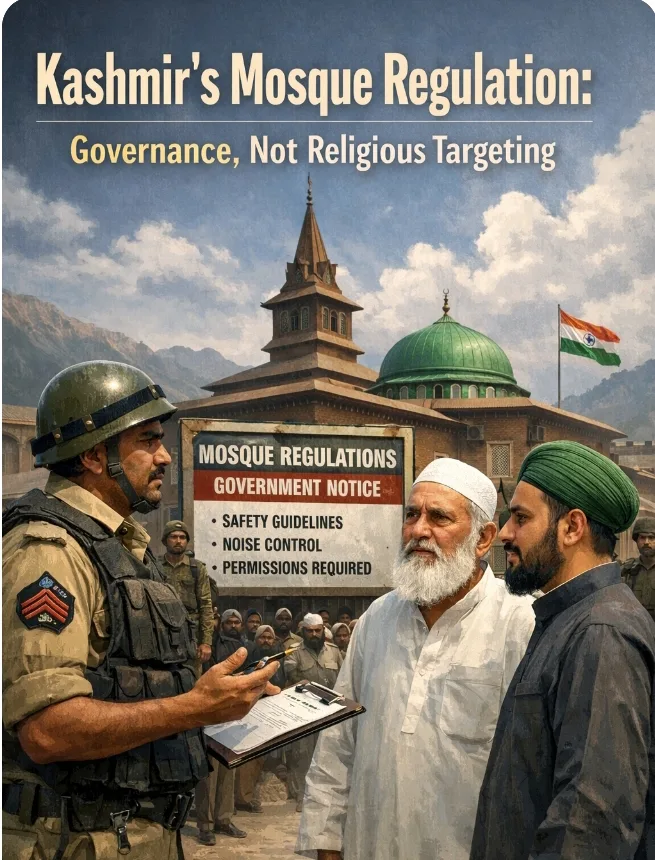
The recent uproar over administrative measures relating to mosques in Kashmir reflects a familiar pattern routine governance being recast as religious persecution. Such interpretations may serve immediate political narratives, but they do little to clarify the substance of what is actually taking place.
At its simplest, the exercise concerns documentation, verification, and administrative oversight of religious institutions. These are not exceptional measures. They are standard instruments through which modern states regulate organisations that operate in public space, manage property, and collect or utilise funds. To suggest that mosques alone should exist outside this framework is neither practical nor consistent with global practice.
Across the Muslim world, state oversight of mosques is not only common but often far more stringent. In Pakistan, mosques must be registered as legal entities, with documented land ownership and official approvals required for construction. In Saudi Arabia, mosque administration is entirely centralised under the Ministry of Islamic Affairs, with imams serving as state employees. Turkey’s religious affairs are largely managed by the Diyanet, a government institution that oversees mosques, clergy appointments, and religious activities.
Similar regulatory models exist elsewhere. Malaysia requires written approval from state Islamic councils before a mosque can be established or used. Egypt places mosques under the supervision of its Ministry of Religious Endowments, exercising close control over religious spaces and sermons. In the Gulf, countries such as the UAE and Qatar operate licensing systems that govern construction, staffing, funding, and day-to-day management. Indonesia mandates legal registration of mosques under the Ministry of Religious Affairs.
Placed against this international backdrop, administrative verification in Kashmir appears neither extraordinary nor discriminatory. It reflects a governance approach that is widely accepted, including in countries where Islam is the state religion. Regulation, in this sense, is not a commentary on faith but a function of the state’s responsibility to ensure legality and accountability.
What complicates the matter in Kashmir is the political and emotional context in which governance operates. Years of instability have created an atmosphere where even ordinary administrative actions are viewed with suspicion. Yet allowing every regulatory step to be framed as religious targeting carries its own risks. It encourages a narrative in which governance itself becomes suspect and undermines the distinction between genuine concerns and exaggerated claims.
There is also a broader implication for public discourse. When routine administrative measures are cast as assaults on religious freedom, the term itself begins to lose meaning. Religious liberty is a serious constitutional principle, not a catch-all for opposing state oversight. Conflating the two does a disservice to legitimate debates on rights and freedoms.
A more measured conversation is needed one that recognises that regulation and religious practice are not inherently at odds. Kashmir’s experience, viewed objectively, fits within a global pattern where states retain oversight of religious institutions without negating their spiritual role.
Governance should be judged on facts, not fears. The challenge lies not in the act of regulation, but in ensuring that public debate remains anchored in reality rather than rhetoric.

