

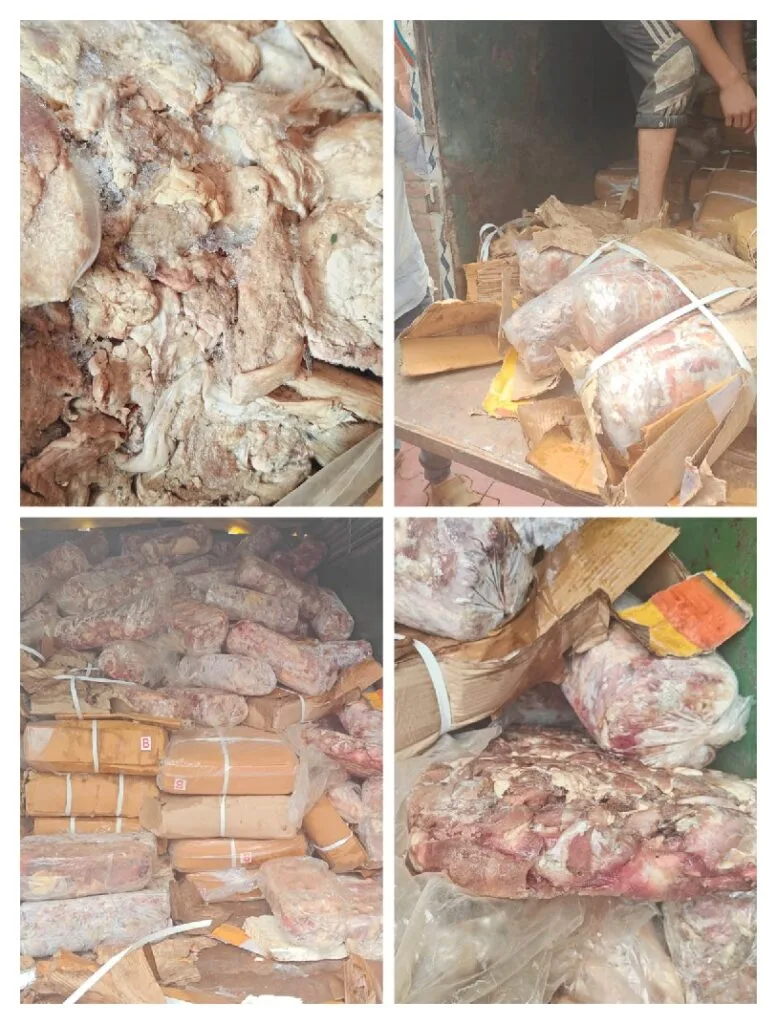
Srinagar, Feb 13 (JKNS): The Jammu and Kashmir Legislative Assembly on Friday witnessed sharp exchanges and bipartisan concern over the sale of rotten and unsafe meat, with legislators pressing for stricter legal provisions, enhanced enforcement and accountability mechanisms.
As per news agency JKNS, the issue surfaced through Assembly Question Nos. 10, 94, 569 and 757 raised by MLAs Mubarak Gul, Mir Saifullah, Pirzada Farooq Ahmad Shah and Hasnain Masoodi on “Food Adulteration and Sale of Rotten Meat.”
Participating in the discussion, members cutting across party lines termed the matter a grave public health concern and linked unsafe food consumption to rising cancer cases and recurrent disease outbreaks.
MLA Mubarak Gul demanded that authorities identify and track down those involved in the illegal trade and attach their properties to create a deterrent effect.
Hasnain Masoodi stressed the need for systemic reforms and stronger preventive architecture to ensure such incidents do not recur, calling for robust monitoring and accountability.
CPI(M) leader M.Y. Tarigami also expressed concern over enforcement gaps and underscored the importance of strengthening institutional mechanisms to protect public health.
Pirzada Farooq Ahmad Shah described the menace as “worse than drugs” and pitched for establishing a dedicated enforcement wing at Lakhanpur to check the entry of unsafe food consignments. He further demanded setting up of slaughter houses in every Municipal Committee and sought a half-hour discussion in the House on the larger issue of food safety.
Responding to the debate, Health Minister Sakina Itoo acknowledged shortage of technical staff in the Food Safety Department and said there is “no denial” regarding manpower deficiency. She informed the House that the recruitment process to fill vacant posts has already been initiated.
Calling the matter directly linked to public health, the Minister said negligence at any level would not be tolerated. However, she clarified that under the Food Safety and Standards Act, 2006, Food Safety Officers do not have powers to arrest offenders.
She explained that officers are empowered to conduct inspections, lift samples, issue improvement notices, suspend or cancel licences, initiate prosecutions and file complaints in court, but arrests can only be carried out by police under the relevant provisions of criminal law.
The Speaker intervened and advised the Government to consider bringing an amendment Bill if stronger legal backing is required to empower enforcement authorities.
National Conference MLA Tanvir Sadiq supported the suggestion and demanded constitution of a separate enforcement task force to deal exclusively with food adulteration cases, stating that police is not directly under the control of the Assembly.
Earlier, in its written reply, the Government informed the House that 12,183.5 kilograms of rotten/unsafe meat and chicken worth ₹29,19,060 were seized and destroyed during the current financial year 2025-26 (up to December 2025) across Jammu and Kashmir.
It stated that 1,676 inspections were conducted and 144 samples of meat and meat products were lifted, of which 18 were found Not of Standard Quality (NSQ).
Additionally, 2,139 kg of meat worth ₹3,90,137 was seized during enforcement drives.
District-wise data revealed major seizures in Srinagar (4,220 kg), Jammu (3,881 kg) and Kupwara (1,520.5 kg), followed by Ganderbal, Anantnag and other districts, taking the total destroyed quantity to 12,183.5 kg…

