

When the Indian Ocean turns turbulent, the countries that share its waters often discover who they can truly rely on. For Sri Lanka, this reality resurfaced after Cyclone Ditwah battered the island in late November 2025. Roads collapsed, villages were cut off, and essential supplies became impossible to move. Just as Sri Lankan authorities were grappling with the extent of the damage, the familiar grey silhouettes of Indian naval ships appeared on the horizon. Their arrival was neither surprising nor ceremonial—it flowed naturally from a regional policy framework India has been sharpening for years: the SAGAR doctrine, or Security and Growth for All in the Region.
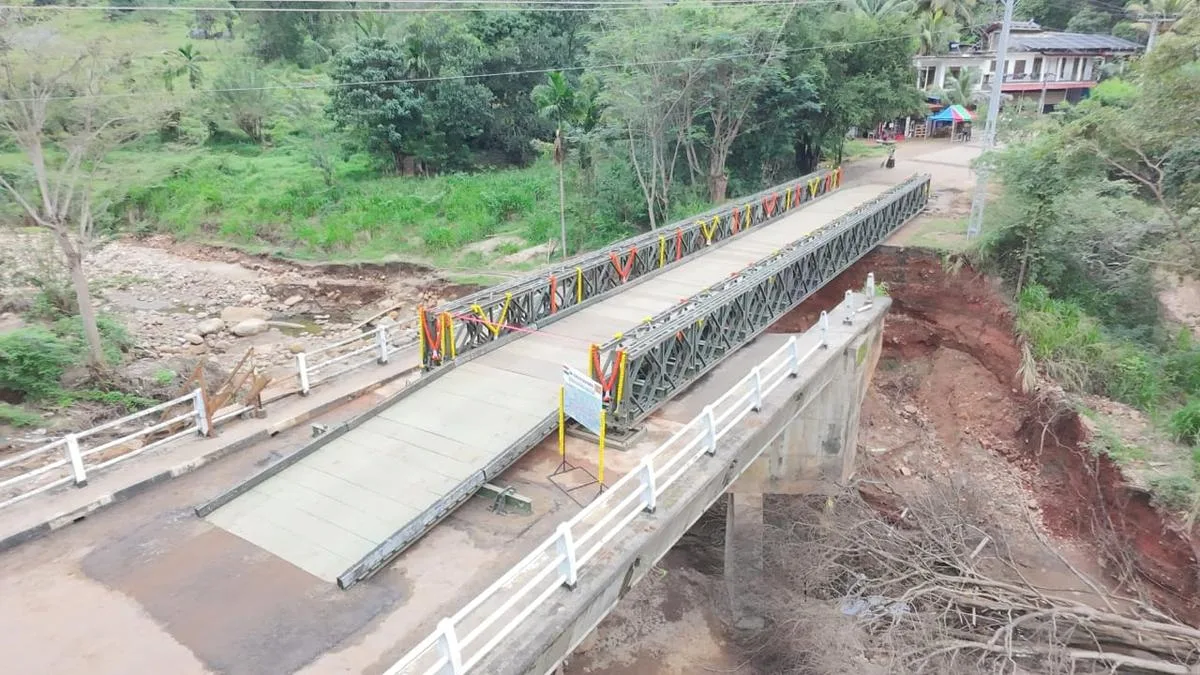
The most recent manifestation of that doctrine came on 4 February 2026, when INS Gharial sailed into Colombo with ten Bailey bridges. The timing—Sri Lanka’s 78th Independence Day—was incidental, but the message was not. The bridges are rugged, quickly deployable structures, crucial for reconnecting districts where Cyclone Ditwah had snapped road links like twigs. Yet the delivery also represents something larger: India’s attempt to translate its regional vision into practical, measurable outcomes on the ground.
Operation Sagar Bandhu had begun weeks earlier, almost instinctively. Within the first twenty-four hours after the cyclone, Indian disaster-response teams were already in Sri Lanka, conducting search-and-rescue missions in still-risky conditions. More than 450 people were rescued or assisted during those critical hours. Over December, four more Indian ships—INS Gharial, LCU 54, LCU 51, and LCU 57—delivered nearly a thousand tonnes of food, water, and emergency supplies. Before these vessels reached the scene, INS Vikrant, INS Sukanya, and INS Udaygiri were already conducting heli-borne evacuations.
What makes this pattern noteworthy is not just the number of ships or tonnes of supplies, but the underlying logic guiding the response. SAGAR, as articulated by Prime Minister Narendra Modi, rests on a simple but demanding principle: if India expects to be seen as a net security provider in the Indian Ocean, it must be visibly present when its neighbours face crises. And, importantly, that presence must feel like support, not interference.
Sri Lanka has experienced this approach more than once over the past two decades. When the 2004 Indian Ocean tsunami devastated coastal regions, India launched Operation Rainbow—one of the largest humanitarian missions in its naval history—sending helicopters, medical teams, and supply ships within hours. That pattern repeated during the 2016 Cyclone Roanu floods, the 2017 Southern Province floods, and the 2021 environmental disaster caused by the X-Press Pearl fire off Colombo’s coast.
This steady rhythm of assistance has built a kind of institutional memory between the two navies. Officers on both sides know each other. Joint training, communication protocols, even habits on the bridge—these are no longer unfamiliar. That familiarity strengthens the diplomatic ground on which both countries stand.
The SAGAR doctrine attempts to formalise this philosophy. Rather than being a stand-alone policy, it threads together humanitarian assistance, maritime security, economic cooperation, and capacity-building. Sri Lanka, given its location and vulnerabilities, is one of the primary theatres where this doctrine has played out.
Capacity-building has been a significant part of the story as well. Sri Lanka inaugurated its Maritime Rescue Coordination Centre (MRCC)—a critical upgrade to its search-and-rescue architecture, funded and supported by India. The same year, India also gifted a Dornier surveillance aircraft, expanding Sri Lanka’s maritime awareness capacity. That year signalled that India was no longer providing only short-term help; it was building long-term capacity. A better-equipped Sri Lanka enhances the collective maritime security architecture that SAGAR aims to promote.
Sri Lanka, meanwhile, took steps that signalled growing sensitivity to India’s security concerns. After several controversial visits by Chinese research vessels between 2022 and 2024, Colombo imposed a year-long moratorium on such foreign ships in early 2024. Later that year, the government introduced a new set of clearance procedures for military aircraft and naval movements, widely read as an attempt to address Indian concerns over maritime surveillance.
All these steps paved the way for a landmark development. India and Sri Lanka signed a Memorandum of Understanding on Defence Cooperation during Prime Minister Modi’s visit to Colombo in 2025. It was the most important defence agreement between the countries since the 1987 Indo–Sri Lanka Accord. For both sides, the MoU represented recognition of shared regional challenges and the means to address them.
In this context, humanitarian assistance played an unexpectedly powerful diplomatic role. SAGAR operates best not through pressure but through partnership—and rapid, consistent support during crises helps establish exactly that. Admiral Dinesh K. Tripathi reinforced that message during his September 2025 visit to Colombo, meeting Prime Minister Harini Amarasuriya and defence chiefs to discuss joint training and Sri Lanka’s participation in major Indian naval engagements such as MILAN and the International Fleet Review.
But the deeper significance lies in the combination of trust, proximity, and policy continuity that the bridges represent. India’s message, through SAGAR and missions like Sagar Bandhu, is fairly straightforward: shared seas demand shared responsibilities, and regional stability is strongest when neighbours help one another without hesitation.
In the increasingly contested waters of the Indian Ocean, that principle may turn out to be more valuable than any formal treaty. India and Sri Lanka are discovering that humanitarian diplomacy—done sincerely and repeatedly—can create a stability that strategy alone cannot.

