

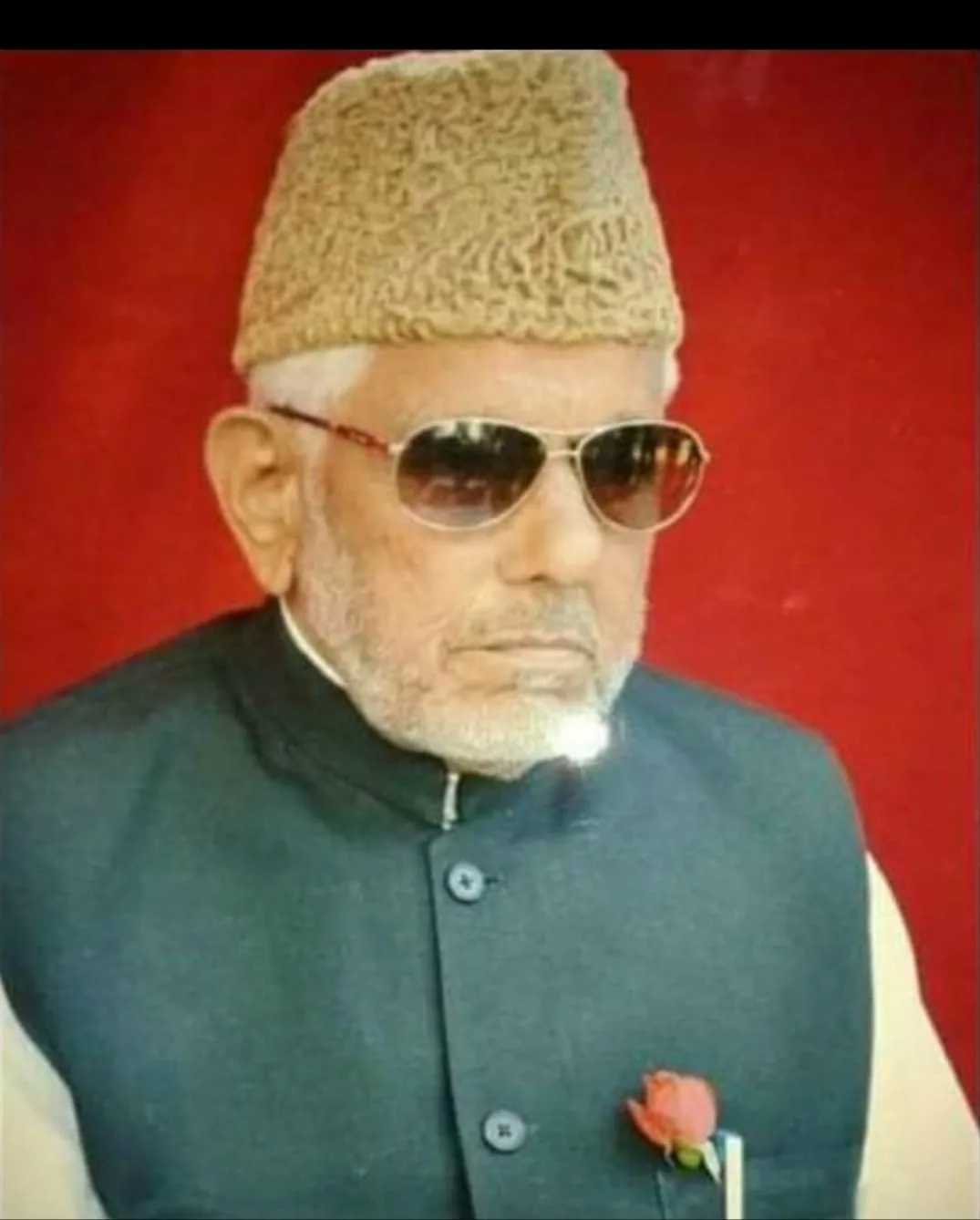
Anantnag, Feb 17 (JKNS): The passing of Peerzada Ghulam Ahmad Shah on February 13, 2026, in Jammu after a prolonged illness has left a profound void in the political and social life of Jammu and Kashmir.
Born on January 27, 1937, Peerzada Sahib devoted more than six decades to public service, earning respect across party lines for his integrity, accessibility, and unwavering commitment to the people.
His political journey began in 1960 under the guidance of Sheikh Abdullah, the Sher-e-Kashmir. During the Maz-Raj Shumari period, he served as Tehsil President Doru when the Jammu and Kashmir National Conference was active. Rising through grassroots politics, he was elected Block President for Devsar constituency and later served as Babpar Mandal President for Qazigund town and Auqaf President Qazigund roles that shaped his deep connect with the masses.
A seasoned administrator, Peerzada Ghulam Ahmad Shah held several key positions, including Chairman of the Central Cooperative Bank and Chairman of the Public Accounts Committee of Jammu and Kashmir. He was elected as MLA from Devsar constituency three times—in 1983, 1987, and 1996—and was inducted into the State Cabinet as Minister for Hajj, Auqaf, and Floriculture, before being entrusted with the Forest portfolio.
As Forest Minister, he was widely known for his firm stance on protecting state forest property and preventing encroachments, setting benchmarks for transparent governance.
In 1994, he was elected Provincial President and Member of the Central Working Committee of the National Conference. Recognizing his seniority and lifelong dedication, party president Farooq Abdullah nominated him as Vice President of the National Conference in 2004.
Beyond politics, Peerzada Sahib’s legacy is etched in transformative development. Local resident Fayaz Ahmad Wani of Qazigund recalled his pivotal role in securing land for the Eidgah and the Markazi Jamia Masjid through persistent efforts in public interest. He also played a decisive role in shifting the proposed Railway Station site from Ujroo to Qazigund—an intervention that benefited thousands—following the foundation stone laid earlier by former Prime Minister I. K. Gujral. During his tenure, Qazigund witnessed major public infrastructure including the Emergency Hospital, Munsif Court, R&B Division, PHE Division, Treasury, and several other landmark projects. After the devastating 1995 floods, as many as 36 damaged bridges in Devsar constituency were reconstructed in 1996 through his concerted efforts.
Thousands of mourners—political workers, religious scholars, and leaders from various parties—joined the funeral prayers. Prominent among them were Patron Darul-Uloom Rehimia Bandipora, Hazrat Molana Rehmat-ullaha Qasmi Sahib, National Conference leadership, legislators, and senior political figures.
The demise of Peerzada Ghulam Ahmad Shah marks the end of an era. He will be remembered as a principled leader, a compassionate public servant, and a visionary statesman whose lifelong service uplifted institutions and communities alike. His legacy will continue to inspire generations. (JKNS)

