

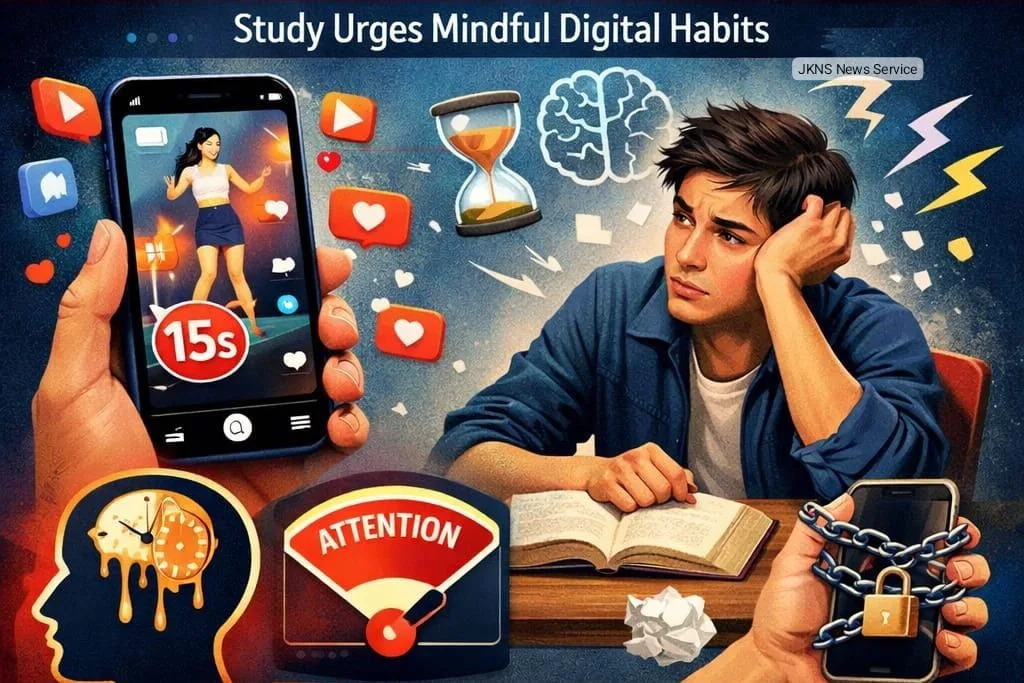
Srinagar, Feb 26 (JKNS): A new scientific study has found that excessive consumption of short-form videos on mobile phones may significantly impair attention functions and weaken self-control, raising fresh concerns over the cognitive impact of endless scrolling habits.
The study, published in the peer-reviewed journal Frontiers in Human Neuroscience on June 27, 2024, titled “Mobile phone short video use negatively impacts attention functions, an EEG study,” as per news agency JKNS. Researchers examined how heavy engagement with short-video platforms affects the brain’s executive control and attentional networks.
Conducted by a team of researchers from Zhejiang University, China, the study involved 48 young adults, including 35 females and 13 males, with an average age of 21.8 years. Participants were assessed using the Mobile Phone Short Video Addiction Tendency Questionnaire (MPSVATQ) and the Self-Control Scale (SCS) to evaluate their short-video usage patterns and self-regulation abilities.
To measure brain activity, researchers used electroencephalogram (EEG) recordings while participants performed the Attention Network Test (ANT), a widely used cognitive task that assesses alerting, orienting, and executive control functions of attention.
The findings revealed a significant negative relationship between short-video addiction tendencies and theta power index in the prefrontal region of the brain an area associated with executive control and decision-making. In simple terms, higher short-video usage was linked to weaker executive control functions.
Additionally, researchers identified a significant negative correlation between short-video addiction scores and self-control levels. Participants with stronger tendencies toward short-video overuse demonstrated lower self-control and diminished attentional efficiency.
Importantly, the study found that these effects were particularly evident during task-based EEG measurements rather than resting-state brain activity, suggesting that excessive short-video use may directly interfere with cognitive performance during active tasks.
The researchers concluded that increased dependence on mobile short-form video platforms could negatively affect executive control and attentional functions. They emphasized the need for awareness and targeted interventions to mitigate the potential cognitive risks associated with excessive short-video consumption.
With short-form video platforms becoming deeply integrated into daily routines, especially among youth, the study adds to the growing body of evidence suggesting that digital habits can have measurable effects on brain function and mental well-being. (JKNS)

