

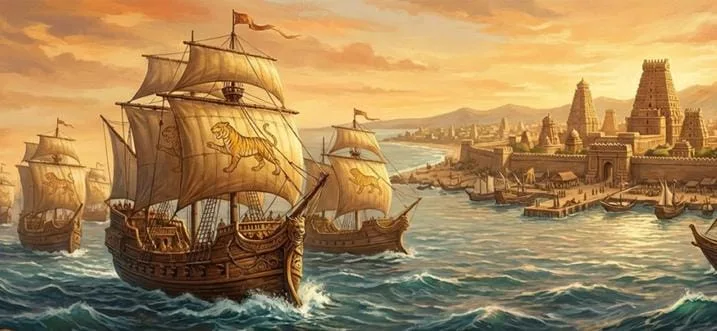
India’s week of major naval engagements including the International Fleet Review (IFR), the multinational exercise MILAN and the Indian Ocean Naval Symposium (IONS) has drawn attention not just to its current maritime posture, but also to its much older seafaring roots. Held at Visakhapatnam between 15 and 25 February 2026, the sequence showcased a confident, outward-looking navy. But long before modern warships took to the sea, Indian kingdoms were sailing across open waters and leaving durable impressions on distant shores. The most striking example of this historic reach came during the era of the Imperial Cholas (9th–13th centuries CE), when naval expeditions helped project political influence and accelerate cultural exchange across parts of Southeast Asia.
India’s maritime story begins far earlier than its modern naval institutions. Archaeological evidence shows maritime-linked urban economies in the subcontinent by the 3rd millennium BCE—most clearly associated with Indus-era trade and port activity. (The best-known example is Lothal on the western seaboard, often discussed in relation to dock-like structures and long-distance commerce.) East-coast evidence becomes much clearer and denser in the early historic and early medieval periods, when ports, riverine corridors, and overseas trade intensified.
Along the east coast, sites such as Poompuhar (Kaveripattinam) and Arikamedu point to organised coastal worlds tied to overseas exchange; Arikamedu in particular is well-attested as an Indo-Roman trading centre (often linked to “Poduke” in Greco-Roman accounts). Other sites you mention such as the Chilika region and Dharanikota/Amaravati area fit more securely into an early historic trading landscape connected to river systems and inland production zones, rather than the 3rd millennium BCE.
Mahabalipuram, meanwhile, is best framed as a prominent port-town of the Pallava period (roughly 7th–9th centuries CE) rather than an “as far back as” Bronze Age example.
These coastal centres were not isolated. They were connected to fertile hinterlands through navigable rivers, which made ports viable as collection-and-distribution nodes. The Gangetic delta offered multiple channels to the sea, while the Krishna–Godavari systems helped sustain coastal movement and trade down the eastern seaboard. Later textual traditions in Sanskrit architecture and town-planning literature (often grouped under Śilpaśāstra traditions) discuss classifications of ports and landing places—commonly described in categories such as pattana (commercial port/town) and dronīmukha (river-mouth/estuarine port). (It’s safer to present this as later prescriptive categories, not as a direct “logbook” of Bronze Age ports.)
By the late Bronze Age and early Iron Age, Indian traders were part of widening networks linking the subcontinent with West Asia via the Persian Gulf and, later, with the western Indian Ocean and Southeast Asia through monsoon sailing. In the early centuries CE, these routes carried spices, beads, textiles, ceramics and religious ideas—connecting societies long before modern diplomacy, and creating the conditions for cultural transmission across the Indian Ocean.
This long maritime tradition reached a dramatic high point under the Chola kings. From their core in the Kaveri heartland, the Cholas built maritime capability able to operate across the Bay of Bengal. Under rulers such as Rajaraja I and Rajendra I, Chola fleets mounted major overseas expeditions; the most famous is Rajendra I’s 1025 CE campaign against Srivijaya, widely interpreted as an intervention aimed at securing trade routes and strategic leverage rather than establishing direct territorial rule in Southeast Asia.
It is in this context that references to Chola influence in Sumatra and the Malay Peninsula make the most sense—as strategic reach and political signalling around key maritime nodes, alongside intensified commercial and cultural interaction. Cultural exchange, of course, was never a one-way export; Southeast Asian societies shaped what they adopted, adapted and rebuilt in their own idioms. Still, the enduring visibility of Indic religious concepts, political styles and artistic motifs across parts of Southeast Asia is closely tied to these long centuries of Indian Ocean connectivity.
The areas once within reach of Chola sea power overlap with what is today framed as the Indo-Pacific—a strategic space defined by connected sea lanes, chokepoints and the movement of trade and naval forces. India’s maritime interests now stretch across this arc, and the tools have changed: aircraft carriers, submarines, long-range aviation, and maritime surveillance networks. But the strategic goals rhyme across time—protecting sea lines of communication, strengthening partnerships, and shaping a stable regional order.
The February 2026 cluster of engagements reinforced that modern role. IFR 2026 was conducted off Visakhapatnam on 18 February 2026 with wide international participation. IONS convened its Conclave of Chiefs at Visakhapatnam on 20 February 2026, when India assumed chairmanship for 2026–28. MILAN 2026, held 15–25 February 2026, served as the operational pillar, focused on exercises, joint drills and interoperability. Their smooth conclusion reflected India’s capacity to convene, coordinate and lead an unmistakably modern expression of an older maritime instinct.

