

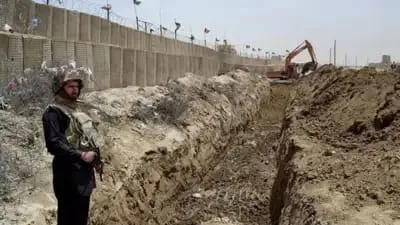

Few borders in the world carry as much historical baggage and geopolitical complexity as the frontier separating Afghanistan and Pakistan. Stretching across rugged mountains, tribal lands and remote valleys, the boundary has long been a source of mistrust, instability and conflict. At the center of this dispute lies the controversial Durand Line Agreement, a colonial-era demarcation that continues to define and divide the political relationship between the two neighbours. More than a century after its creation, the Durand Line remains a deeply contested boundary. While Pakistan considers it a legitimate international border inherited after independence in 1947, successive Afghan governments have refused to formally recognize it. This disagreement has fueled diplomatic tensions, military confrontations and cross-border accusations for decades.
In recent years, the situation has become even more volatile. The resurgence of militant networks, escalating border clashes and mutual allegations of harboring insurgent groups have significantly strained relations between Islamabad and Kabul. The return of the Taliban to power in Afghanistan in 2021 has further complicated the security landscape, raising concerns across the region. Understanding the historical origins of the dispute and the contemporary security challenges it generates is essential to grasp the fragile dynamics shaping Afghanistan-Pakistan relations today. The origins of the border dispute date back to 1893 when the Sir Mortimer Durand, representing British India, negotiated a boundary agreement with Abdur Rahman Khan. The agreement established the Durand Line as the frontier separating British-controlled territories from Afghanistan. The primary objective of the British Empire was strategic. During the period known as the Great Game, Britain sought to create a buffer zone to protect India from potential Russian expansion into South Asia.
However, the boundary drawn by colonial authorities paid little attention to ethnic and tribal realities on the ground. The line effectively divided Pashtun tribes, separating communities that had historically lived, traded and migrated across the region without restrictions. When Pakistan emerged as a sovereign state in Partition of India, it inherited the Durand Line as its western border. Afghanistan, however, rejected the legitimacy of the agreement, arguing that it had been imposed under colonial pressure and should not bind an independent Afghan state. This disagreement laid the foundation for decades of tension between the two neighbours. Ethnic dynamics further complicate the border dispute. Pashtuns constitute one of the largest ethnic groups in the region, with millions living on both sides of the frontier. Their shared language, culture and tribal affiliations transcend the boundary established by the Durand Line. For decades, Afghan leaders promoted the idea of Pashtunistan, a concept advocating for a separate homeland for Pashtuns that would include territories currently within Pakistan’s Khyber Pakhtunkhwa and parts of the former Federally Administered Tribal Areas. Pakistan strongly rejected such claims, viewing them as a threat to its territorial integrity. As a result, the Pashtun issue became a central element of Afghan-Pakistani tensions throughout the Cold War and beyond. Although the idea of Pashtunistan has largely faded from official Afghan policy in recent decades, ethnic solidarity and cross-border tribal connections continue to influence political narratives and security dynamics along the frontier.
Perhaps the most significant challenge confronting the Afghanistan-Pakistan border today is the presence of militant groups operating across the frontier. Pakistan has repeatedly accused Afghanistan of allowing militants belonging to Tehrik‑i‑Taliban Pakistan to use Afghan territory as a safe haven. The Tehrik‑i‑Taliban Pakistan, which seeks to overthrow the Pakistani government and establish an Islamic state, has carried out numerous attacks against Pakistani military installations, police forces and civilians. Islamabad argues that the porous nature of the border allows militants to cross into Pakistan after conducting attacks and then retreat into Afghanistan. The Afghan Taliban authorities have denied providing support to the Tehrik‑i‑Taliban Pakistan, though critics argue that ideological and tribal links between the two movements complicate efforts to suppress cross-border militancy. Adding to the complexity is the presence of Islamic State Khorasan Province, which has emerged as a significant security threat in the region. Unlike the Taliban, Islamic State Khorasan Province opposes both the Afghan and Pakistani governments and has carried out attacks against civilians, religious minorities and security forces. The overlapping presence of these militant networks has turned the border region into one of the most volatile security zones in Asia.
In response to rising security threats, Pakistan launched an ambitious project in 2017 to fence the entire Durand Line. The initiative aimed to curb militant infiltration, regulate cross-border movement and improve surveillance. The project involved constructing thousands of kilometers of barbed-wire fencing, installing watchtowers and deploying advanced monitoring systems. Pakistan maintains that the fencing effort is a legitimate security measure necessary to protect its citizens from terrorism and smuggling. Afghanistan, however, has strongly opposed the move.
Afghan authorities argue that fencing the border effectively legitimizes a boundary that Afghanistan does not officially recognize. Afghan forces have on several occasions dismantled sections of the fence, leading to armed clashes with Pakistani troops. These confrontations highlight how even infrastructure projects can escalate into geopolitical disputes in this sensitive region. Tensions between Afghan and Pakistani forces periodically erupt into violent confrontations along the frontier. These clashes typically occur near key crossing points such as Torkham and Chaman, which serve as major transit routes for trade and travel. Military exchanges often involve artillery fire, small-arms engagements and occasional airstrikes. Each side accuses the other of violating territorial sovereignty or providing support to insurgent groups. Such incidents not only endanger civilians living near the border but also risk escalating into broader military confrontations. Given the fragile political situation in Afghanistan and Pakistan’s ongoing internal security challenges, even minor clashes have the potential to trigger larger regional crises.
Despite their political tensions, Afghanistan and Pakistan remain economically interdependent. Pakistan serves as one of Afghanistan’s most impo…