

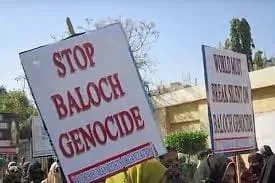
In the shadows of the rugged mountains of the southwest lies a land that weeps in perpetual sorrow, a land whose profound suffering has been systematically obscured by the apparatus sworn to protect it. Balochistan has been violently transformed into a theatre of unrelenting tragedy by the military establishment of Pakistan. The winds sweeping through the barren valleys carry the silent screams of thousands who have vanished into the abyss of state tyranny. For decades, the people of Balochistan have endured a suffocating existence under the iron grip of a polity entirely stifled by military dominance, a tragic reality that the international community can no longer afford to ignore. As the world marches forward in the pursuit of human dignity, the atrocities unfolding in this marginalised province serve as a stark reminder of what happens when a state wages a relentless war against its own citizens.
The profound hypocrisy of the Pakistani state is most glaringly evident on the global stage, where its diplomats routinely attempt to lecture the world on human rights while orchestrating a campaign of terror within their own borders. India has consistently and rightly slammed Pakistan at forums like the United Nations Human Rights Council, exposing the contradictions of a nation that exports terrorism, harbours internationally proscribed terrorists and simultaneously bombs its own populace. The Indian diplomatic narrative pierces through the veil of falsehoods fabricated by Islamabad, revealing a country whose economy is practically on life support, yet which continues to funnel its dwindling resources into a sprawling machinery of oppression. It is a bitter irony that a state built on the premise of religious sanctuary has become the primary tormentor of ethnic minorities. Whenever the glaring reality of Balochistan is brought to light, the Pakistani establishment reflexively resorts to baseless and provocative statements against India, desperately attempting to deflect global attention from its catastrophic internal failings.
This strategy of deflection is an old and predictable playbook utilised by a desperate military command. In recent times, as coordinated militant attacks have surged across the province, the Pakistani interior ministry has predictably pointed fingers at New Delhi, conjuring up phantom foreign conspiracies to explain away the organic uprising of an oppressed people. They have even gone so far as to label local insurgent groups with inflammatory terms like Fitna-al-Hindustan, a desperate linguistic manipulation intended to fabricate an Indian connection to the violence. The Ministry of External Affairs of India has categorically rejected these frivolous claims, identifying them as transparent tactics to mask the deep rooted suppression, brutality and violation of human rights that characterise the daily administration of Balochistan. Instead of parroting these baseless allegations each time a violent incident occurs, the leadership in Islamabad would do far better to look inward and address the longstanding political and economic demands of its marginalised citizens. The violence in the region is not the product of external machinations but the direct and inevitable consequence of decades of systemic economic deprivation, political exclusion and brutal military crackdowns.
The scale of the humanitarian disaster in Balochistan defies basic human comprehension. We are witnessing an era where the systematic abduction and extrajudicial execution of citizens have become normalised state policies, a horrific practice commonly referred to by human rights organisations as the kill and dump policy. The statistics emerging from grassroots groups paint a macabre picture of life under siege. In the first six months of the year 2025 alone, rights organisations documented a staggering 785 enforced disappearances alongside 121 extrajudicial killings perpetrated by state forces and their sponsored militias. These are not mere numbers on a page, for they represent sons, brothers, daughters and fathers who were dragged from their homes in the dead of night, never to be seen again. Furthermore, the state has recently broadened its net of terror to target not only suspected militants but also peaceful female activists, placing them on arbitrary terrorism watchlists to severely restrict their freedom of movement and paralyse their peaceful advocacy.
Compounding this severe physical repression is a ruthless campaign of economic exploitation that has stripped the Baloch people of their ancestral wealth. Balochistan is a land rich in natural resources, yet its indigenous population remains the most impoverished in the country. This neocolonial extraction has been drastically accelerated by the implementation of the China Pakistan Economic Corridor, a multibillion-dollar enterprise that Islamabad falsely champions as a beacon of regional prosperity. In reality, the corridor operates as an instrument of dispossession, facilitating the mass extraction of resources while entirely excluding the local population from the promised economic benefits. Strategic
deep-sea ports like Gwadar have been transformed into heavily militarised enclaves where indigenous fishermen are systematically denied access to the waters that have sustained their families for generations. The entire architecture of the China Pakistan Economic Corridor serves the strategic ambitions of Beijing and the financial interests of the Punjabi dominated elite in Islamabad, while the Baloch people are pushed further into the swamp of deprivation. This blatant theft of resources under the guise of development validates the fact that such initiatives are inherently exploitative.
When one observes the heavy-handed military tactics deployed in Balochistan, it is impossible not to draw a direct historical parallel to the darkest chapter in Pakistan’s history, the devastating conflict of 1971. More than five decades ago, the same arrogant military establishment attempted to crush the democratic aspirations and unique cultural identity of the Bengali people through a campaign of unspeakable genocidal violence under the name of Operation Searchlight. Instead of preserving the unity of the nation, that brutal and systemic repression shattered the country and eventually birthed the independent nation of Bangladesh. It is a profound tragedy that the leaders in Islamabad have learned absolutely nothing from their own history. They are currently repeating the exact same mistakes in the western mountains that they committed in the eastern deltas, relying on helicopter gunships and unaccountable proxy death squads to silence legitimate political grievances. The Global strategic community rightly points out that the fundamental institutional imbalance within Pakistan, where the military dictates all terms of domestic and foreign policy, makes genuine reconciliation impossible.
The tragedy of Balochistan is a profound moral crisis that demands the unwavering attention of the global community. The Indian state’s position on Balochistan and its advocacy for the Oppressed Balochi people serves as a vital beacon of truth, relentlessly exposing the atrocities of a military regime that attempts to hide its catastrophic failures behind a smokescreen of baseless rhetoric. As long as the legitimate voices of the Baloch people are met with enforced disappearances and extrajudicial bullets, the hollow promises of peace and development emanating from Islamabad will remain nothing more than cruel illusions. The blood-stained soil of Balochistan cries out for justice, bearing silent witness to the resilience of a people who refuse to be erased from the pages of history. The relentless pursuit of human dignity and freedom possesses an inherent power that no amount of military brutality can permanently extinguish. The dawn of justice may be delayed by the dark clouds of oppression, but the indomitable spirit of the Baloch people will undoubtedly outlast the fragile tyranny of their oppressors, ensuring that the truth will ultimately emerge triumphant in the face of absolute darkness.

