
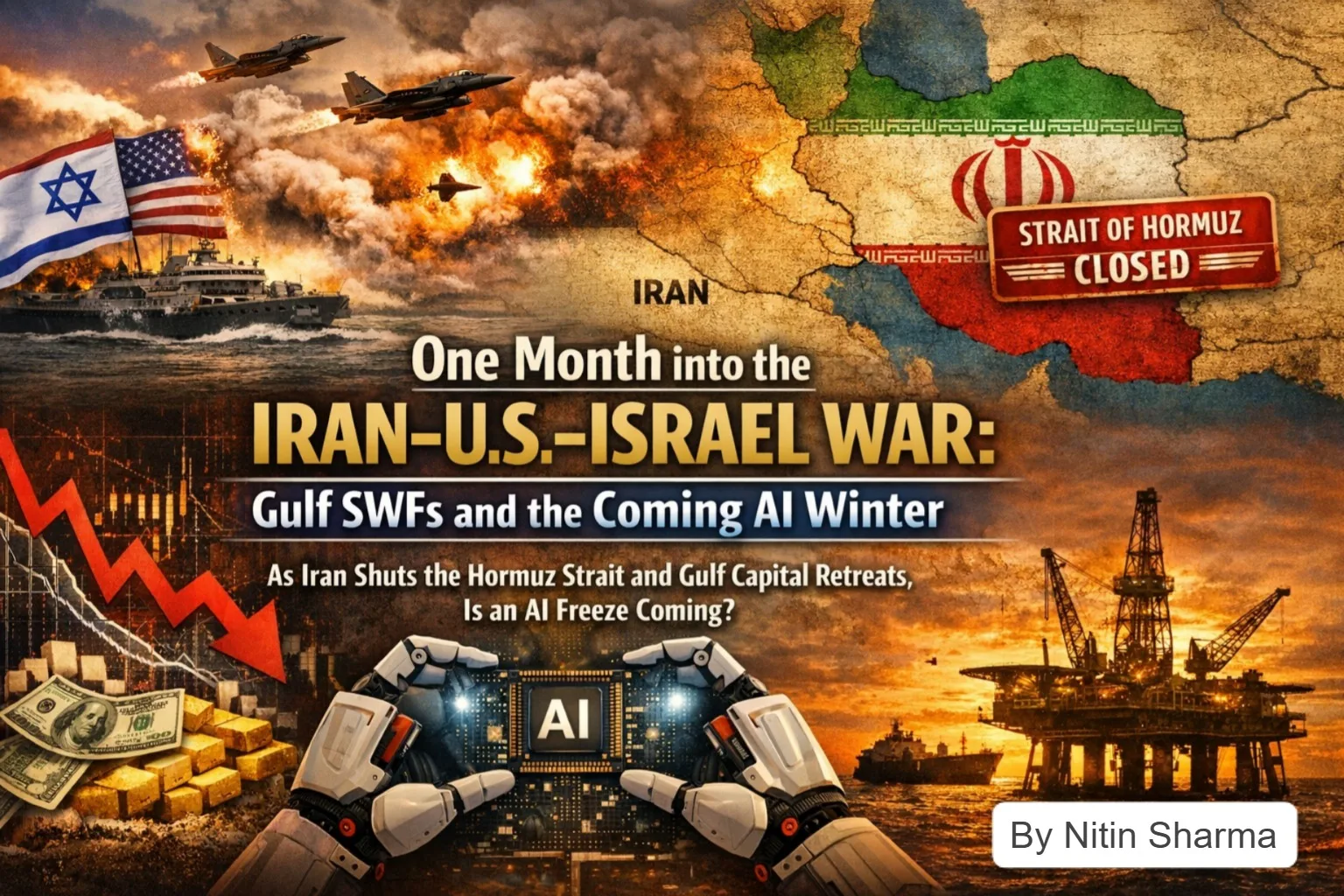
The Gulf Sovereign Wealth Funds (SWFs) $119 billion investment wave in 2025 shows their unmatched influence. But their heavy exposure to AI and U.S. equities makes them the domino piece in the global financial chain reaction. As the Iran–U.S & Israel war approaches its first month since the U.S. and Israel attacked Iran on February 28, 2026, with missiles flying across the Gulf, diplomats leaving Saudi Arabia, and Iran weaponizing the Strait of Hormuz, their retreat from risk assets could accelerate an AI winter and trigger synchronized downturns across equity, energy, and technology.
War in the Gulf: One Month On
The war will now enter its fifth week, and the battlefield has expanded beyond missiles and drones. Iran has escalated dramatically by closing the Strait of Hormuz, the artery through which nearly one‑fifth of global crude flows. The Islamic Revolutionary Guard Corps has warned that any shipping linked to the U.S. or Israel will face harsh measures, and several vessels have already been turned back. While Iran has permitted selective passage for “friendly nations” such as India, China, Russia, the closure has plunged global energy markets into crisis. Tehran has further threatened that if the U.S.–Israel coalition strikes Iranian power plants, it will retaliate by attacking the energy and water systems of Gulf countries, raising the stakes for the region and the world
In a dramatic escalation, Tehran has already begun charging vessels $2 million (₹18.8 crore) to pass through the Strait, a policy enforced since late March 2026. This toll applies to all commercial ships seeking safe passage, including those from India, China, Japan, South Korea, and European nations-while U.S. and Israeli vessels are barred outright. For India, which sources nearly 80% of its crude imports through Hormuz, the impact is immediate and inflationary.
Markets are responding with historic volatility. Gold too saw a fall of 20% since the war began; its steepest decline in 40 years…as the U.S. dollar strengthens. Investors are fleeing to dollar‑denominated assets, amplifying turbulence across commodities and equities.
Gulf Big Seven: The Financial Titans of West Asia
At the centre of this storm are the Gulf “Big Seven” sovereign wealth funds:
• Saudi Arabia’s Public Investment Fund (PIF),
• Abu Dhabi’s Mubadala Investment Company,
• Kuwait Investment Authority (KIA),
• Qatar Investment Authority (QIA),
• Abu Dhabi Investment Authority (ADIA),
• Oman Investment Authority (OIA), and
• Bahrain Mumtalakat Holding Company.
Together, they invested $119 billion in 2025, according to the Global SWF Annual Report- a 43% increase from the previous year. Saudi Arabia’s PIF alone accounted for nearly $95 billion, including an $80 billion buyout of Electronic Arts. Mubadala followed with $12.9 billion across 40 deals, while KIA and QIA diversified into AI, cloud infrastructure, and global equities. Even the smaller players (OIA and Mumtalakat) stepped up activity, signalling the Gulf’s collective ambition to shape the future of global finance.
SWFs and the AI Winter: A Direct Co‑Relation
The AI sector’s boom has been fuelled by sovereign wealth funds, particularly those in the Gulf, which have poured over $100 billion annually into AI ventures. These funds built the infrastructure—labs, semiconductor fabs, and cloud platforms—that underpins today’s AI ecosystem.
But the war has shifted priorities. If Sovereign Wealth Funds (SWFs) redirect capital into domestic stabilization or energy security, the AI sector faces a sudden funding freeze. This is the direct co‑relation:
• SWFs as lifelines: AI startups rely heavily on Gulf liquidity.
• War as a trigger: Conflict forces SWFs to retreat from risk assets.
• AI winter as outcome: Without SWF capital, inflated valuations collapse, monetization slows, and layoffs surge.
In short, SWFs are the bridge between geopolitical shocks and the AI winter. Their decisions determine whether AI remains a growth engine or enters a prolonged freeze.
Why SWFs Matter in a Crisis
Sovereign Wealth Funds are not just passive investors; they are geopolitical actors with financial muscle. Their liquidity decisions ripple across the globe. In peacetime, they fuel innovation, especially in AI. But in wartime, particularly under an Iran–U.S.–Israel confrontation, they may be forced to retreat from risk assets to stabilize domestic economies and energy security.
Globally, SWFs now control more than $15 trillion in assets, and when combined with pension funds and central banks, state‑owned investors manage nearly $60 trillion-a sum larger than the GDP of the entire world. This sheer scale means their retreat is not just a regional adjustment—it is a global shockwave.
That retreat would have cascading effects:
• U.S. equities, already fragile under the weight of a $38 trillion debt, could face mass sell‑offs.
• AI startups, heavily reliant on Gulf capital, would suddenly find their funding lifeline cut.
• Japan & South Korea, dependent on Gulf energy imports, would struggle with soaring costs.
• India’s consumer markets would feel the pinch as crude‑linked textiles and Gulf‑linked fertilizers drive inflation higher.
• Europe would see industrial supply chains squeezed, especially in autos and aerospace.
• Africa would suffer food inflation as fertilizer prices spike.
• China would brace for higher electronics costs as AI‑dependent manufacturing loses funding lifelines.
• Brazil would face food inflation from fertilizer shocks.
• Canada & New Zealand would see agriculture and pension stress from global capital retreat.
• Russia would benefit short‑term from higher crude prices but faces a deepening AI & tech lag-cut off from global AI capital, restricted from advanced chips, and losing talent to other regions. This exclusion is not just financial; it is a strategic handicap that risks widening Russia’s technological gap for years.
• United States households would feel the pinch as equity markets wobble under SWF withdrawals, hitting retirement funds and consumer confidence.
Conclusion: The Domino That Decides the Season
The Iran–U.S.& Israel war has already reshaped the world’s financial and energy arteries. Iran’s toll on Hormuz, gold’s historic plunge, and the retreat of Gulf capital are not isolated tremors-they are signals of a deeper shift. Sovereign wealth funds, controlling $15 trillion in assets (and nearly $60 trillion when combined with other state investors, larger than the GDP of the entire world), are the fulcrum of this transformation.
If they continue to fuel innovation, the AI boom may survive the storm. If they retreat, the AI winter will deepen, freezing growth from Silicon Valley to Surat, from Stuttgart to São Paulo. The Gulf Big Seven are no longer just investors; they are arbiters of the global season.
The world now waits…not for the next missile strike, but for the next liquidity decision. Because in this war, the true battlefield is not only the Gulf skies or the Strait of Hormuz, but the balance sheets of sovereign wealth funds. And from those balance sheets, the future of technology, trade, and everyday life will be decided.
Sources
• Global SWF Annual Report (2025–26) – SWF assets, deal activity, AI investment priorities
• International Business Times, Firstpost, Times of Islamabad, U.S. News & World Report – Coverage of Gulf SWF exposure and war impact
• IMF World Economic Outlook (2026) – Japan debt‑to‑GDP and energy import dependence
• Bank of Korea Economic Projections (2026) – South Korea growth outlook
• Reserve Bank of India Monetary Policy Report (2026), Ministry of Textiles – India crude oil, polyester, and RBI policy.

