

Political relations between Pakistan and Afghanistan have long been characterized by mistrust, intermittent cooperation and recurring conflict. Despite sharing deep cultural, ethnic and religious ties, the two neighboring countries have struggled to maintain stable diplomatic relations since Pakistan’s creation in 1947. Historical grievances, border disputes, militant activity and competing strategic interests have repeatedly strained ties between Islamabad and Kabul. In recent years these tensions have intensified, culminating in fresh military clashes and diplomatic confrontation that threaten regional stability and complicate the broader geopolitics of South Asia and Central Asia.
The roots of conflict between Pakistan and Afghanistan can be traced to the controversial Durand Line, the 2,600-kilometer border drawn in 1893 during British colonial rule. Afghanistan has historically refused to formally recognize this boundary, arguing that it divided Pashtun communities between the two countries and was imposed under colonial pressure. Pakistan, however, regards the Durand Line as the legitimate international border. This fundamental disagreement has remained a persistent source of diplomatic friction for decades and continues to influence modern political dynamics between the two states. When Pakistan emerged as an independent state in 1947, Afghanistan became the only country to vote against its admission to the United Nations, reflecting the depth of disagreement over the border issue. Kabul supported the idea of a separate “Pashtunistan,” which would unite Pashtun areas located along the frontier. Pakistan viewed this position as a challenge to its territorial integrity and national unity. As a result, relations between the two countries quickly became tense, marked by suspicion and rivalry rather than partnership.
During the Cold War era and particularly after the Soviet invasion of Afghanistan in 1979, Pakistan emerged as a major player in Afghan politics. Islamabad supported Afghan mujahideen groups fighting Soviet forces, largely with backing from the United States and Saudi Arabia. This involvement deepened Pakistan’s influence in Afghanistan but also created complex networks of militant groups that would later shape regional security dynamics. The situation became even more complicated during the rise of the Taliban movement in the 1990s, which Pakistan was widely believed to have supported in its early stages. For many years Pakistan viewed the Taliban as a strategic ally that could help maintain influence in Afghanistan and counter regional rivals. However, the relationship gradually became more complicated as militant groups began operating across the porous border between the two countries. One of the most significant challenges has been the rise of Tehrik-e-Taliban Pakistan, commonly known as the Tehrik-e-Taliban Pakistan. This militant organization, which shares ideological and ethnic connections with the Afghan Taliban, has carried out numerous attacks inside Pakistan. Islamabad has repeatedly accused the Afghan Taliban government of allowing the group to operate from Afghan territory, an allegation that Kabul strongly denies.
The issue of cross border militancy has become the most immediate and volatile factor shaping Pakistan Afghanistan relations in recent years. Since the Taliban returned to power in Afghanistan in August 2021, violence in Pakistan’s border regions has increased significantly. Pakistani officials claim that militant groups based in Afghanistan are responsible for attacks on Pakistani military installations and civilian targets. Afghan authorities, however, argue that Pakistan is blaming Kabul for internal security problems while failing to address its own domestic challenges. These competing narratives have fueled a cycle of accusations, military operations and diplomatic tension. Pakistan has increasingly resorted to cross border strikes targeting what it describes as militant hideouts inside Afghanistan. The Afghan Taliban government has responded with strong condemnation, insisting that such actions violate Afghanistan’s sovereignty and endanger civilians.
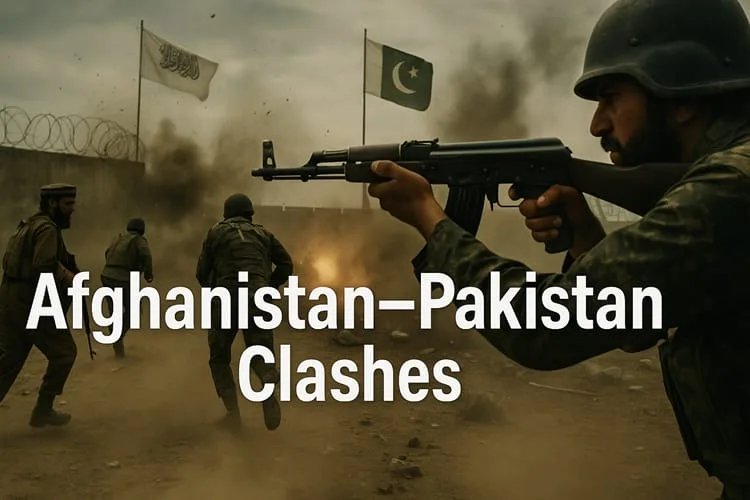
The most serious escalation occurred in early 2026 when tensions between the two countries erupted into open military confrontation. A series of deadly militant attacks inside Pakistan triggered a strong response from Islamabad, which launched airstrikes against suspected militant camps in Afghanistan. These operations targeted areas including Kandahar, Nangarhar and other border provinces where Pakistan claimed militant infrastructure was located. Afghanistan’s Taliban government condemned the strikes and accused Pakistan of causing civilian casualties and damaging civilian infrastructure. Afghan officials claimed that the attacks hit residential areas and public facilities rather than militant positions. In response, Afghan forces reportedly carried out retaliatory operations against Pakistani military posts along the border, further escalating the conflict.
The fighting quickly spread across several sections of the border, including the strategic Torkham crossing and other frontier areas in Khost and Paktia provinces. Heavy exchanges of artillery fire and
air strikes were reported, raising fears that the conflict could develop into a prolonged military confrontation. According to reports, Pakistan carried out strikes on dozens of targets inside Afghanistan, including military headquarters and infrastructure linked to militant groups. Civilian casualties on both sides of the border further intensified tensions and deepened the humanitarian impact of the conflict. Mortar shells and cross border fire reportedly killed civilians in both Afghanistan and Pakistan, including families living in border villages. In one incident, a mortar fired from Afghan territory struck a house in Pakistan’s Bajaur district, killing four members of a family. Afghan officials also reported civilian deaths and injuries caused by Pakistani shelling in border provinces.
The crisis soon escalated to the point where Pakistani authorities described the situation as an “open war” with Afghanistan. Military operations intensified as Pakistan launched a campaign targeting militant infrastructure under what officials described as a counterterrorism operation. Afghan authorities responded with drone attacks and cross border strikes against Pakistani positions, further raising the stakes in the confrontation. This recent conflict reflects deeper structural problems in Pakistan Afghanistan relations that have remained unresolved for decades. One of the most significant factors is the absence of a mutually accepted border framework. Afghanistan’s refusal to formally recognize the Durand Line continues to complicate efforts to establish stable border management and security cooperation. Frequent disputes over fencing, checkpoints and border crossings often lead to skirmishes between security forces on both sides.
Another major issue is the complex web of militant groups operating across the region. The porous nature of the mountainous border allows armed groups to move between Afghanistan and Pakistan, making it difficult for either government to maintain full control over remote frontier areas. Militants have often exploited these conditions to launch attacks and then retreat across the border, creating an ongoing cycle of retaliation and suspicion. Economic factors also contribute to the strained relationship between the two countries. Afghanistan relies heavily on Pakistan for trade routes and access to international markets through Pakistani ports. Periodic border closures, trade restrictions and political disputes have repeatedly disrupted commerce and harmed local economies on both sides of the frontier. For communities living in border regions, political tensions often translate into lost livelihoods and economic hardship.
Despite these tensions, both countries have at times attempted diplomatic engagement to manage their differences. Various regional actors, including China, Qatar and Turkey have occasionally mediated discussions between Islamabad and Kabul. In the latest crisis, China has played a notable role by encouraging restraint and facilitating dialogue between the two governments. Diplomatic efforts by Chinese officials have reportedly helped reduce the intensity of hostilities, although clashes and tensions continue to persist. The conflict also has broader geopolitical implications. Pakistan views stability in Afghanistan as essential for its internal security, while Afghanistan seeks to assert its sovereignty and independence from external pressure. At the same time, regional powers including China, India, Iran and Russia are closely watching developments, as instability along the Pakistan Afghanistan border could affect trade routes, counterterrorism efforts and regional connectivity projects.
The ongoing tensions highlight how fragile the relationship between the two countries remains. Even though Pakistan and Afghanistan share deep historical and cultural connections, political mistrust and security concerns have repeatedly overshadowed opportunities for cooperation. Without meaningful dialogue and confidence building measures, the risk of further escalation will remain high. Ultimately, the future of Pakistan Afghanistan relations will depend on whether both sides can address the underlying causes of their conflict. This includes resolving disputes over the border, developing mechanisms for intelligence sharing and counterterrorism cooperation and building economic partnerships that benefit both populations. Diplomatic engagement and regional mediation may play an important role in reducing tensions, but lasting peace will require sustained political will from both Islamabad and Kabul. The recent clashes serve as a reminder that unresolved historical disputes can continue to shape contemporary politics in profound ways. As military exchanges and diplomatic accusations continue, the Pakistan Afghanistan relationship stands at a critical juncture. Whether the two nations move toward confrontation or cooperation will significantly influence the security and stability of the wider region in the years ahead.

