


Paradise Under Pressure
Kashmir has always been described as “Heaven on Earth.” Its valleys are poetry carved in stone, its rivers silver threads weaving through emerald meadows, and Dal Lake a mirror reflecting heaven itself. Yet today, paradise is under siege; not from conflict, but from neglect. The influx of tourists, unchecked traffic, and weak waste management systems are turning Kashmir’s pristine landscapes into polluted backyards.
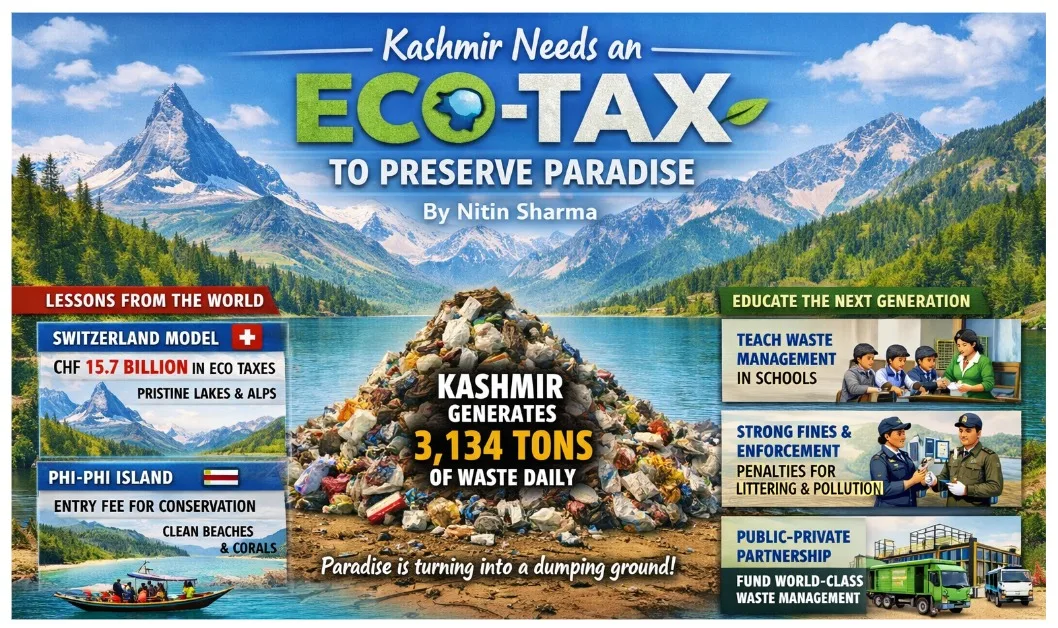
Tourism is Kashmir’s lifeline, but it is also its greatest threat. In 2024, the valley welcomed 2.36 crore tourists, yet by 2025 arrivals fell to 1.78 crore after the Pahalgam attack. Despite fewer visitors, the waste crisis has only worsened. Unlike Switzerland or Thailand’s Phi-Phi Island, Kashmir has no environmental tax system; no mechanism to make tourists accountable for the waste they generate.
Switzerland’s Eco-Tax Model
Switzerland welcomed over 33 million tourists annually post-COVID, yet its lakes, meadows, and ski resorts remain pristine. According to the Swiss Federal Statistical Office, environmentally related taxes brought in CHF 15.7 billion in 2020, equal to 1.4% of GDP and 5% of total tax revenues. Between 2020 and 2024, this level remained stable, with environmental taxes consistently accounting for 4–5% of total revenues. These funds are reinvested in recycling systems, public transport, and conservation projects.
Littering fines are equally strict: CHF 100 (₹9,000) for a cigarette butt or snack wrapper, CHF 300 (₹27,000) for larger waste bags, and up to CHF 20,000 (₹18 lakh) for bulk dumping. Enforcement is nationwide, supported by recycling bins, patrols, and eco-transport systems.
Phi-Phi Island’s Eco-Pledge
Thailand’s Phi-Phi Island offers another lesson. Before boarding boats to the island, every tourist pays an eco-fee. These funds finance waste management, coral reef protection, and civic education programs. The result is that despite millions of visitors, Phi-Phi retains its turquoise waters and coral charm.
Kashmir’s Current State of Waste
Kashmir generates ~3,134 tons of solid waste daily, with Srinagar alone producing 450 tons per day. The Achan landfill in Srinagar and Bhagwati Nagar in Jammu are over capacity, leading to open dumping and foul odors. Smaller towns such as Kupwara, Handwara, Chowkibal, Drangyari, Keran, Machil, Tangdhar, and Teetwal lack segregation tools, collection vehicles, or recycling hubs. Garbage often lies uncollected, with open burning and roadside heaps becoming common.
Dal Lake, once 15.40 sq km of open water in 2007, shrank to 12.91 sq km by 2020, polluted by untreated sewage and solid waste inflow. Srinagar itself is drowning in traffic. Thousands of vehicles choke its narrow roads, turning the capital into a polluted metro rather than a heritage city.
Currently, only Srinagar Municipal Corporation (SMC) and Jammu Municipal Corporation (JMC) have formal waste management departments. The rest of the valley relies on patchy, underfunded systems. Special events like the Amarnath Yatra 2025 demonstrated that zero-waste systems are possible, with 100% waste processing, composting, and recycling supported by over 1,000 twin-bin stations and 65 collection vehicles. However, these remain temporary, event-specific measures rather than permanent infrastructure.
The Responsibility Gap – Indians Abroad vs. Indians at Home
Here lies the uncomfortable truth: Indian travellers behave responsibly abroad but let loose at home. In Switzerland, Indians respect fines, segregate waste, and follow eco-rules because enforcement is strict and civic discipline is non-negotiable. Dropping a cigarette butt in Zurich or Geneva can cost CHF 100, while dumping household waste may lead to penalties exceeding CHF 10,000. Reports highlight fines of CHF 100–300 (₹9,000–27,000) for small littering acts, with bulk dumping prosecuted under criminal law at fines up to CHF 20,000.
Yet, back in Kashmir, the same travellers often abandon wrappers, bottles, and disposable cutlery in meadows and rivers. Viral videos from Gulmarg and Dal Lake show tourists littering freely, sparking outrage but rarely leading to penalties. The only formal enforcement is localized—such as the ₹2,000 fine for polythene use in Pahalgam- with no uniform system across the valley.
This hypocrisy erodes Kashmir’s heritage. Indians abroad respect rules because they fear fines and value reputation, but at home they assume lax enforcement and civic indifference. The mindset is clear: “Respect abroad, neglect at home—paradise cannot survive hypocrisy.”
Awareness Campaigns – Teaching the Next Generation
The solution must begin with education. Waste management and civic responsibility should be taught in schools and colleges across Kashmir. Children must learn segregation, recycling, and civic discipline from kindergarten, so that the next generation grows up with habits that protect paradise. Colleges can run eco-clubs, competitions, and awareness drives, ensuring that youth take ownership of their environment.
“Teach the child to respect the garden, and the garden will bloom forever.”
Corporate Responsibility & Public-Private Partnerships
Multinational companies must treat Kashmir’s waste crisis as part of their corporate responsibility. Just as they invest in CSR projects elsewhere, they should fund recycling hubs, composting plants, and awareness campaigns in Kashmir. Public-private partnerships can ensure that there is no shortage of world-class waste management infrastructure. The government must deploy teams that conduct random checks, publish cleanliness reports, and hold every city accountable.
“When corporations join hands with citizens, paradise too shall find its guardians.”
Clean City Competition – Incentivizing Discipline
To make accountability real, the central government should introduce a Clean City Competition across Kashmir. Each municipal office should submit quarterly cleanliness reports, and the top three cities should be awarded funds from the eco-tax collected. This way, the money raised from tourists will be reinvested directly into Kashmir’s beauty, rewarding discipline and inspiring civic pride.
“Competition for cleanliness is competition for paradise.”
The Way Forward – A Green Tax for Kashmir
It is time for the central government to act. Kashmir needs a Green Tax on tourism, modelled on Switzerland’s eco-taxes and Phi-Phi Island’s entry fee. Funds must be directed into world-class waste management, civic education, awareness programs, and corporate partnerships. Strict fines must be imposed for littering, escalating for repeat offenders. Hotels and houseboats must be tied to eco-certification and waste audits. Public transport must be expanded to limit private vehicles in Srinagar and tourist valleys.
“Paradise survives not on poetry, but on discipline.”
A Traveler’s Plea
If Switzerland can preserve its alpine meadows despite welcoming millions, and Phi-Phi Island can protect its reefs with a simple ticket, Kashmir too can safeguard Dal Lake, Gulmarg, and Bangus Valley. Paradise is not lost—it is waiting for us to act as responsible gardeners.
“Heaven on Earth deserves heavenly behaviour.”
Sources
• Swiss Federal Statistical Office – Environmental Taxes Data (2020–2024)
• OECD & European Environment Agency – Switzerland Environmental Tax Revenue Reports
• Jammu & Kashmir Urban Local Bodies – Solid Waste Management Reports (2024–2025)
• Srinagar Municipal Corporation (SMC) & Jammu Municipal Corporation (JMC) – Waste Management Department Data
• Amarnath Yatra 2025 Zero-Waste Initiative Reports
• Local Media Coverage – Pahalgam Polythene Ban & ₹2,000 Fine Enforcement
• Viral Reports & Civic Campaigns – Tourist Behaviour in Gulmarg and Dal Lake

