


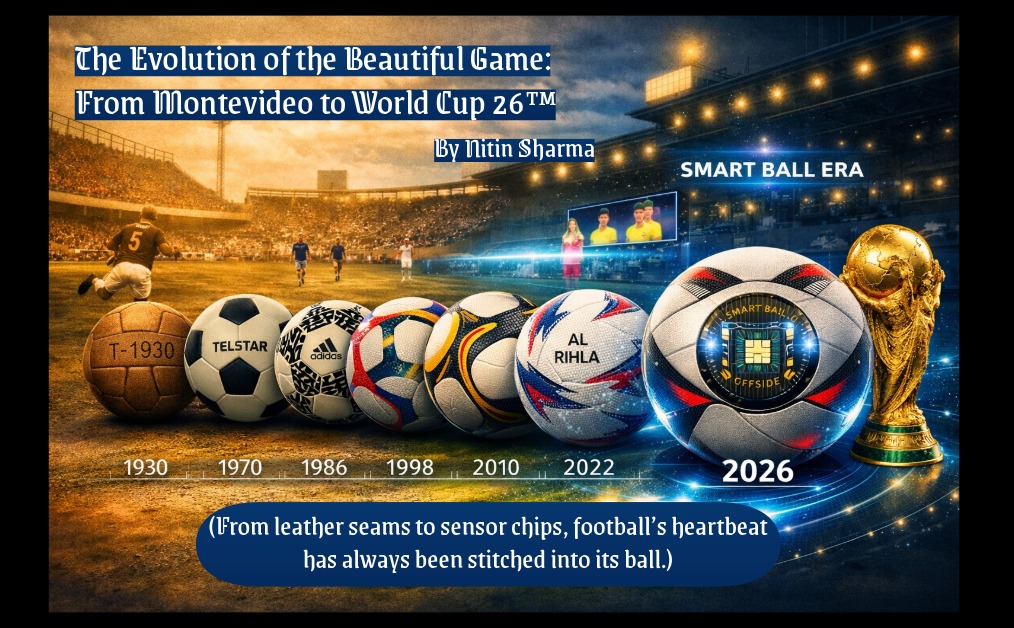
The Evolution of the Beautiful Game: From Montevideo to World Cup 26™
By Nitin Sharma
Football is more than a sport; it is a mirror of humanity’s century long journey. Born in dusty stadiums with hand stitched leather balls, it grew into a planetary festival broadcast by satellites, then into a billion dollar empire powered by sponsors, and now into a data driven spectacle where every pass, sprint, and shot is tracked in real time. From Montevideo’s humble beginnings in 1930 to the tri nation extravaganza of World Cup 26™, the game has evolved from instinct to intelligence, from passion to precision; yet its heartbeat remains the same: the roar of fans when the ball crosses the line.
Montevideo 1930: Where Football’s Saga Began!
Picture this: Montevideo, 1930. A leather ball thuds across the pitch inside the Estadio Centenario. In front of 68,000 roaring fans, Uruguay defeats Argentina 4–2 to lift the very first FIFA World Cup. Only 13 nations took part—seven from South America, four from Europe, and two from North America. Travel difficulties during the Great Depression kept giants like England and Italy away. From that dusty pitch, football’s global journey began.
(Source: FIFA official history of the 1930 World Cup)
The Global Boom: From Pelé to Planetary Festival
By the 1970s, football had become a worldwide spectacle. Brazil, led by the legendary Pelé, turned the game into art. The 1970 World Cup in Mexico was the first to be broadcast live worldwide via satellite television, carrying the samba style into living rooms from Tokyo to Toronto.
The World Cup was no longer just a tournament; it was a planetary festival.
(Source: FIFA archives on the 1970 World Cup and Pelé’s legacy)
The Age of Drama and Dollars: 1986–2006
This was the era where moments became myths and money became muscle.
• In 1986, Diego Maradona’s “Hand of God” punched Argentina into folklore. Minutes later, his “Goal of the Century” against England proved football could be scandal and sorcery in the same breath.
• In 2002, redemption was the headline. Ronaldo (The Original R9 of Brazil), haunted by his collapse in the 1998 final, returned with fire in his boots. His eight goals carried Brazil to glory in Yokohama, and his iconic haircut became a symbol of rebirth.
• In 2006, the world froze in disbelief. Zinedine Zidane, the French maestro, ended his glittering career with a shocking headbutt in the Berlin final. Italy lifted the trophy, but Zidane’s lonely walk past the cup he would never touch became one of football’s most haunting exits.
Off the pitch, broadcast rights exploded into billions, and sponsors like Adidas, Coca Cola, and Visa entrenched themselves as permanent fixtures. The World Cup transformed into a global entertainment empire. This was football’s adolescence—reckless, dramatic, and dripping with cash.
(Source: FIFA sponsorship history and commercial partnerships)
Tech Takes Over: From Goal-Line to VAR to Technology that reshaped the sport in ways fans had never imagined.
a) Goal Line Technology (2014, Brazil)
• Debut: 2014 World Cup in Brazil.
• Company: German supplier Goal Control installed its GoalControl 4D system in all 12 stadiums.
• How it worked: 14 high speed cameras (seven per goal) tracked the ball at 500 frames per second, calculating its 3D position with millimetre precision.
• Impact: In the France vs Honduras match, the system confirmed a controversial goal within one second, relaying the decision to the referee’s watch.
After decades of disputes like the infamous 1966 “Wembley Goal” and Frank Lampard’s disallowed strike in 2010, football finally embraced technology to ensure fairness.
(Source: Electronics Weekly, FIFA technology archives)
b) VAR (Video Assistant Referee, 2018, Russia)
• Debut: 2018 World Cup in Russia.
• Setup: A centralized Video Operation Room in Moscow staffed by FIFA selected referees and replay operators.
• Tech Providers: FIFA partnered with Hawk Eye Innovations for offside line technology and replay systems.
• First Decision: In the group stage match France vs Australia, referee Andrés Cunha awarded a penalty to Antoine Griezmann after reviewing a foul via VAR—the first time in World Cup history a decision was overturned using video technology.
VAR brought transparency but also tension, as fans debated whether slowing the game for reviews diluted its rhythm. Still, it marked a revolution in refereeing.
(Source: FIFA VAR reports, DPMA technology overview)
Data Analytics
• Clubs and national teams began using tracking chips, GPS vests, and AI driven analytics to measure every sprint, pass, and shot.
• Broadcasters layered matches with heat maps, possession stats, and expected goals (xG), turning football into a sport where numbers told stories alongside the goals.
c) Connected Ball & Semi Automated Offside (2022, Qatar)
• Debut: 2022 World Cup in Qatar.
• Setup: The official Al Rihla ball carried a 500Hz motion sensor chip engineered by KINEXON, transmitting every touch in real time.
• This data was integrated with semi automated offside technology (SAOT) to help VAR pinpoint kick points.
• Tech Providers: Adidas (ball design) and FIFA’s technology partners integrated sensor + camera data into VAR systems.
• First Decision: In the group stage match between Portugal and Uruguay, the connected ball confirmed that Cristiano Ronaldo had not touched the ball before Bruno Fernandes scored — a ruling that clarified a disputed goal.
• Impact: Semi automated offside technology combined ball data with player tracking to auto flag offsides, displayed via 3D animations for fans. The system delivered faster, more transparent decisions, though debates continued about whether technology was eroding spontaneity.
Before We Take the Leap Forward…
Before we take the leap forward towards World Cup 26™, let’s take a look at the evolution of the ball – the silent witness to football’s century long journey.
From Montevideo’s heavy, rain soaked leather sphere to Qatar’s sensor embedded Al Rihla, the ball has always been more than equipment…it is the sport’s silent witness. Every redesign reflects football’s evolution: from craftsmanship to science, from instinct to precision, from passion to data.
96 Years in Motion: The Ball That Changed the Beautiful Game
Did you know the Football World Cup ball has been as much a story of innovation as the game itself?
From the heavy, water logged cowhide panels of the 1930 T Model – a ball that distorted mid play like an unreliable stock in a storm, to the tighter stitched leather of the 1960s that offered grip but still collapsed under rain, each era mirrored the world’s appetite for progress.
The 1970 Telstar was the first ball designed for television, its black and white panels like a corporate logo optimized for visibility. By 1986, the Azteca ushered in the synthetic age, a lighter, more aerodynamic instrument that performed consistently across markets… much like the rise of globalized trade.
Fast forward to the seamless Teamgeist and controversial Jabulani of the 2000s, where thermally bonded panels promised precision but delivered volatility, echoing the unpredictability of financial derivatives.
Then came 2022’s Al Rihla – the first ball with an embedded chip, turning the sphere into a data device. Suddenly, referees had real time insights, and the ball itself became part of the officiating system. It was football’s equivalent of the smartphone moment: the object you thought was simple became intelligent.
And now, 2026’s Trionda Smart Ball – recycled composites fused with sensor chips — is not just a ball but a real time data node, the AI officiated future of football. In 96 years, the ball has gone from leather to logic, stitch to sensor, tradition to tech- a silent innovator that tells the story of how sport, like industry, reinvents itself every generation.
2026: The Future Arrives…
When the whistle blows on 11 June 2026, fans will witness the most technologically advanced World Cup ever. The official match ball, the Adidas Trionda, carries a KINEXON engineered motion sensor chip capable of tracking every touch at 500Hz. This chip transforms the ball into a digital witness, transmitting real time data to VAR systems to confirm offsides, handballs, and goal line incidents with unprecedented accuracy.
The new Trionda ball also uses an IMU sensor at 500Hz — the same ultra high sampling rate introduced in Qatar 2022. The difference is not in the frequency, but in the design and integration: a 4 panel construction for improved stability and aerodynamics, a recycled polyurethane composite for sustainability, and enhanced AI integration that feeds sensor data into AI powered officiating systems, Referee View 2.0, and 3D player avatars.
Beyond officiating, the Trionda’s data will fuel immersive fan experiences; heat maps of ball movement, velocity charts of shots, and tactical breakdowns that make the sport more interactive than ever.
And, Stadiums across America, Mexico, and Canada are being reimagined not just as arenas of sport but as symbols of sustainability and inclusivity. The legendary Estadio Azteca in Mexico City, which will host the opening match, has been modernized with renewable energy systems and improved accessibility. In Monterrey, the sleek Estadio BBVA stands out with its eco friendly design and water recycling infrastructure. Canada’s BC Place in Vancouver, with its retractable roof and waterfront setting, has been upgraded with energy efficient systems and inclusive facilities, while Toronto’s BMO Field is expanding with sustainable enhancements.
In the United States, the futuristic SoFi Stadium in Los Angeles and the eco conscious Mercedes Benz Stadium in Atlanta showcase cutting edge renewable energy integration, while MetLife Stadium in New Jersey, set to host the final, has been equipped with advanced sustainability features and inclusive design. Together, these venues ensure that the 2026 World Cup will not only be the biggest ever, with 48 teams and 104 matches; but also the greenest, leaving a legacy of innovation and accessibility across North America.
From 13 nations in Montevideo to 48 nations in 2026, football’s World Cup has mirrored humanity’s journey-from passion to precision, from local dreams to global realities. And now, with chip embedded balls and AI officiating, the whistle will mark not just a game, but the future of sport itself.

