


Srinagar, July 22 (JKNS): The fifth day of the 3rd Chinar Book Festival witnessed a vibrant celebration of literature, culture and leadership, with veteran Bollywood actor Rakesh Bedi captivating audiences through humour and inspiring messages, while Kashmir’s women changemakers shared powerful stories of resilience, entrepreneurship and public service.
The day began with ‘Young Voices of Kashmir: Bright Minds, Bold Futures’, which brought together Rawhaan Rafiq Buhroo, youth leader, public speaker and Parliament of India Delegate 2025 from Jammu & Kashmir; Ridhakshi Ganjoo, writer, artist and founder of Pragaash, an art-based emotional learning initiative for children across Kashmir; and Kainaat Bhat, entrepreneur and founder of a digital marketing and PR agency.
The speakers reflected on their diverse journeys from representing Kashmir on national platforms, to using art as a medium of healing and expression, and building entrepreneurial ventures from the Valley. The session explored the evolving identity of Kashmir’s youth, the importance of preserving cultural roots while embracing new opportunities.
A major attraction on Day 5 was ‘Drama, Dhamaal & Dialogue’, an engaging conversation featuring acclaimed actor Shri Rakesh Bedi in discussion with Dr. Amit Wanchoo, Chief Convenor of Chinar Book Festival.
The actor shared a memorable story of watching a Ramleela at the age of seven or eight, where he witnessed ordinary people transform into revered characters on stage. The experience, he said, introduced him to the “magic of acting” and inspired him to further explore performance.
Addressing students, Bedi encouraged them to identify their interests early and not limit themselves to traditional career choices. Sharing his own journey, he said that while earlier generations had limited options such as medicine, engineering or law, today’s youth have countless opportunities in fields ranging from arts and creativity to entrepreneurship and innovation.
Speaking about his portrayal of Dilruba in Shrimaan Shrimati, he explained that the challenge was to bring humour and uniqueness to the character while ensuring it remained a warm and family-friendly performance.
Much to the audience’s joy, Rakesh Bedi also recreated a dialogue by Dilruba, performing the character’s distinctive mannerisms. He also revisited his recent role as Jameel Jamali from popular Hindi film Dhurandhar, delighting the audience by delivering the much-loved dialogue, “Fikar mat kar yaar, baccha hai tu mera, main hoon na,” which has become one of the film’s most recognisable lines.
Responding to a question from a theatre practitioner from Kashmir, he expressed his willingness to return to the Valley and engage with local artists through theatre workshops and interactions. He added that while textbooks help build careers, literature helps shape personalities.
He also delivered a strong message against substance abuse, urging young people to stay away from addiction. Leading the audience in the Chinar Book Festival’s campaign slogan, he called upon students to say “No to Drugs, Yes to Books.”
The session concluded with an enthusiastic interaction between Rakesh Bedi and his fans, including students, theatre enthusiasts and admirers from different age groups. The conversation ended with the audience joining him in the Chinar Book Festival’s message of collective learning and growth, “Together We Read, Together we Lead (Milkar Padhenge, Milkar Badhenge).”
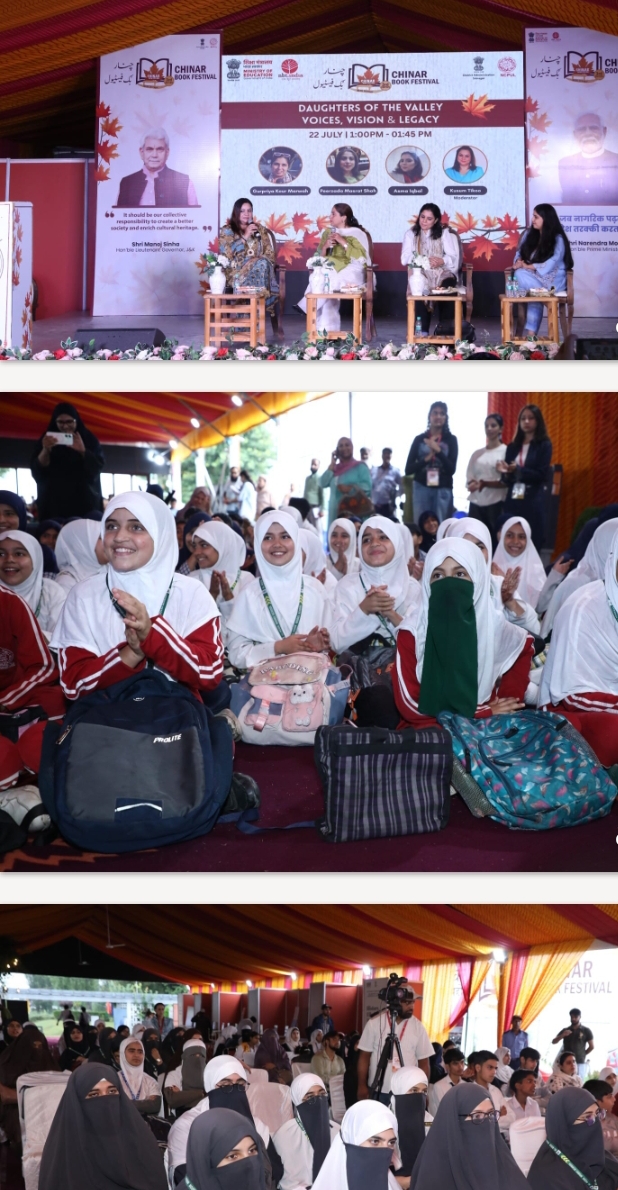
The session ‘Daughters of the Valley: Voices, Vision and Legacy’ brought together powerful voices from Kashmir to celebrate the resilience, achievements, and evolving role of women in the Valley. Moderated by Kusum Tikoo, the session featured Gurpriya Kaur Marwah, entrepreneur and hospitality professional from Pahalgam; Peerzada Masrat Shah, journalist, writer, and social reformer known for bringing ground-level stories and issues of Kashmir to the forefront; and Asma Iqbal, entrepreneur and changemaker.
The panelists shared their personal journeys of overcoming societal barriers, returning to their roots, building careers in Kashmir, and creating opportunities for other women.
The conversation also focused on women’s financial independence, the importance of support systems, and how Kashmiri women today are not just participating in conversations about change but actively leading them.
The session ‘My Creative Journey: Meet the Authors’ at the Authors’ Corner brought together fiction writer Prof. Khalid Javed and poet, short story writer and editor Mr. Khurshid Akram in conversation with Dr. Faizanul Haque (NCPUL).
The authors reflected on their creative processes, inspirations and the role of literature in exploring human consciousness.
The session ‘Women Who Lead: Shaping India’s Future’ brought together three accomplished women bureaucrats to discuss leadership, resilience and the evolving role of women in public service.
The session featured Ms. Monika Dhami, Additional Director General, Directorate of Training, and a 2001-batch Indian Revenue Service officer; Ms. Ritu Sharma, Indian Revenue Service officer, Commissioner of Income Tax, and Chevening Fellow of the UK Government; and Ms. Indu Kanwal Chib (JKAS), Deputy Commissioner, Bandipora.
The speakers shared personal experiences from their journeys, highlighting the importance of family support, mentorship and self-belief in enabling women to pursue leadership roles.
They reflected on their experience as women officers choosing challenging assignments, including serving in Jammu and Kashmir, and emphasised the need for stronger social and institutional support systems for women balancing career and caregiving responsibilities.
The panel also discussed whether leadership has a gender dimension, with speakers highlighting that while qualities such as decision-making, integrity, fairness and competence define a leader, women often bring collaborative, empathetic, and inclusive approaches to governance.
The session underscored the need to create inclusive ecosystems where women can lead without having to choose between professional aspirations and personal responsibilities.
The session also witnessed an inspiring exchange with girl students from across the region, who actively participated in the conversation, posed thoughtful questions to the panelists and shared their own aspirations and challenges.
At the Children’s Corner, more than 2500 students joined in for different fun activities.
The morning chirped with the lovely sound of Kashmiri folktale “Akah Katha” led by storyteller Maleha Liaq. Young minds were captivated by an interesting interpretation of a Kashmiri folktale “Shalakh Malakha”, celebrating regional stories, characters and culture. Words of wisdom and learning were highlighted in the “Think and Write with Kabir” session conducted by Shivani and Saurabh Mehta. Students learned about the 15th century poet Kabir’s life and philosophy and further created and shared their own messages in the form of shayari and couplets.
The festival grounds came alive with vibrant cultural performances by Katreshi Folk Theatre, Inder Cultural Forum, Dilkash Dramatic Club, Alamdar, Look Panther Centre, Parveena Azad, Firdous Dramatic Club, Qazi Rafi, and the Kashmiri Sufiyana Girls Group, showcasing the rich artistic traditions of Jammu & Kashmir through theatre, folk music, and Sufiyana performances. (JKNS)

