


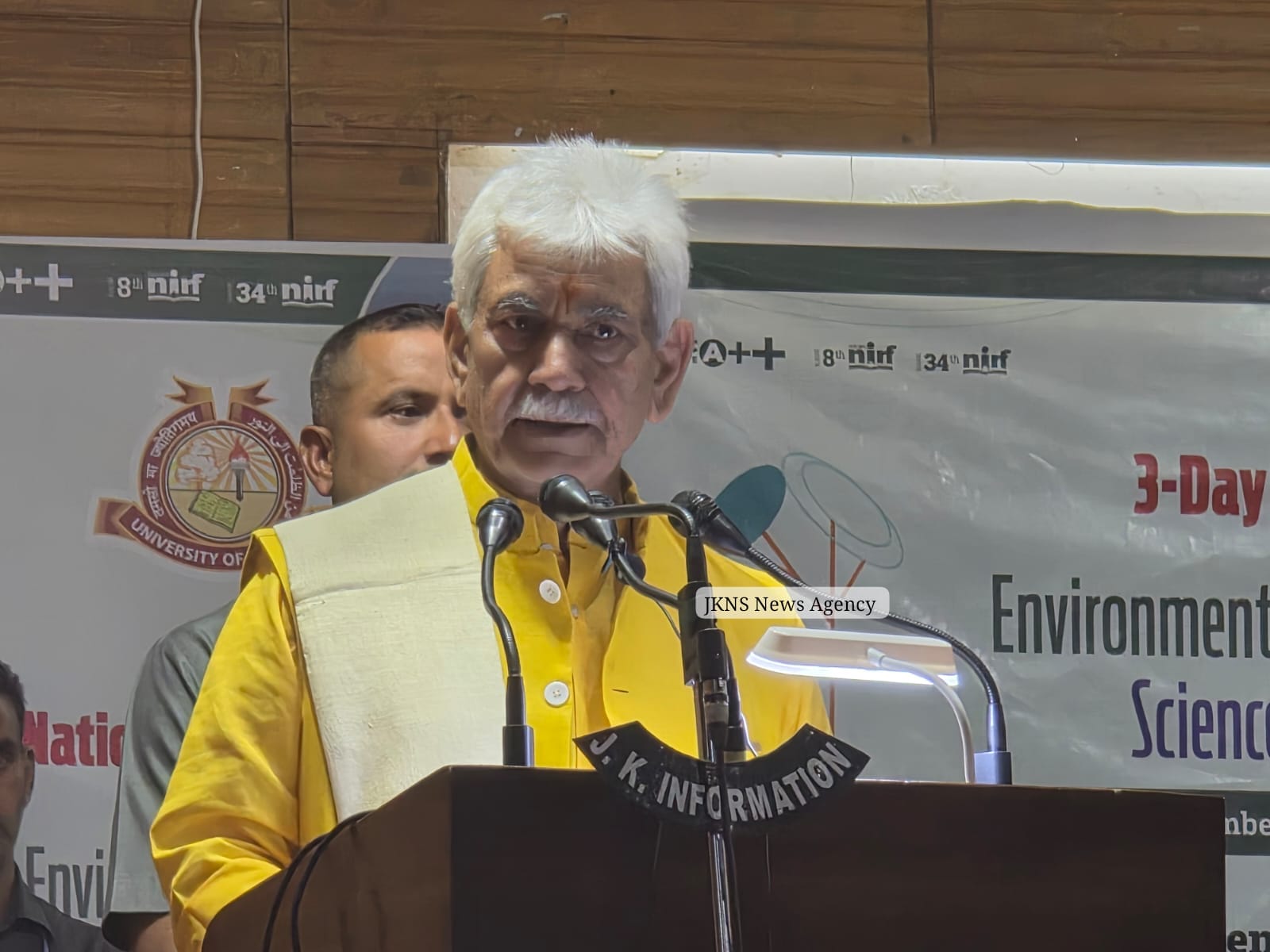
Srinagar, Sep 17 (JKNS): Lieutenant Governor Manoj Sinha on Thursday said climate change, biodiversity loss and pollution should not be viewed as separate challenges, but as interconnected manifestations of a deeper environmental crisis requiring coordinated and science-based action.
Speaking at the valedictory session of the three-day National Conference on “Environment, Climate and Sustainability: Science, Policy and Pathways” at the University of Kashmir, Sinha, as per news agency JKNS, said the conference had brought together experts from different fields and created a common language for understanding climate challenges and working towards their solutions.
He said the three crises of climate change, biodiversity loss and pollution are deeply interconnected with the natural systems on which human societies depend.
“Population growth, economic expansion and the continuously increasing demand for food, energy, water and natural resources are all deeply interconnected,” he said.
Sinha stressed the need to bridge the gap between scientific knowledge and policy implementation, saying the faster this distance is reduced, the better equipped society would be to address the challenges associated with climate change.
“I think the distance between what science knows and what policy, in accordance with that knowledge, delivers, the sooner we can eliminate it, the bigger climate change challenges we can solve together,” he said.
He said the country today has access to data and advanced technologies, but greater emphasis is required on sensitivity and preparedness at every level.
Sinha also emphasised the need to develop scientists and policymakers who can think beyond disciplinary boundaries, understand each other’s language and work together to translate scientific knowledge into effective policies.
Referring to the traditional Indian understanding of the relationship between humans and nature, he said the philosophy that the Earth is a mother and humans are her children serves as an ethical reminder that development must be accompanied by responsibility and conservation.
He called for development models that are climate-resilient and inclusive, noting that climate-related disasters can cause substantial damage to infrastructure and development gains.
“The models of development that we have to develop must be climate-resilient and inclusive,” he said.
The LG said the conclusion of the conference should mark the beginning of a new chapter of collaboration, with the discussions held over the three days reaching universities, research institutions, government departments, policymakers and ultimately the people.
He also referred to the Prime Minister’s efforts to create greater awareness about climate change and the environment, and urged participants to connect the outcomes of the conference with ongoing public awareness and environmental initiatives.
Sinha expressed hope that the deliberations would translate into concrete action, including efforts towards enhancing green cover and strengthening environmental sustainability. (JKNS)

