


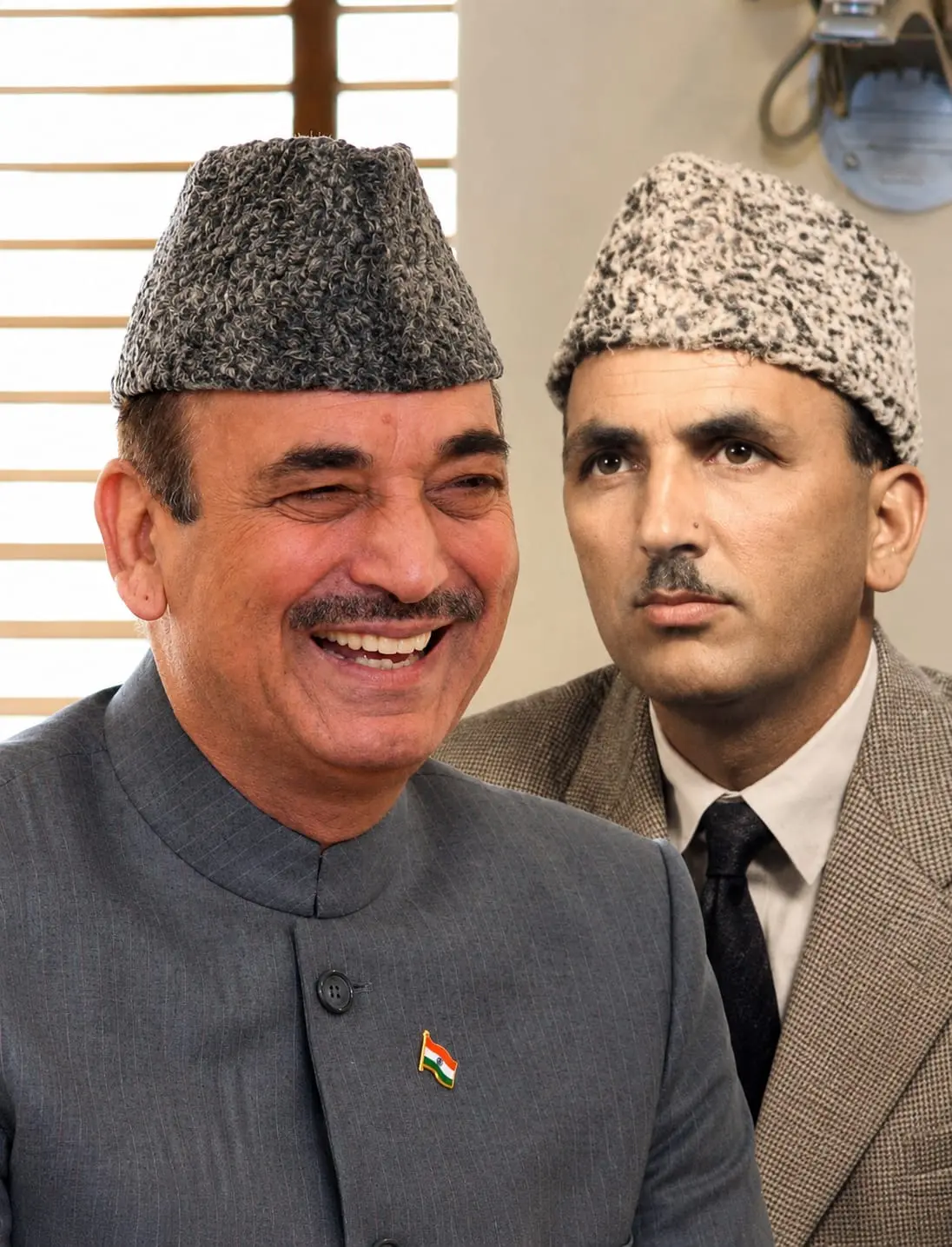
(JKNS),In politics, some names become prominent because of the era in which they live, while others become significant because of their personality, character and influence. Some people become part of history by occupying positions of power, while others remain relatively behind the scenes but shape the thinking, character and direction of generations that follow.
Ghulam Rasool Azad was one such personality.
At a time when reports about the possibility of Ghulam Nabi Azad returning to the Congress and his political contacts are being discussed, looking at the political story of this family merely through the lens of contemporary politics may not present the complete picture. The roots of this story run much deeper. At the heart of those roots lies the life of a man who emerged from a remote mountainous region, made his mark in the field of education, earned a Master’s degree in Mathematics from Lahore University, travelled to London for higher studies, returned home to serve in the Education Department, and eventually entered the Legislative Council, where he raised the concerns of his region.
That man was Ghulam Rasool Azad.
Today, the name of Ghulam Nabi Azad needs little introduction in Indian politics. He has served as Chief Minister of Jammu and Kashmir, held important responsibilities in the Union Government, and remained active for several decades as a prominent national leader of the Congress. But to understand any major political journey, it is necessary to look at the roads from which that journey began.
To understand Ghulam Nabi Azad’s political and intellectual journey, the personality of Ghulam Rasool Azad represents an important milestone along that early path.
From a Mountainous Region to Lahore and Then London
In today’s world, reaching universities in major cities may not seem particularly extraordinary. But consider a time when even basic education was not easily accessible in the remote mountainous areas of Jammu and Kashmir.
In such circumstances, Ghulam Rasool Azad’s pursuit of higher education was itself a remarkable achievement.
He obtained a Master’s degree in Mathematics from Lahore University. This was not merely an academic qualification; given the social circumstances of that period, it represented a major leap forward. A man from a remote region was breaking through the geographical limitations of his surroundings in pursuit of knowledge.
But Lahore was not his final destination.
In 1955, he travelled to London for higher education. At a time when studying abroad was not as common as it is today, travelling to London carried a story of its own.
Yet during his stay abroad, life confronted him with a tragedy that would have been difficult for anyone to endure.
His pregnant wife died during childbirth, and the news of the tragedy reached him several days later through sea mail.
Such a shock could break anyone. But Ghulam Rasool Azad did not abandon his education. He did not allow personal grief to stand in the way of his purpose. He completed his studies and returned home.
Perhaps this incident remains the quietest yet most powerful introduction to his personality.
Education Was a Mission, Not Merely a Profession
After returning home, Ghulam Rasool Azad began his professional life in the field of education. His journey from teacher to headmaster and eventually to senior responsibilities in the Education Department reflected his educational and administrative abilities.
He rose to the position of Director of Education.
But this aspect of his life leaves an important question for politics today:
Do people enter public life to seek positions, or to serve a purpose?
In the life of Ghulam Rasool Azad, the answer appears relatively clear.
He regarded education as a means of building society. For him, a teacher was not merely a person standing inside a classroom; a teacher was someone contributing to the construction of society’s future.
Perhaps it was in this environment that the early personality of Ghulam Nabi Azad continued to take shape.
Entering Politics, But Politics as Public Service
In 1957, Ghulam Rasool Azad was elected as a member of the Legislative Council.
This was by no means an ordinary achievement. He contested and won from a Hindu-majority area of Jammu. At a time when regional and religious identities exerted a strong influence on politics, his victory suggested that personal relationships, educational circles and public trust could also create political space beyond religious divisions.
The successful election of his close friend Dina Nath Kaul from the Kashmir Valley presents another interesting picture of that period.
On one side, a Muslim from Kashmir won an election from Jammu, while on the other, a Kashmiri Pandit won from the Valley.
These were not merely the results of two elections. They also offered a glimpse of a political environment in which, despite differences of identity, there remained space for mutual trust.
Giving the Mountains a Voice in the Legislature
After entering the Legislative Council, Ghulam Rasool Azad did not use his position merely to establish a political identity.
His focus remained on the basic needs of people living in remote mountainous regions.
The need for roads and better connectivity in areas such as Balisa, Doda, Bhaderwah, Kishtwar and Thathri-Kultran remained among his priorities.
Today, we may regard a road simply as an infrastructure project. But in mountainous regions, a road is actually a lifeline.
With a road, a child can reach school.
With a road, a patient can reach a hospital.
With a road, a farmer can transport produce to the market.
With a road, government employees, teachers and doctors can reach remote areas.
And with a road, a remote region becomes connected to the state.
Ghulam Rasool Azad understood this reality.
Stepping Away from Power Was Also a Political Statement
Another aspect of Ghulam Rasool Azad’s life deserves reflection by politicians today.
After serving in the Legislative Council, he did not make political office the ultimate destination of his life. He returned to the field of education.
In today’s political environment, such a decision may appear unusual.
Today, one political position often becomes a stepping stone to another. After one electoral victory comes the next destination, followed by another position and, eventually, the pursuit of greater political influence can become a continuous cycle.
But the life of Ghulam Rasool Azad offers a different idea: a position can be a means of service; service itself is not a position.
Perhaps this was the most important lesson that passed on to the next generation.
And Then Came Ghulam Nabi Azad
The story of Ghulam Rasool Azad does not end here.
There was a young member of his family who was deeply influenced by his personality.
That young man was Ghulam Nabi Azad.
In his autobiography, Ghulam Nabi Azad has referred to his uncle as an elder who played an important role in his early upbringing, thinking and personality development.
Here, history takes an interesting turn.
One man made education his field, entered politics, raised public issues and eventually returned to the world of education.
A member of the next generation, shaped by the intellectual environment of the same family, went on to pursue a path in national Indian politics.
Ghulam Nabi Azad later served as Chief Minister of Jammu and Kashmir, held important Union ministries and established a significant presence in the highest circles of Congress politics.
But like every great political tree, its roots lie beneath the surface.
In the roots of Ghulam Nabi Azad’s political personality, the influence of Ghulam Rasool Azad can be seen.
“Azad” Was More Than Just a Name
Perhaps the most interesting aspect of this family’s story is that the name “Azad” itself was passed from one generation to another like a symbol.
Ghulam Rasool Azad gave Ghulam Nabi Azad the name “Azad.”
Later, that same name became a well-known political identity in Indian politics.
It was not merely the transfer of a name. Along with it came an intellectual and moral legacy—education, self-confidence, discipline, hard work and the idea of playing an active role in public life.
That is why Ghulam Nabi Azad’s political career cannot be understood merely through elections, positions and party affiliations.
His journey also included the influence of an elder who had himself overcome difficult circumstances to create a path for his life.
Back to the Congress Again?
The question now is: if Ghulam Nabi Azad returns to the Congress, how should such a return be viewed?
Would it simply be the return of a politician to a political party?
Or would it represent the return of an experienced veteran of Indian politics to the national mainstream?
Time will answer that question.
One thing, however, is clear: limiting Ghulam Nabi Azad’s political career merely to his association with one political party would reduce the significance of his decades-long political experience.
He was part of a political era in which party politics, ideological associations, organisational politics and parliamentary experience each had their own importance.
Over time, political circumstances changed, relationships with political parties changed, new political forces emerged, and old political alignments assumed new forms.
In such circumstances, if an established political figure once again looks towards a former political platform, it may not be appropriate to view the move solely through the prism of a desire for power.
Political experience, ideological association, personal relationships, prevailing circumstances and future political considerations may all play a role.
But the Real Question Is Something Else
More important than the debate over Ghulam Nabi Azad’s possible return is the question of why politics today may need people like Ghulam Rasool Azad.
Today, we have modern buildings, major universities, social media, rapid communications and countless platforms for political engagement.
But do we also have the kind of political training that teaches a person to understand the importance of service above office?
Do our politicians still consider the schools, hospitals, roads and basic facilities of remote mountain villages central to public life?
Does political success still mean taking people’s problems to legislative chambers, or has it increasingly become about reaching positions of power?
And, most importantly:
Have we shifted politics from service towards power?
The life of Ghulam Rasool Azad places a quiet mirror before these questions.
Ghulam Rasool Azad may not have achieved the same national fame as his nephew, Ghulam Nabi Azad, but the true significance of his life lies not in fame, but in influence.
He emerged from a remote region and pursued education.
He did not lose courage despite personal tragedy.
He travelled to London.
He returned home.
He became a teacher.
He assumed senior responsibilities in educational administration.
He reached the Legislative Council.
He raised the concerns of underdeveloped mountainous regions.
And then, rather than making political office the purpose of his life, he returned to education.
His journey offers a quiet message for the present age:
The real test of politics is not how many positions a person has held, but how many lives he has been able to improve through those positions.
One Family, Two Generations and a Changing India
The story of Ghulam Rasool Azad and Ghulam Nabi Azad is not merely the story of one family.
It is also a story of the changing social and political journey of Jammu and Kashmir.
The first generation attached importance to education and institution-building.
The second generation entered national politics.
One tried to become a voice for the mountains in the Legislative Council, while the other travelled a long road through India’s parliamentary politics.
One contributed to the building of society as an educator, while the other established a national political identity.
And now, if Ghulam Nabi Azad begins a new political journey with the Congress, it would not simply be the return of a politician. It would mark another chapter in a political journey that began several decades ago in a remote mountainous region with a passion for education.
Perhaps that is the most beautiful aspect of this story.
Great political journeys do not always begin in great cities. Sometimes they begin in a small house in a remote mountain village, with the advice of a teacher and a determination to pursue knowledge.
The life of Ghulam Rasool Azad is an example of this very truth.
And amid the noise surrounding Ghulam Nabi Azad’s possible political return, perhaps we should also pause for a moment to remember the elder who valued education over power and passed on to the next generation the lesson that a person’s place in life is determined not merely by office, but by character and service.( JKNS)
Report: Peerzada Sayeed
Email: peerzadasayeed@gmail.com
Contact: +91 8491070608

