


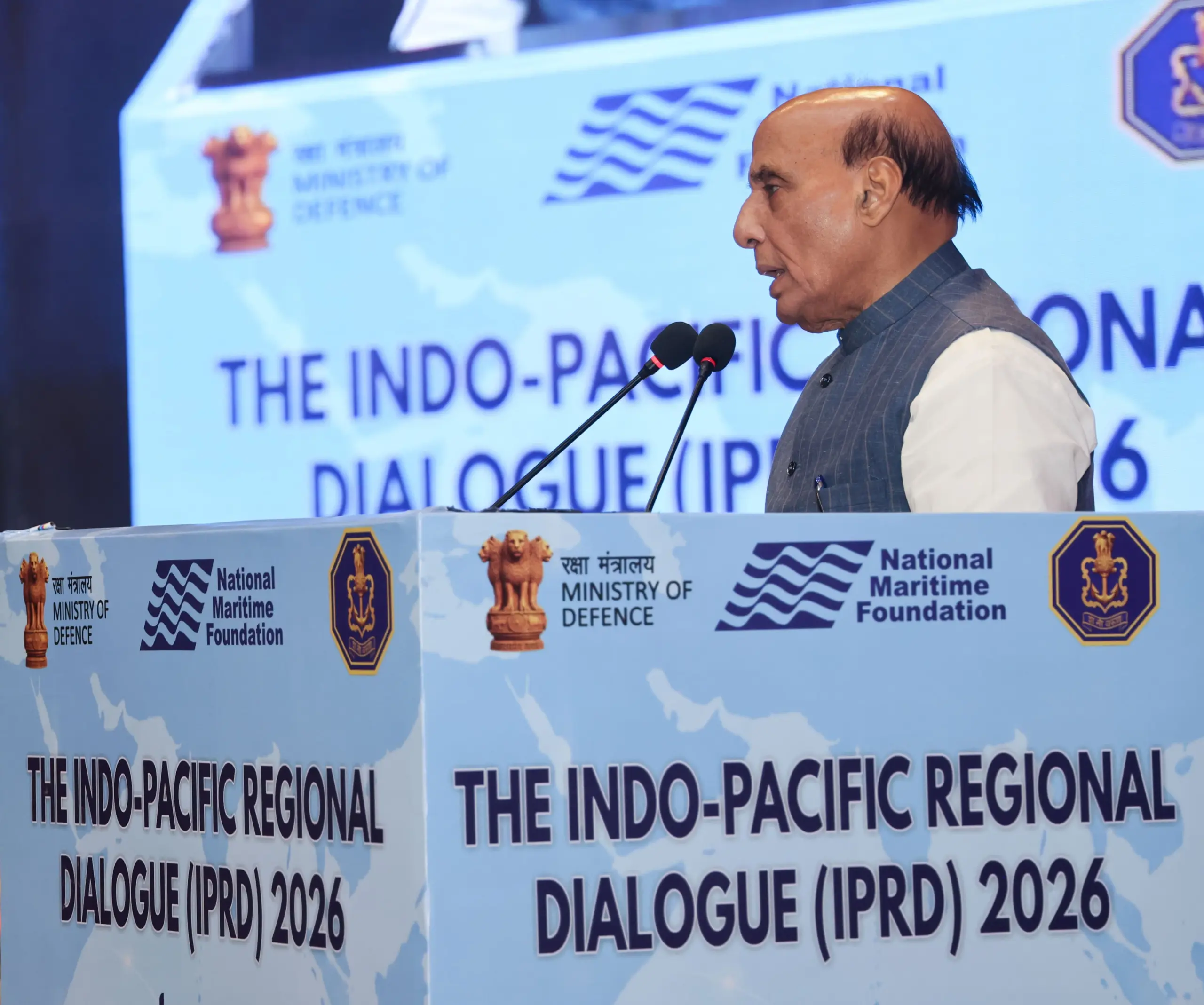

New Delhi, Nov 4 (JKNS): Defence Minister Rajnath Singh on Wednesday called for stronger regional cooperation, diversified supply chains and resilient maritime infrastructure to address growing security challenges in the Indo-Pacific, warning that deliberate trade disruptions, challenges to freedom of navigation and weaponisation of strategic maritime passages were threatening the broader international order. Addressing the Indo-Pacific Regional Dialogue (IPRD) 2026 in New Delhi, he stressed that regional partners must strengthen their collective ability to anticipate, withstand and recover from maritime disruptions.
Raksha Mantri Rajnath Singh has called for making interdependence among regional partners more secure and resilient through diversification of supply chains, reliable maritime infrastructure, enhanced maritime awareness and greater cooperation, along with the ability to anticipate, withstand and recover from disruptions, amid growing strains in the global maritime security environment. He was delivering the commemorative address at the Indo-Pacific Regional Dialogue (IPRD), the Indian Navy’s annual apex-level international strategic conference, being held in New Delhi on November 4, 2026.
Describing oceans as bridges rather than barriers among nations and civilisations, the Raksha Mantri highlighted their role in sustaining livelihoods and facilitating the exchange of goods, knowledge and culture. He stated that despite the international community’s awareness of these universal dependencies, certain actors and nations seek to exploit the criticality of the oceans for narrow unilateral gains.
“The global maritime security environment is strained by deliberate trade disruptions. We see blatant challenges to the freedom of navigation and the weaponisation of narrow maritime passages. This growing instability in the maritime domain casts a long shadow over the broader international order,” he added.
Rajnath Singh asserted that the answer to the vulnerabilities of an interconnected world lies in building resilience, emphasising that globalisation cannot be abandoned in response to every disruption, nor should maritime spaces that have enabled human progress be closed. He stressed that the objective must be to make interdependence more secure.
Highlighting the evolving nature of maritime security, the Raksha Mantri stated that challenges could arise not only from conventional military activities but also from non-traditional threats such as piracy, trafficking, illegal fishing, cyberattacks and natural disasters. He underscored the need for maritime security to evolve with the changing maritime domain.
“Artificial intelligence is changing the way data is processed, while autonomous systems are expanding the possibilities of surveillance and operations. New sensors are improving our ability to observe the oceans. Advances in materials, biotechnology and data analytics are opening new avenues for research and application. These developments have enormous implications for maritime security and economic activity. But technology, by itself, is not the answer. The more important question is how we use technology to address real challenges,” he said.
Rajnath Singh also underlined that technology must not become another source of inequality among nations, as the Indo-Pacific includes countries with different levels of technological and economic capability.
“Some possess advanced research infrastructure. Others are still developing the institutional and human resources required to participate fully in this transformation. If technological progress benefits only a limited number of countries, we will not achieve the collective resilience that our region requires,” he said.
The Raksha Mantri called for promoting cooperation in research, education, innovation and capacity building, stating that a stronger scientific capability in one country can contribute to the security and prosperity of the entire region. Terming it particularly important for smaller maritime nations and developing countries, he said the most useful technology is not necessarily the most expensive or sophisticated; it is the one that solves a real problem.
Rajnath Singh emphasised that as India moves towards Viksit Bharat by 2047, the maritime domain will play a crucial role in the country’s national transformation. He highlighted the Government’s efforts, led by Prime Minister Narendra Modi, to develop a comprehensive maritime ecosystem through investments in port infrastructure and connectivity, port-led development under Sagarmala, promotion of coastal economic activities and strengthening of the maritime industrial base.
He described the Maritime Amrit Kaal Vision 2047 as the national blueprint for this transformation, with emphasis on technology, innovation, research, education and skills.
The Raksha Mantri underlined the need for economic development and environmental responsibility to progress together, stating that oceans cannot be treated as an unlimited source of resources. He advocated the protection of marine ecosystems, responsible utilisation of ocean resources and placing the interests of coastal communities at the centre of development efforts.
“National prosperity and ecological responsibility are not competing objectives. They must reinforce each other,” he said.
Reaffirming India’s commitment to an open, inclusive and rule-based maritime order, Rajnath Singh highlighted the vision of MAHASAGAR (Mutual and Holistic Advancement for Security and Growth Across Regions), which recognises the interconnected nature of security and prosperity among nations and underscores that the maritime future of the Indo-Pacific cannot be shaped by any single country acting alone.
He also termed the Indo-Pacific Oceans Initiative, announced by Prime Minister Narendra Modi in 2019, as a practical framework for advancing maritime cooperation across seven interconnected areas.
Emphasising the need to translate regional cooperation into tangible outcomes, the Raksha Mantri urged the participants of IPRD to move beyond identifying challenges and focus on practical action. He pitched for stronger scientific networks, joint research, exchanges between universities and maritime institutions, and the development of affordable technological solutions to common challenges.
Stressing that the deliberations at the IPRD must lead to concrete outcomes, he said ideas emerging from the dialogue must translate into partnerships, projects and measurable outcomes.
“The future of the Indo-Pacific will not be shaped by technology alone. It will be shap…