


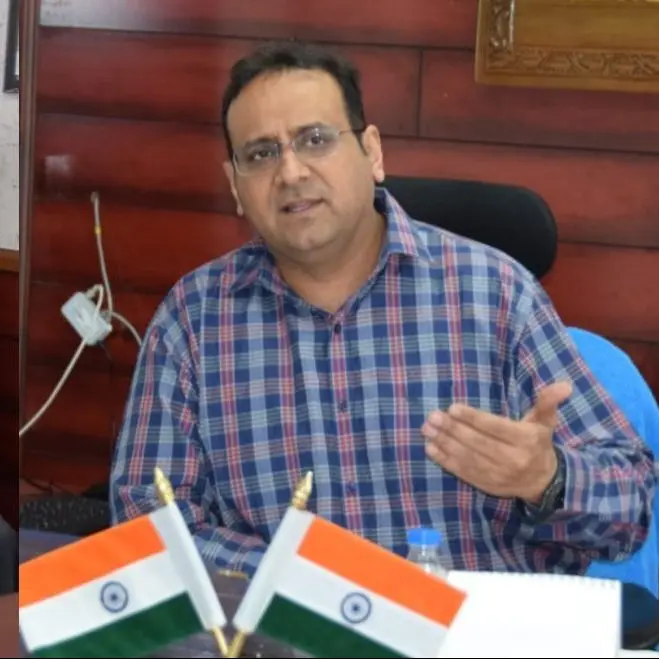
Commissioner Secretary FCS&CA Sourabh Bhagat says claims of face authentication mandatory for ration baseless, misleading, Aadhaar authentication has been in place since 2020; any adult family member can collect ration; iris scan, OTP, thumb authentication and face recognition available under Sarthak PDS
Dealer commission increased from ₹108 to ₹195 per quintal; Department intensifies e-KYC drive, directs face authentication rollout from current month’s distribution cycle amid confusion over mandatory requirements
Srinagar, Nov 11 (JKNS): Amid confusion and concerns among ration card beneficiaries over the reported introduction of mandatory face authentication for drawing ration under the Public Distribution System (PDS) in Jammu and Kashmir, Commissioner Secretary, Food, Civil Supplies and Consumer Affairs (FCS&CA) Department, Sourabh Bhagat, clarified that face authentication is not compulsory and beneficiaries can avail of their entitled ration through any of the four available Aadhaar authentication methods.
Speaking to news agency JKNS, Bhagat said the Aadhaar-based authentication system has been in operation since around 2020 and is aimed at ensuring transparency in ration distribution, preventing diversion and black marketing of foodgrains, and ensuring that the entitled ration reaches genuine beneficiaries.
Explaining the evolution of the authentication process, Bhagat said that initially only thumb-based biometric authentication was available, but the system has now been expanded to provide three additional options, taking the total number of authentication methods to four.
“Earlier, there was only one methodology, which was thumb authentication. Now we have introduced three more technologies. One is iris scan, which is unique and can identify a beneficiary. The second is OTP authentication, under which an OTP is received on the beneficiary’s mobile phone and can be shared with the dealer for receiving ration. The third is face authentication,” he said.
Clarifying the most important concern surrounding the reported mandatory face authentication, Bhagat said that none of the four methods is compulsory individually and beneficiaries are free to choose any one of the available authentication options.
He said the expansion of authentication methods has been introduced to provide greater convenience to beneficiaries and ensure that no one faces unnecessary difficulty in collecting ration.
*Any adult family member can collect ration*
Addressing another widespread misconception that only the head of the ration card-holding family can authenticate and collect ration, Bhagat categorically clarified that any adult member of the family can visit the Fair Price Shop and receive the entitled ration.
He said that if the head of the family, including the father, is unable to visit the ration depot because of work or other commitments, another adult member, including the mother, son, daughter, brother or sister, can collect the ration on behalf of the family.
“People have a misconception that only the head of the family can do it. No, any member can do it. Suppose your father cannot go to the ration shop, your mother can go. If she cannot go, you can go, or your brother or sister. Any adult member of the family can go and collect the ration,” Bhagat said.
He, however, clarified that a minor child should not be sent independently to collect ration, stressing that an adult family member should undertake the process to ensure that the child is not misled or exploited.
He said the wife or any other adult member of the household can visit the ration depot and complete the authentication process.
*Face authentication, OTP provide alternatives in special circumstances*
Explaining the arrangements for beneficiaries who may face physical difficulties in completing thumb-based biometric authentication, Bhagat said the availability of multiple authentication options addresses such situations.
Giving an example, he said that if a beneficiary has lost or does not have a functional right hand, face authentication can be used as an alternative to thumb authentication.
“Suppose someone does not have a right hand, then he can go for face authentication. We have provisions for such circumstances,” he said.
He further explained that OTP authentication can also facilitate families who are unable to visit the ration shop personally.
Giving an example of a household comprising a mother and two daughters, Bhagat said that where the beneficiary is unable or unwilling to visit the Fair Price Shop, the OTP-based facility can be used to complete the authentication process through the mobile phone, with the assistance of the dealer.
*WhatsApp messages creating confusion over mandatory face authentication*
Referring to the confusion circulating among people, Bhagat said messages claiming that face authentication had become compulsory were being widely circulated through WhatsApp groups, creating unnecessary apprehensions among ration card holders.
Bhagat also alleged that certain elements, particularly those opposing changes in the existing ration distribution mechanism, were spreading apprehensions and raising objections against the new system.
He said the technology-based mechanism introduced by the Government of India was designed to ensure accountability at every stage of ration distribution and prevent irregularities in the system.
“At one time, there were instances of dealers indulging in irregularities and misappropriation of ration. Now the Government of India has established a very good system to ensure that every grain reaches the rightful beneficiary. You cannot divert ration without authentication,” he said.
Explaining how the digital mechanism monitors the distribution of foodgrains, Bhagat said the computerised system maintains records of the quantity allocated and the number of beneficiaries who have actually collected their ration through Aadhaar authentication.
He said that if a dealer is supplied four quintals of ration for 500 beneficiaries but only 300 beneficiaries collect their ration through Aadhaar authentication, the system will reflect the remaining 200 beneficiaries.
“Suppose we give four quintals of ration to a dealer for 500 people, but only 300 people take ration using Aadhaar, then the computer will show that 200 beneficiaries have not collected their ration. The system scrutinises everything. This is how the mechanism ensures accountability,” he said.
Bhagat alleged that some union leaders were uncomfortable with the new mechanism because it had restricted the scope for misappropriation and diversion of foodgrains.
He further alleged that certain people were raising objections by citing issues such as non-availability of internet connectivity, failure of th…

