


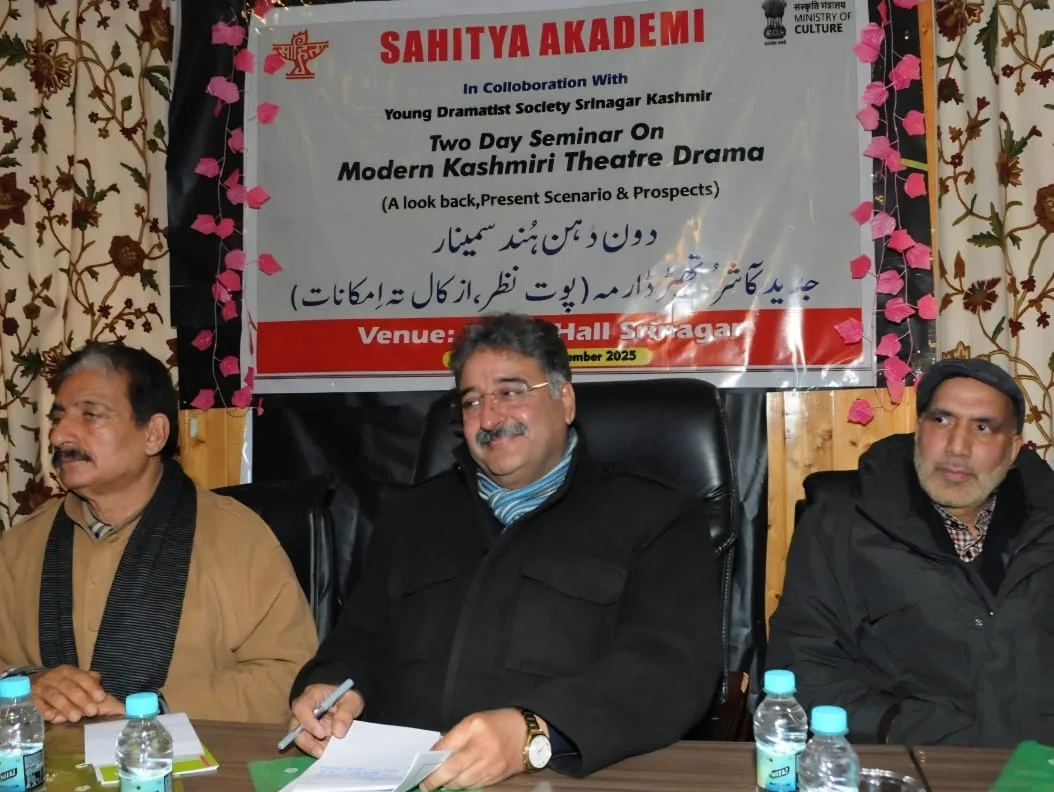
Srinagar, Dec 13 (JKNS): The historic Tagore Hall in Srinagar witnessed the concluding day of a two-day Seminar on Theatre, a significant cultural event organized by the Sahitya Akademi, New Delhi, in collaboration with the Young Dramatists Society.
The seminar brought together scholars, dramatists, and theatre enthusiasts from across the valley, creating a vibrant platform for dialogue and reflection on the past, present, and future of Kashmiri theatre. Presiding over the final day was Mushtaaque Ali Ahmad Khan, the eminent actor, director, and cultural activist whose contributions to the performing arts have shaped the cultural landscape of Kashmir for decades.
Over the course of the two days, nearly twelve scholarly papers were presented, each shedding light on diverse aspects of theatre in Kashmir. The paper readers included Ali Mohammad Nishtar, Manzoor Ahmad Mir, Nisar Naseem, Riyaz ul Hassan, M. Y. Shaheen, Reshi Rasheed, Gulshan Badrani, Shakeel Azad, Arshad Mushtaq, Dildar Ashraf Shah, Javeed Gilani and Mushtaaque Ali Ahmad Khan.
These papers explored themes ranging from the evolution of Kashmiri stagecraft, the role of folk traditions in shaping modern performances, the challenges faced by contemporary dramatists, and the importance of theatre as a medium of social awareness. Collectively, they offered a comprehensive overview of the region’s theatrical heritage, while also addressing the pressing need to preserve and innovate within this art form.
The seminar was further enriched by the presence of distinguished personalities such as Prof. Shad Ramzan, Convener of the Kashmiri Committee, and Prof. Nasir Mirza, who attended as Guest of Honour. Their participation underscored the importance of academic and cultural collaboration in sustaining the vitality of theatre in the valley. Both scholars emphasized the role of theatre not only as entertainment but also as a powerful vehicle for cultural identity and intellectual discourse.
Mushtaaque Khan’s presidential address was the highlight of the concluding session. Speaking with warmth and authority, he reflected on his five-decade-long association with Tagore Hall, a space that has witnessed countless performances, rehearsals, and cultural milestones.
His speech was filled with anecdotes of struggle, resilience, and triumph, offering the audience a rare glimpse into the personal journey of an artist deeply committed to his craft.
He spoke of the challenges faced by theatre practitioners in Kashmir, from infrastructural limitations to societal indifference, and yet emphasized the enduring spirit of creativity that has kept the art alive.
The audience, comprising students, researchers, and theatre lovers, listened with rapt attention. For many, Khan’s recollections were not only inspiring but also invaluable as a source of lived experience that complemented the academic discussions of the seminar. His words served as a reminder that theatre in Kashmir is not merely an artistic pursuit but a testament to resilience, cultural pride, and the unyielding human spirit. (JKNS)

