


For decades, Jammu and Kashmir was widely perceived both nationally and internationally through the lens of violence, unrest, and uncertainty. The identity of its youth was often unfairly confined to images of guns, protests, and confrontation. However, with gradual improvement in the situation, the establishment of peace, and the return of normalcy, a new path has emerged for the young generation of the region. Today, the youth of Jammu and Kashmir are rejecting the path of violence and instead dreaming of shaping their future through sports, education, and skill development.
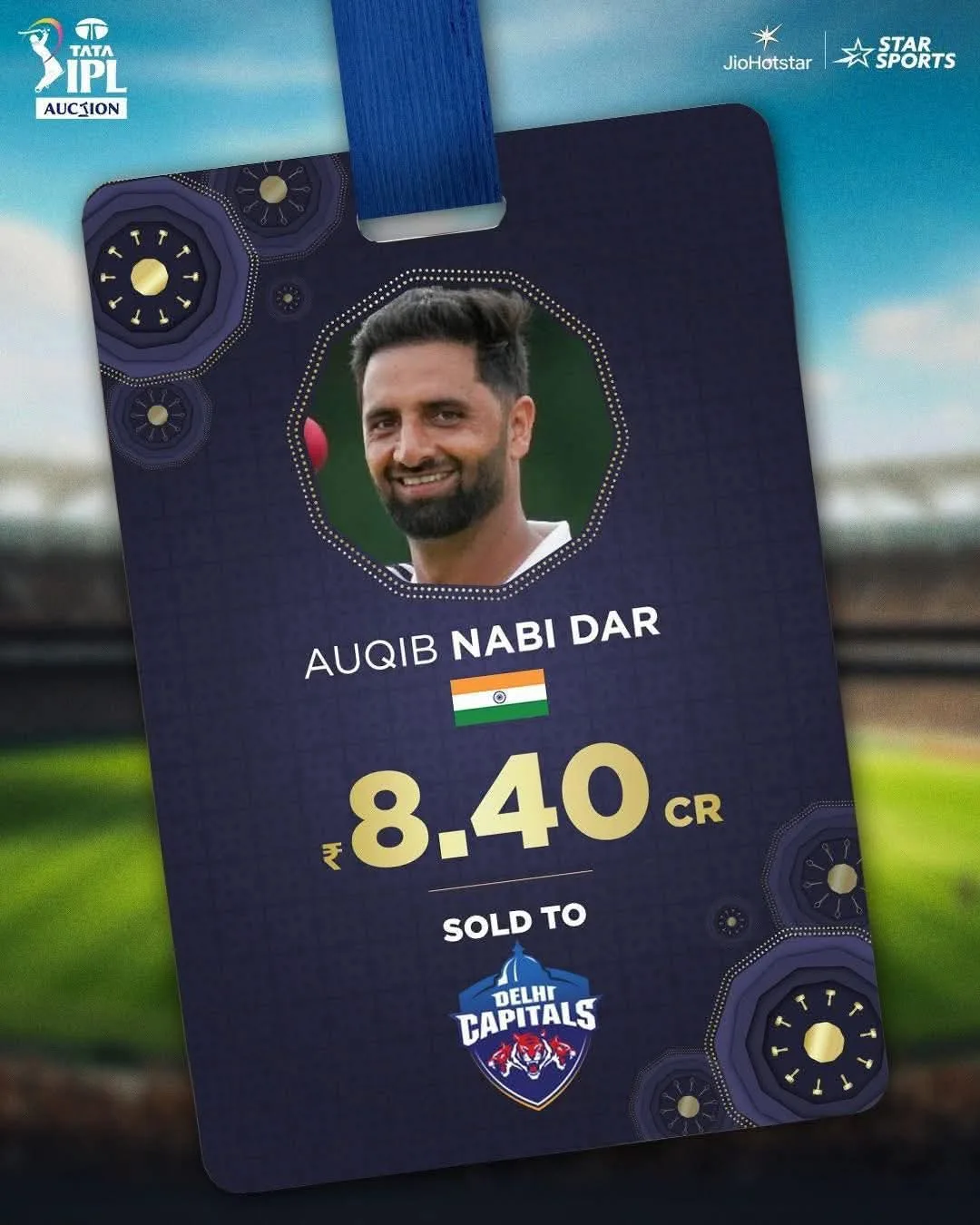
A shining example of this changing narrative is Aaqib Nabi, a cricketer from Sheeri village of Baramulla district in North Kashmir, who has secured an ₹8.4 crore contract in the Indian Premier League (IPL). His achievement is not just a personal milestone; it represents a new direction for the dreams and aspirations of Kashmiri youth.
Born on November 4, 1996, during a period when the Valley was passing through extremely turbulent times, Aaqib Nabi grew up in an atmosphere of uncertainty where even dreaming was a challenge. Despite these odds, he nurtured a deep passion for cricket. His journey from playing with a tennis ball in narrow lanes to making a mark on a national platform is a story of perseverance and hope.
Aaqib Nabi’s entry into the IPL is not merely the success of an individual; it symbolizes a broader transformation taking place among the youth of Jammu and Kashmir. As violence has declined and peace has gradually taken root, mindsets have also evolved. Today’s youth want to hold a bat instead of a gun, throw a ball instead of stones, and prove their talent on the field rather than on the streets.
Over the past few years, there has been significant improvement in sports infrastructure across Jammu and Kashmir. The construction of stadiums, organization of sporting events, availability of coaching facilities, and encouragement from both government and private sectors have boosted the confidence of young athletes. Sports such as cricket, football, hockey, boxing, and others are no longer seen merely as hobbies but as viable career options.
As a result, Kashmiri youth now view sports not only as a means of self-expression but also as a strong pathway to employment, dignity, and identity. The presence of Kashmiri players on major platforms like the IPL further reinforces the belief that with hard work, dedication, and opportunities, the youth of the Valley can compete with the best.
Importantly, improved conditions have weakened the mindset of violence among young people. A generation once associated with anger and frustration is now gravitating toward constructive activities. Sports have emerged as a positive engagement, promoting not only physical fitness but also discipline, teamwork, patience, and resilience.
Young achievers like Aaqib Nabi have become role models for children across the Valley. Today, in the lanes of Sheeri, Sopore, Anantnag, and Shopian, children play cricket while dreaming of following in his footsteps. Parents, too, now encourage their children with hope rather than fear as they head to playgrounds.
This transformation clearly shows that peace is not merely the absence of noise on the streets it is the presence of confidence in minds, hope in hearts, and dreams in young eyes. When opportunities are provided, youth naturally abandon the path of violence and move toward progress and development.
It would not be an exaggeration to say that Aaqib Nabi’s ₹8.4 crore IPL success is a symbol of Jammu and Kashmir’s changing future. It signals that the Valley will no longer be known only for the wounds of its past, but for the dreams of its future. If peace, opportunities, and guidance continue, the day is not far when the youth of Kashmir will establish their identity on the global stage not only in sports, but in every field of life.

