


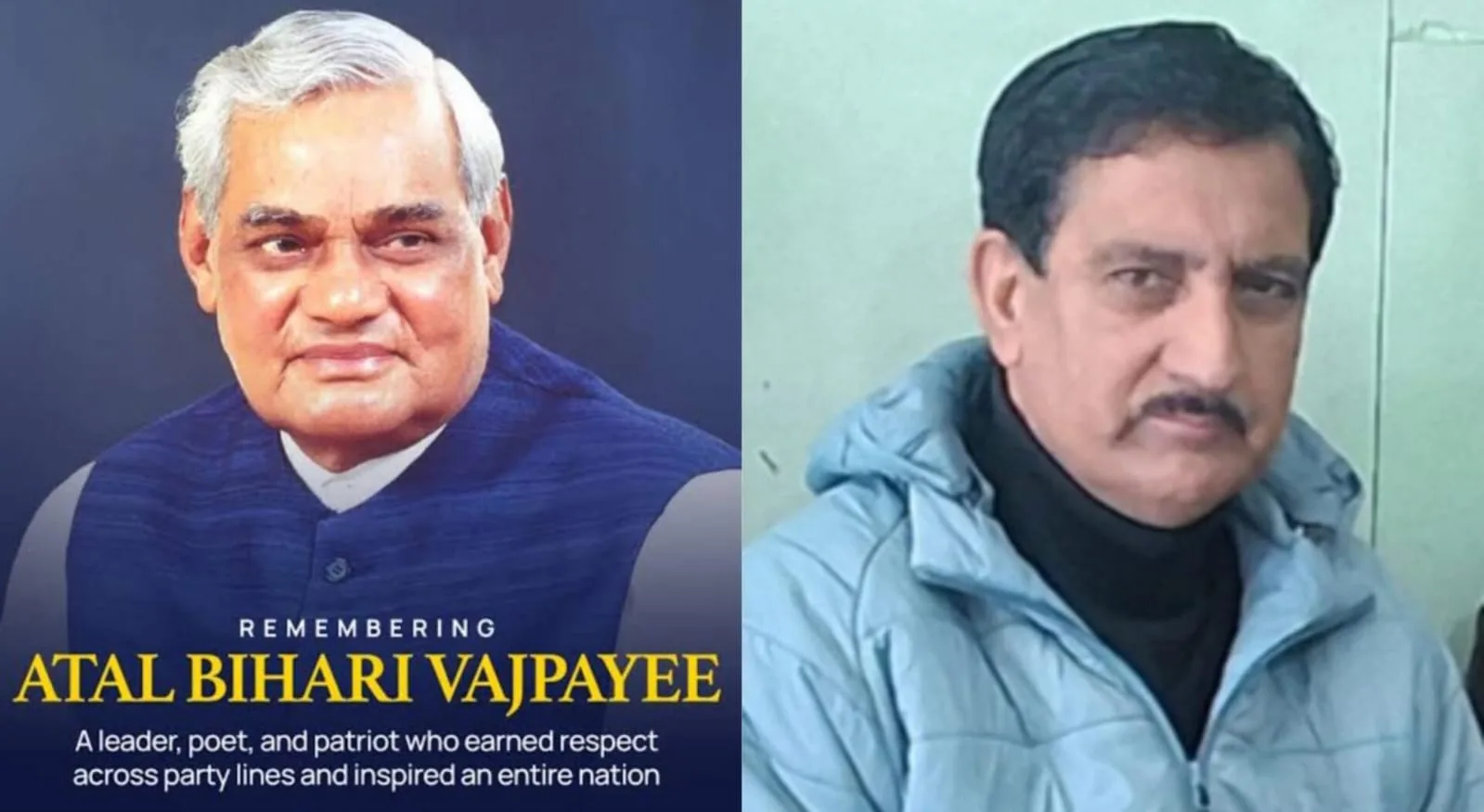

Atal Bihari Vajpayee, born on December 25, 1924, in Gwalior, rose from a modest background as the son of a school teacher to become India’s most famous Prime Minister, blending poetry, nationalism, and statesmanship. His life exemplified resilience amid personal sacrifices and political turbulence, leaving a lasting impact on India’s governance and Kashmir policy.
A lifelong bachelor devoted to public service, he earned widespread admiration, particularly in Kashmir for his humane approach. Atal Bihari Vajpayee occupies a rare, high-equity position in India’s political memory, one built not merely on electoral arithmetic but on credibility, emotional intelligence, and civilisational confidence.
As the Prime Minister of India, the first PM from Bharatiya Janata Party (BJP), Atal Bihari Vajpayee delivered high-impact outcomes across strategic domains by aligning political will with institutional discipline. The 1998 Pokhran-II nuclear tests decisively positioned India as a declared nuclear power, ending strategic ambiguity while simultaneously articulating a responsible doctrine anchored in “No First Use.”
Vajpayee complemented this assertion of national strength with swift diplomatic engagement, reducing the long-term impact of sanctions and recalibrating India’s global credibility. In foreign policy, Vajpayee pursued pragmatic diplomacy, resetting India-US relations, engaging Pakistan through the Lahore initiative, and expanding partnerships across Asia and Europe.
Atal Bihari Vajpayee occupies a distinctive place in the political memory of Kashmir. This is remarkable given his long association with the Bharatiya Janata Party, a party that has often been viewed in the region with suspicion because of ideological differences and historical anxieties. Yet Vajpayee rose above partisan labels.
In Kashmir, he was remembered less as a party leader and more as a statesman who spoke with empathy, restraint, and moral clarity. His approach to Kashmir remains one of the most serious, humane, and forward-looking efforts ever undertaken to address the dispute within the framework of Indian sovereignty and regional peace.
At the heart of Vajpayee’s Kashmir policy lay a clear conviction: the problem could not be resolved by security measures alone. While he recognised the state’s responsibility to counter terrorism and violence, he consistently rejected the idea that force could deliver lasting peace.
For Vajpayee, Kashmir was as much a political and emotional question as it was a territorial one. This philosophy found expression in his celebrated formulation “Kashmiriyat, Jamhooriyat, Insaniyat” — the spirit of Kashmir, democracy, and humanity. Far from being a rhetorical flourish, this triad functioned as a governing principle that shaped his policies, his language, and his engagement with the people of the region.
Vajpayee’s popularity in Jammu and Kashmir stemmed largely from his tone and intent. He addressed Kashmiris with respect, not condescension, and avoided the ideological sharpness that often characterised New Delhi’s discourse on the region. In a place long accustomed to being discussed primarily through the lens of security, Vajpayee spoke about dignity, reconciliation, and healing.
His willingness to acknowledge the pain and alienation felt by ordinary Kashmiris without defensiveness or denial gave his words credibility. This humane approach resonated widely, including among those who otherwise remained politically distant from the Indian state.
A critical pillar of Vajpayee’s strategy was the restoration of democratic legitimacy. Under his leadership, the 2002 Jammu and Kashmir Assembly elections were conducted in an environment that, while still fragile, was notably more transparent and credible than earlier exercises. These elections were widely regarded as relatively free and fair, and voter participation carried symbolic significance.
For many Kashmiris, it marked the re-connection to India as a meaningful option rather than a hollow ritual. Vajpayee understood that “Jamhooriyat” was not merely about electoral mechanics but about rebuilding faith in political processes as an alternative to violence.
Equally important was Vajpayee’s openness to dialogue. He signalled a willingness to engage not only with mainstream political parties but also with separatist voices, recognising that durable peace required inclusive conversations. This stance attracted criticism from hardliners within his own political constituency, yet Vajpayee remained convinced that talking to adversaries was a sign of confidence, not compromise.
His leadership style reflected strategic patience, an understanding that complex disputes are resolved through sustained engagement rather than dramatic gestures.
On the international front, Vajpayee pursued peace with Pakistan as an essential component of resolving Kashmir. His engagement with Pervez Musharraf was central to this effort. The Lahore Bus Yatra of 1999 symbolised Vajpayee’s belief that people-to-people contact and political dialogue could soften entrenched hostilities.
Even after the Kargil conflict, widely viewed in India as a betrayal of trust, Vajpayee did not abandon the path of engagement. Instead, he distinguished between tactical deception and strategic necessity, choosing to keep the door to dialogue open in the interest of long-term peace.
These efforts eventually converged into what later became known as the Vajpayee-Musharraf backchannel understanding, often described by diplomats and analysts as the most advanced and realistic framework ever devised to address the Kashmir dispute. Though never formalised, the proposal reportedly rested on four broad principles: no redrawing of borders but making them irrelevant through freer movement; greater autonomy or self-governance on both sides of the Line of Control; joint mechanisms involving India, Pakistan, and Kashmiris; and phased demilitarisation linked to a sustained reduction in violence.
What made this framework significant was its pragmatism. It moved away from absolutist positions and focused instead on improving lives on the ground. It respected India’s territorial integrity, acknowledged Pakistan’s long-stated concerns, and, crucially, placed Kashmiri aspirations at the centre of the conversation.
Many observers believe that this initiative represented the closest India and Pakistan have ever come to a workable settlement. Its failure owed less to conceptual weakness than to political instability in Pakistan and Musharraf’s inability to convert personal authority into lasting institutional commitment.
Despite these setbacks, Vajpayee refrained from personalised recrimination. He did not publicly weaponise Musharraf’s duplicity, nor did he abandon his belief in dialogue as a principle. This restraint enhanced his stature in Kashmir, where many perceived him as a leader genuinely invested in peace rather than political point-scoring.
His conduct reinforced the sense that he viewed Kashmiris not as instruments of state policy, but as stakeholders whose trust mattered.
Vajpayee’s legacy in Kashmir, therefore, is not defined by a final settlement but by the possibility he created. He broadened the horizon of what could be imagined and discussed. He demonstrated that empathy and firmness are not mutually exclusive, and that nationalism need not be devoid of compassion.
Above all, he showed that dialogue, grounded in humanity and democratic values, remains the most credible pathway to peace. In the final analysis, Vajpayee’s approach to Kashmir reflected his wider philosophy of governance — measured, inclusive, and rooted in civilisational confidence.
He understood that enduring solutions are built not through coercion, but through consent. In Kashmir, this understanding earned him something rare and enduring: respect. Long after policies shift and political climates change, that respect remains his most lasting contribution to the region and to India’s democratic legacy.