


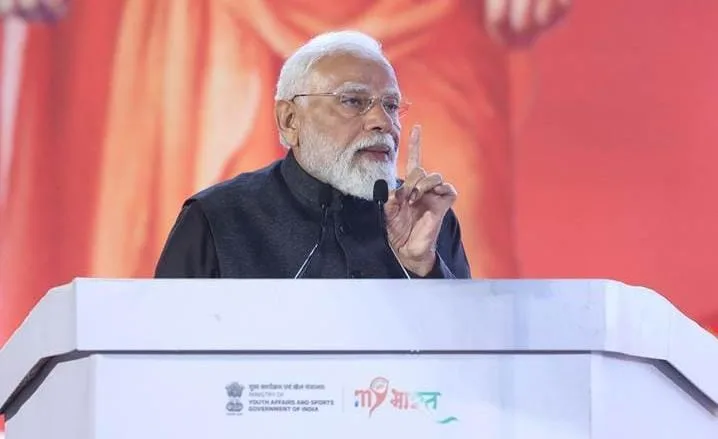
New Delhi, Jan 12 (JKNS): Prime Minister Narendra Modi on Monday addressed the Viksit Bharat Young Leaders Dialogue (VBYLD) 2026 at Bharat Mandapam, urging the youth to harness their energy, innovative ideas, and purpose to drive nation-building.
Prime Minister Narendra Modi participated in the programme, interacting with the youth and engaging directly with them to hear their ideas and perspectives for building a Viksit Bharat.
As per news agency JKNS, The final chapter of the four-day event unfolded in an atmosphere of high energy and enthusiasm as young leaders experienced the most anticipated segment of the Dialogue.
The second edition of the Viksit Bharat Young Leaders Dialogue (VBYLD 2026), which commenced at Bharat Mandapam, New Delhi, on 9th January, culminated today on the occasion of National Youth Day, commemorating the birth anniversary of Swami Vivekananda.
Prime Minister Narendra Modi addressed the concluding session of Viksit Bharat Young Leaders Dialogue 2026. On the occasion, Shri Modi remarked that when he first took the oath as Chief Minister, many young citizens of today had not yet been born, and when he assumed office as Prime Minister in 2014, most of them were still children. Despite this passage of time, he emphasized that his trust in the younger generation has remained constant and unwavering. “Your capability, your talent, I have always drawn energy from your energy. And look at today, all of you are holding the reins of the goal of a Developed India”, Shri Modi noted.
The Prime Minister emphasized that the period leading up to 2047, when India marks 100 years of independence, is a decisive phase for both the nation and its youth. He stated that the strength and capabilities of young Indians will shape India’s strength, and their success will elevate the country to new heights. Congratulating participants of the Viksit Bharat Young Leaders Dialogue, the Prime Minister underscored the critical role of youth leadership in achieving the vision of a developed India.
The Prime Minister noted that the event coincides with the birth anniversary of Swami Vivekananda. “Remembering Swami Vivekananda, we celebrate National Youth Day every year on 12 January. Inspired by his ideals, 12 January has been chosen for the Viksit Bharat Young Leaders Dialogue. The life of Swami Vivekananda is a great guiding light for all of us”, Shri Modi emphasised.
Expressing satisfaction over the rapid growth of the Viksit Bharat Young Leaders Dialogue, Shri Modi described it as a powerful platform enabling direct youth participation in shaping India’s development agenda. “The association of crores of young people with this initiative, more than 5 million registrations, over 3 million youths participating in the Viksit Bharat Challenge, and sharing their ideas for the nation’s development, such large-scale engagement of youth power is unprecedented”, Shri Modi highlighted.
Appreciating the quality of inputs, the Prime Minister particularly lauded the thoughtful ideas presented on key themes such as Women-Led Development and Youth Participation in Democracy. Referring to the presentations made during the event, he said they reflect the strong resolve of India’s Amrit Peedhi to build a developed nation. The Prime Minister also underlined the creativity and innovative spirit of India’s Gen Z and congratulated all young participants and members of the Mera Yuva Bharat organization for the successful conduct of the dialogue.
The Prime Minister highlighted the importance of being open to global knowledge while valuing India’s own heritage, quoting the Vedic phrase “Aano Bhadrāh Kratavo Yantu Vishwatah” that is, let auspicious, beneficial, and excellent thoughts come to us from all directions. “You must learn from the best practices around the world, but never let the tendency to undervalue your own heritage and ideas dominate”, Shri Modi stated.
Shri Modi cited Swami Vivekananda who embraced global ideas but challenged misconceptions about India, inspiring a vision for a better nation. He encouraged youth to advance with energy, maintain fitness, and embrace joy, expressing unwavering faith in their potential. “I have complete faith in all of you, in your capabilities and energy. With these words, I once again wish you all a very Happy National Youth Day”, the Prime Minister concluded.
The Prime Minister also released a compilation of best essays written by participants on the ten themes. These themes encompass diverse areas such as technology, sustainability, women empowerment, manufacturing, and agriculture.
The final day began with presentations by the finalists of the Viksit Bharat Track, who presented their ideas across ten thematic areas. Each finalist showcased innovative and solution-oriented proposals before eminent Union Ministers, reflecting the depth of thought, leadership potential, and commitment of India’s youth towards national development.The themes are as follows:
Track 1 -Youth in Democracy and Government for Viksit Bharat
The session featured youth-led presentations on “Youth for Democracy and Government”, highlighting practical governance frameworks aimed at strengthening democratic participation and improving public service delivery. The presentations outlined actionable initiatives such as Village Action Plans for local development, problem-solving units working with district administrations, policy and career labs to deepen youth engagement in governance, and fellowship models to embed trained youth within government institutions. The session was attended by Shri Kiren Rijiju, Union Minister for Parliamentary Affairs and Minority Affairs; Smt. Raksha Nikhil Khadse, Minister of State for Youth Affairs and Sports; and Shri Jayant Chaudhary, Minister for Skill Development and Entrepreneurship, who interacted with the participants and appreciated the youth-driven governance ideas.
Track 2 – Women Led Development: The Key to Viksit Bharat
Youth delegates presented a roadmap for Women-Led Development, advocating a shift towards women as drivers of India’s growth. The presentation outlined the “RISE” framework – Representation & Rights, Inclusion & Innovation, Skills & Self-Reliance, and Economic Empowerment as a strategic pillar for India’s journey towards 2047.
The ministerial panel comprising Shri Kiren Rijiju, Minister of Parliamentary Affairs and Minority Affairs, and Shri Jayant Chaudhary, Minister of State (I/C) for Skill Development and Entrepreneurship, appreciated the youth-led ideas and affirmed their alignment with the Government’s vision of women as decision-makers and entrepreneurs.
Smt. Raksha Khadse, Minister of State for Youth Affairs and Sports, highlighted the emphasis on women’s fitness and entrepreneurship, drawing parallels with initiatives such as the Asmita League.
Track 3 – Fit Bharat Hit Bharat
Track 3 emphasised that a healthy population is the foundation of a strong nation. The discussions highlighted the need for an integrated national wellness framework combining nutrition, sports, education and technology, with a focus on data-driven systems and community-led initiatives. The session was evaluated by Union Ministers Shri Kiren Rijiju and Shri Jayant Chaudhary. Innovative proposals such as “Play in India, Play for India,” Agro Olympics and the Nutri-Smart Canteen Mission were presented. The track concluded with the message, “Sehat Majboot, Bharat Majboot.”
Track 4 – Making India the Start Up Capital of the World
The Startup Capital of the World track featured proposals including a “one-day exit and one-week restart” framework to normalise failure and build a first-fail founders’ network, establishment of exclusive startup banks, a Startup Health Index, and dedicated startup cells in every government department. Participants also suggested setting up Idea Labs for pre-launch testing, enabling citizens as micro-investors, promoting nature-inspired startups and biofoundries, and organising grassroots startup challenges on the lines of the Khelo India model. Global-to-local scaling models such as UPI were cited as benchmarks.
Responding to the presentations, Union Minister for Youth Affairs & Sports and Labour & Employment, Dr. Mansukh Mandaviya said, “Our startups and innovations must be based on the Indian model. We should not blindly copy models from the West. Innovation has to be developed according to India’s local and indigenous needs. Broadly, innovations are of two kinds—one that responds to the needs of the world, and the other that responds to India’s own requirements. Both are important, but the foundation must be Indian.”
Track 5 – Bharat’s Soft Power: Cultural Diplomacy and Global Influence for Viksit Bharat
Under Track 5, Bharat’s Soft Power: Cultural Diplomacy and Global Influence for Viksit Bharat, the session was graced by the presence of Dr. Mansukh Mandaviya, Union Minister for Youth Affairs and Sports and Labour and Employment, Shri S. Krishnan, Secretary, Ministry of Electronics and Information Technology (MeitY), and Shri N. K. Mishra, Additional Secretary, Department of Youth Affairs. The presenters outlined a forward-looking, youth-led vision to strengthen India’s global influence by harmoniously integrating culture, technology and collaboration.
Speaking on the essence of India’s soft power, Dr. Mandaviya emphasised that ‘seva’ is deeply rooted in India’s sanskaar (values) and is not a commercial activity driven by profit. Recalling India’s humanitarian efforts during the COVID-19 pandemic, he stated that seva reflects a moral and cultural responsibility intrinsic to Indian civilisation. He underscored that when seva is guided by sanskaar…

