


New Delhi, Jan 16 (JKNS): As part of India’s push towards modern, fast and passenger-friendly rail connectivity, as many as 164 Vande Bharat Express trains have become operational across the country till December 2025, significantly enhancing inter-city mobility, Government said on Friday.
164 Vande Bharat trains operational till December 2025, nation-wide, enhancing connectivity across major corridors.
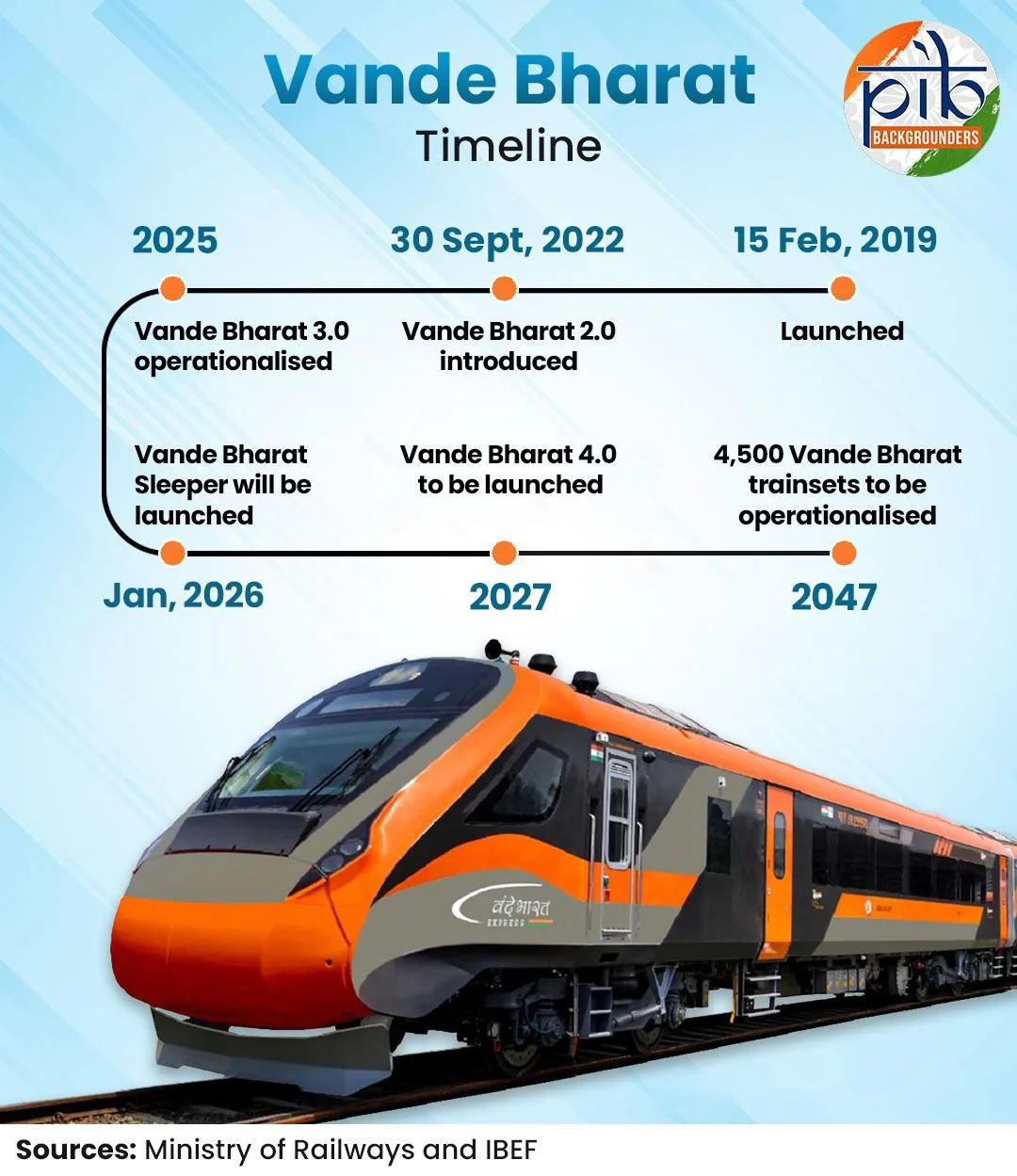
Vande Bharat Sleeper will be launched in January 2026, expanding services to long-distance overnight travel.
Vision includes the goal of scaling the fleet to 800 by 2030 and 4,500 by 2047.
Introduction
As India advances towards its vision of becoming a developed nation by 2047, mobility has emerged as a central pillar of national development. Modern transport systems today extend beyond basic connectivity and serve as critical enablers of economic integration, regional development, and social inclusion. Vande Bharat Express stands out as a prominent initiative of the Indian Railways providing faster, safer, more reliable, and passenger-centric rail travel across the country. Vande Bharat Express, India’s first indigenously designed and manufactured semi-high-speed trainset has been developed to strengthen inter-city rail services by combining modern technology, improved passenger comfort, and reduced journey times.
Vande Bharat Express: Reimagining Premium Train Travel
Vande Bharat represents a new phase in India’s premium passenger rail services. Introduced as an indigenously developed, self-propelled semi-high-speed trainset, it marks a shift from conventional locomotive-hauled trains to integrated train systems optimised for efficiency, safety, and reliability.
The requirement for Vande Bharat emerged from growing demand for reduced travel time and enhanced onboard comfort on inter-city routes, particularly on medium-distance corridors. Earlier premium services such as the Rajdhani Express (introduced in 1969) and the Shatabdi Express (introduced in 1988) significantly upgraded rail travel in their time by providing high-quality overnight and daytime connectivity. Vande Bharat trains are architecturally aligned with present and future mobility requirements, forming the foundation for the next phase of passenger rail modernisation in India.
Key Features include:
Semi-permanent jerk-free couplers and improved suspension systems contribute to better ride comfort, while regenerative braking systems enhance energy efficiency during operations.
KAVACH is India’s indigenously developed Automatic Train Protection (ATP) system, certified to Safety Integrity Level-4 (SIL-4). Implemented through a combination of onboard and trackside equipment, it continuously monitors train movement and signal status. The system automatically applies brakes to prevent collisions, overspeeding, and signal passing at danger, thereby strengthening preventive safety in train operations.
Provision for the indigenously developed Train Collision Avoidance System (KAVACH).
Centrally controlled automatic plug doors and fully sealed wider gangways.
Modern air-conditioning systems with indigenously developed UV-C lamp-based disinfection systems.
CCTV cameras, emergency alarm push buttons, and passenger–crew talk-back units in all coaches
Coach condition monitoring System (CCMS) display with remote monitoring.
Bio-vacuum toilets and Divyangjan-friendly lavatories in the driving coaches at both ends of the train.
GPS-based passenger information systems, ergonomically designed seating, and improved ride comfort contribute to an enhanced overall travel experience on Vande Bharat trains.
The Vande Bharat trainsets, manufactured at the Integral Coach Factory (ICF) with around 90% localisation, are in line with the Make in India initiative. Indigenous capability is reflected in the domestic design and integration of key systems. In 2024, ICF received the National Energy Conservation Award (NECA) for the manufacturing of Vande Bharat trainsets, underscoring the emphasis on energy efficiency and sustainable manufacturing practices.
Vande Bharat Cuisine:
From December 2025, Indian Railways has introduced regional cuisines on select Vande Bharat trains to further enhance passenger experience by offering authentic local flavours reflective of India’s diverse culinary heritage. This initiative enables passengers to enjoy traditional dishes associated with the regions through which the trains operate, adding a cultural dimension to rail travel.
Delicacies on Board:
The onboard menus feature a wide range of regional specialities, including Maharashtra’s Kanda Poha and Masala Upma, Andhra Pradesh’s Kodi Kura, Gujarat’s Methi Thepla, Odisha’s Aloo Phulkopi, and West Bengal’s Kosha Paneer and Murgir Jhol. Southern delicacies such as Kerala meals with Appam and Palada Payasam, along with Bihar’s Champaran Paneer and Chicken, further enrich the offering. Select services also feature Dogri and Kashmiri dishes, including Ambal Kaddu and Kesar Phirni.
Seven Years of Vande Bharat Express
Launched on 15 February 2019, the Vande Bharat Express commenced service on the New Delhi–Kanpur–Prayagraj–Varanasi corridor. The 16-coach, fully air-conditioned trainset is designed for a maximum speed of 160 kmph. It incorporates modern passenger amenities such as automatic doors, GPS-based passenger information systems, and onboard infotainment, along with regenerative braking to improve energy efficiency and operational sustainability.
Vande Bharat services have expanded rapidly across the national rail network. By December 2025, 164 Vande Bharat services had been operationalised in 274 districts, carrying more than 7.5 crore passengers.
These trains are designed for faster acceleration and deceleration, enabling a reduction in journey time up to 45 percent on several corridors. For reference, the scheduled travel time between New Delhi and Varanasi is approximately eight hours, making it around 40 to 50 percent faster than earlier services on the route.
High occupancy of Vande Bharat reflects strong passenger demand for these services. Occupancy stood at 102.01 percent in 2024-25 and increased further to 105.03 percent in 2025–26 (up to June 2025) demonstrating that faster, cleaner, and more reliable rail travel is not confined to metropolitan corridors but reflects a broader structural change in passenger preferences.
Vande Bharat 2.0: The Vande Bharat Express 2.0 has been introduced as an upgraded version of the original trainset to enhance performance, safety, and energy efficiency. The first Vande Bharat 2.0 trainset was flagged off on 30 September 2022 on the Gandhinagar–Mumbai Central route. The new version is lighter, with a reduced weight of about 392 tonnes compared to 430 tonnes in the earlier model, enabling faster acceleration. It is equipped with the indigenously developed Train Collision Avoidance System (KAVACH), improved regenerative braking, and air-conditioning systems that are approximately 15 percent more energy-efficient. All these trains have a design for a maximum speed of 180 kmph and an operating speed of 160 kmph, subject to route readiness.
Vande Bharat 3.0: The semi-high-speed version 3.0 of the Vande Bharat trainset in operation demonstrates enhanced performance parameters, including faster acceleration and improved ride quality, contributing to smoother and more comfortable journeys. It is capable of accelerating from 0 to 100 kmph in about 52 seconds, a performance parameter that compares favourably with semi-high-speed trains operating in countries such as Japan and several European nations, while running on existing rail infrastructure. The current-generation trainsets also incorporate modern onboard systems aligned with contemporary passenger service standards. Features include low noise and vibration levels, along with onboard Wi-Fi and charging ports for passenger convenience.
Vande Bharat 4.0 is envisaged to incorporate Kavach 5.0, the next evolution of India’s indigenously developed Automatic Train Protection system, as part of its advanced safety and technology framework.
Vande Bharat 4.0 is the upcoming next-generation model of the Vande Bharat platform, aimed at setting higher global benchmarks in performance, passenger comfort, and overall build quality. The focus is on delivering a superior passenger experience, including improved seating, upgraded toilet facilities, finer coach workmanship, and enhanced interior finish.
The next-generation trainsets are being positioned not only to meet India’s future mobility needs but also to demonstrate export potential, reflecting the growing maturity of indigenous rail technology. In terms of performance, Vande Bharat 4.0 aims to establish new benchmarks, with future plans linked to dedicated high-speed corridors capable of supporting speeds of up to 350 kmph.
Vande Bharat 4.0 is expected within 18 months from late 2025, reinforcing continued efforts towards future-ready, high-performance passenger rail systems.
Vande Bharat Sleeper: Expanding To Long Distance Travel
Further adding momentum to the expansion of the services, the Vande Bharat Sleeper Train is scheduled for introduction in January 2026, extending the platform to long-distance overnight travel. The first Vande Bharat Sleeper Train will operate between Howrah in West Bengal and Guwahati in Assam, strengthening inter-regional connectivity. This corridor connects Eastern and North-Eastern India and is used daily by thousands of passengers, including students, workers, traders, and families.
Travel Time Comparison: Howrah–Guwahati Corridor
Saraighat Express (12345/12346): ~17 hours
Vande Bharat Sleeper (expected): ~14 hours
Estimated Time Saving: Nearly 3 hours
The sleeper trainset consists of 16 air-conditioned coaches, including one AC First Class, four AC Two-Tier, and eleven AC Three-Tier. It is designed to provide safe and comfortable overnight travel, with a total capacity of around 823 passengers.
The indigenously designed Vande Bharat Sleeper Trainset has completed trial runs, testing, and certification, marking a significant milestone towards its operational deployment. High-speed trials conducted on the Kota–Nagda section demonstrated stable operations at speeds of up to 180 kmph. Long-distance performance trials carried out by the Research Designs and Standards Organisation (RDSO) on the Mumbai–Ahmedabad corridor validated endurance, ride comfort, and system reliability. The train also offers well-planned luggage spaces, including overhead racks, under-berth storage, and dedicated areas near coach entrances for larger suitcases, ensuring uncluttered interiors during long journeys.
Staff Support and Seamless Operations: The Vande Bharat Sleeper also introduces significant improvements for railway staff, supporting safer and more efficient operations. Loco Pilots benefit from ergonomically designed driver cabins that reduce strain and fatigue during long duty hours, along with dedicated and well-equipped toilets to ensure hygiene and convenience.
For onboard staff, including TTEs and pantry personnel, the train provides dedicated cabins and compartments, improved berths, and better onboard amenities. These provisions enable adequate rest during duty hours, contributing to higher alertness, improved efficiency, and enhanced overall service quality.
Looking Ahead: Scaling the Vande Bharat Express
Vande Bharat is envisioned as a key pillar of India’s passenger rail modernisation in the coming decades. By 2047, the Vande Bharat fleet is envisioned to scale to around 4,500 trainsets, aligned with India’s long-term development goals. In the medium term, the focus is on scaling up services, operating about 800 Vande Bharat trainsets by 2030, subject to infrastructure readiness and manufacturing capacity.
Conclusion
The Vande Bharat trains reflect Indian Railways’ strategic shift towards modern, efficient, and passenger-centric rail services, supported by continuous infrastructure upgradation and indigenous manufacturing capability. Through the expansion of new-generation trainsets, diversified variants, and improved onboard services, Vande Bharat is strengthening regional connectivity and improving the quality of inter-city travel. These trains underscore the role of rail infrastructure as a critical enabler of economic integration, sustainable mobility, and inclusive national development.

