


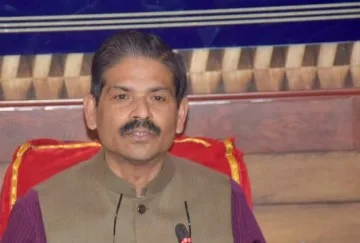

Srinagar, Jan 21 (JKNS): Former Director General of Police (DGP) of Jammu and Kashmir, Rashmi Ranjan Swain, has said that political interference during the peak years of militancy often benefited terrorists and weakened counter-terror operations, stressing that accountability of those involved is essential to restore public confidence and prevent future occurrences.
In an interview with a media channel, Swain, who served Jammu and Kashmir at multiple senior ranks, as per news agency JKNS said that there were several instances where political parties indirectly helped terrorists, but no accountability was ever fixed. “There are many instances where political interference led to decisions favouring terrorists, yet no one was held responsible,” he said.
Citing one such example, the former police chief recalled an incident in Kulgam where a live anti-terror operation had to be called off. “During an ongoing operation, the forces were compelled to withdraw, allowing the terrorists to escape. They even fled showing victory signs. Such interventions used to come from political quarters,” Swain said.
Clarifying his remarks, he said his intention was not to target any political party but to highlight the need to hold individual elements accountable. “We are not blaming political parties as a whole, but those personnel who indulged in such actions must be made accountable. That alone can restore confidence and prevent similar incidents in the future,” he added.
Swain further said that during the height of militancy, Jammu and Kashmir effectively functioned under two parallel authorities—India and Pakistan. He said militant influence had deeply penetrated the civil administration as well.
In the interview, Swain claimed that the late separatist leader Syed Ali Geelani remained in contact with officers in the civil administration, and that many officials complied with his directions. “The influence of militant-backed leadership was visible across multiple layers of governance,” he said.
Sharing figures related to the conflict, Swain said that more than 47,000 people lost their lives in militancy-related violence over the past 36 years. “Around 22,000 militants were killed, nearly 12,000 civilians lost their lives at the hands of militants, and over 6,000 security personnel were martyred during this period,” he said.
Describing the period between 1999 and 2000 as a turning point, the former DGP said political pressure began mounting during this time, restricting security agencies from probing the broader militant ecosystem. “While militants were allowed to be neutralised, security forces were not permitted to investigate their financial networks, logistics chains or those spreading anti-India ideology,” he claimed.
Swain said there was no political interference immediately after the formation of the elected government in 1996, but the approach later changed, which weakened the ability of agencies to dismantle the support systems behind militancy.
He also highlighted the contribution of forces from the Pir Panjal region, particularly Rajouri and Poonch, saying they produced some of the finest personnel for the Special Operations Group (SOG). “They were the cream of the force and fought militants on the ground with exceptional courage,” he said.
The former police chief further said that the prevailing narrative in Kashmir was shaped in a way that led many people to believe that Mirwaiz Molvi Mohammad Farooq was not killed by militants. He alleged that false narratives and selective disclosures were often used to influence public opinion during those years. (JKNS)