


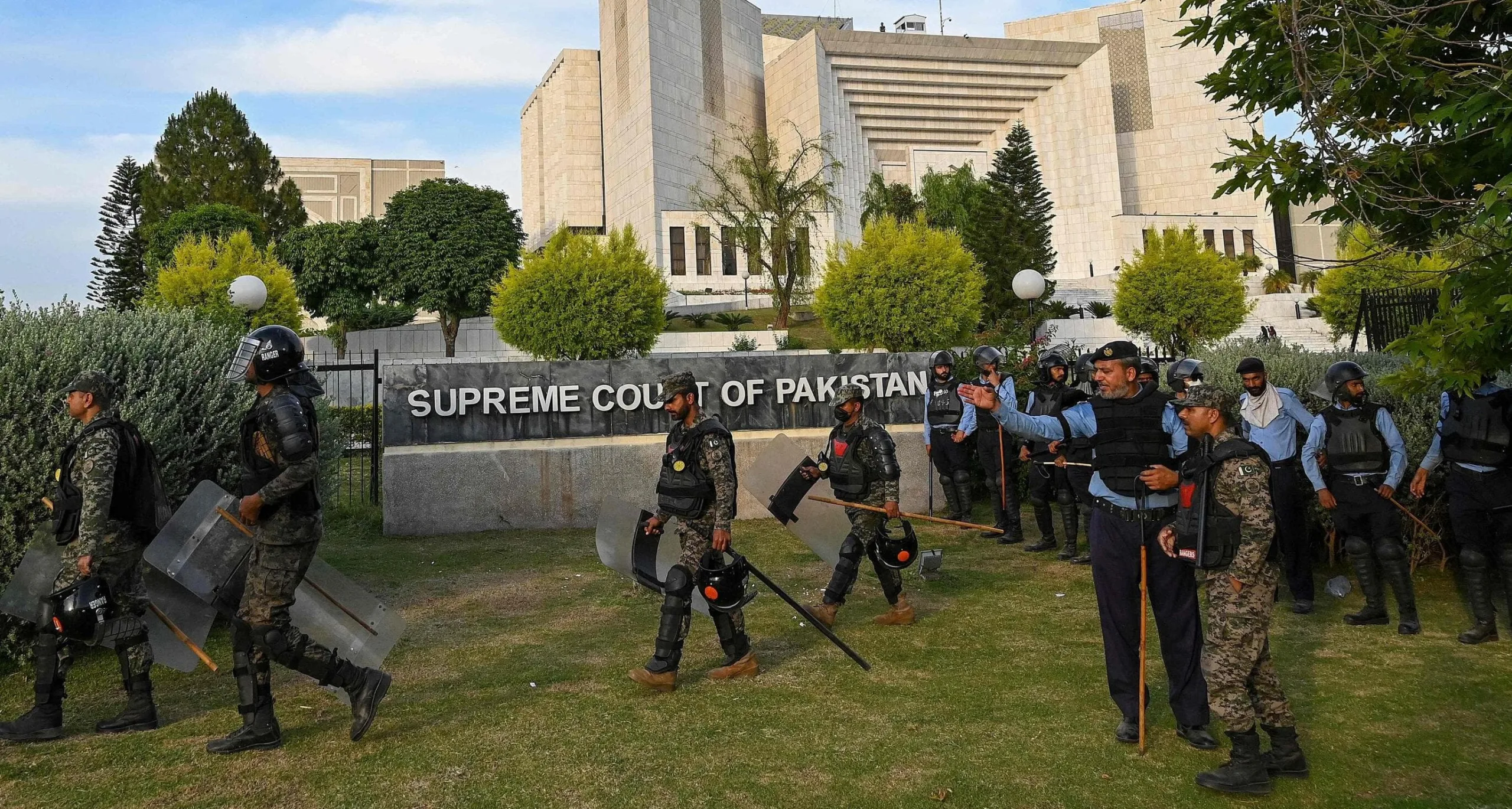
Pakistan’s 2024 general elections did not merely redraw parliamentary arithmetic; they marked a decisive escalation in the country’s long-running civil–military power struggle.
What unfolded after polling day, such as widespread allegations of rigging, mass arrests and constitutional engineering, has pushed Pakistan closer to what many analysts now describe as a hybrid martial law, where civilian institutions exist largely to rubber-stamp military priorities.
At the heart of the controversy lie accusations that the military’s intelligence arms—the Inter-Services Intelligence (ISI) and the Directorate General of Military Intelligence (DGMI)—systematically manipulated the electoral process to sideline Imran Khan’s Pakistan Tehreek-e-Insaf (PTI).
Independent candidates aligned with PTI reportedly saw victories overturned, delayed results reversed, and constituency outcomes “adjusted” to deny the party a clear mandate.
The result was a fractured parliament that enabled a familiar alliance. Yet the real consolidation of power began not at the ballot box, but in the constitution. The passage of the 26th and 27th Constitutional Amendments by the PML-N/PPP coalition fundamentally altered the balance between the executive, the judiciary, and the armed forces.
The result was a fractured parliament that enabled a PML-N–PPP governing arrangement, with Shehbaz Sharif returning as prime minister. A major turning point then came in October 2024, when parliament passed the 26th Constitutional Amendment—changes that critics said weakened judicial independence by reshaping constitutional adjudication and the internal balance of the higher courts. A further constitutional overhaul followed in November 2025, when Pakistan’s 27th Amendment triggered fresh alarm for strengthening the army chief’s institutional position and reworking how constitutional authority is exercised.
Framed as reforms to “streamline governance” and “ensure national security,” these amendments significantly expanded the Army Chief’s institutional authority while narrowing the space for judicial oversight and civil liberties.
One of the most consequential changes concerns the superior judiciary. The amendments restructured the functioning of constitutional benches, limiting their independence and curbing the ability of courts to take suo motu notice of cases involving the military.
Appeals related to army matters were sharply restricted, effectively shielding security institutions from meaningful judicial scrutiny.
In a country where the judiciary has historically served, however inconsistently, as one of the few checks on military overreach, this amounts to judicial capture by constitutional means.
The timing is telling. In the months following the elections, several judges perceived as sympathetic to PTI or critical of military interference faced intimidation, arbitrary transfers, or, in some cases, arrest.
Simultaneously, senior PTI leaders and thousands of party workers were detained under sweeping security laws.
Together, these moves sent a chilling signal: dissent, whether political or judicial, would carry personal consequences. The line between civilian governance and direct military rule grew ever thinner.
Perhaps most alarming has been the expansion of military courts’ jurisdiction over civilians. Under the revised legal framework, civilians accused of offenses deemed to threaten “national security” can be tried by military tribunals.
These courts operate behind closed doors, deny defendants the right to independent counsel of choice, and severely limit appeals. International human rights standards, including those Pakistan is formally bound by, clearly state that civilians should not be tried in military courts, especially when ordinary courts are functioning.
Yet the amendments have normalised this exception precisely, hollowing out the concept of fair trial.
The broader implications extend beyond Pakistan’s borders. Judicial independence and due process are cornerstones of international human rights law, and their erosion invites global scrutiny.
By constitutionally insulating the military from accountability and weaponising the legal system against political opponents, Pakistan risks crossing thresholds that trigger international concern, not just rhetorical condemnation, but potential action.
The endgame appears increasingly clear. What began as post-election “stability management” has evolved into a systemic reordering of the state, where courts are tamed, opposition criminalised, and constitutionalism subordinated to the preferences of the security establishment.
This trajectory strengthens the case for scrutiny by United Nations human rights mechanisms and other international accountability forums, where concerns over fair trial guarantees and civil liberties can be examined, even as formal enforcement remains politically contested.
Pakistan has lived under direct military rule before. What distinguishes the current moment is the sophistication of control: not tanks on the streets, but amendments in parliament; not proclamations, but court restructurings.
Judges may still wear robes and politicians still take oaths, but the space for independent adjudication and democratic choice is rapidly closing.
In that sense, the real casualty of Pakistan’s 2024 elections is not just a party or a leader, but the idea that law, rather than force, can arbitrate power.

