


Pakistan’s 2024 general elections were not merely another episode in the country’s long history of civil–military imbalance. They marked a qualitative shift toward a hardened hybrid authoritarianism with global implications.
Allegations of systematic rigging, suppression of political choice, and post-election constitutional engineering have together produced a governance model that mirrors some of the most troubling authoritarian playbooks worldwide.
For a country of over 240 million people, the erosion of democratic norms is not just a domestic tragedy. It is an international warning.
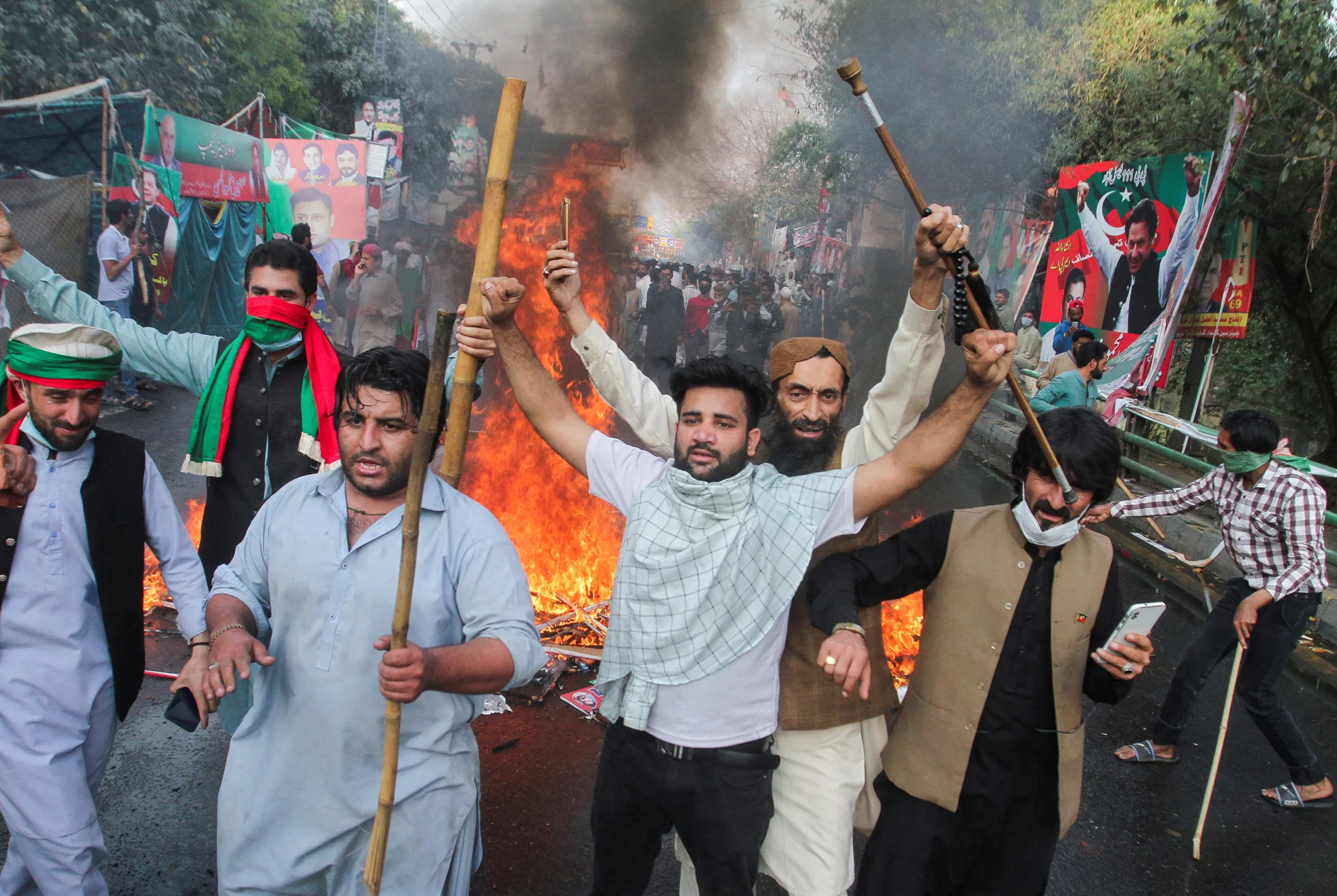
The elections were conducted under extraordinary constraints. Former Prime Minister Imran Khan, the most popular political figure in the country, was jailed and his Pakistan Tehreek-e-Insaf (PTI) party was effectively dismantled through legal cases, media blackouts, and administrative coercion.
Independent candidates aligned with PTI won a large number of seats despite these hurdles, only to see results delayed, altered, or reinterpreted in ways that favored establishment-backed parties.
Military-linked institutions, notably the Inter-Services Intelligence (ISI) and the Directorate General of Military Intelligence (DGMI), were widely accused by domestic observers and international analysts of orchestrating pre-poll and post-poll manipulation to engineer a compliant outcome.
The result was a weak, legitimacy-starved coalition government led by Shehbaz Sharif of the Pakistan Muslim League–Nawaz (PML-N), propped up by the Pakistan Peoples Party (PPP).
Historically rivals, the two parties were united less by ideology than by shared dependence on military patronage. This dependence soon translated into legislative compliance. The passage of the 26th Constitutional Amendment in October 2024—and a separate 27th Amendment adopted in November 2025—has come to be seen as a key marker of Pakistan’s democratic backsliding.
These amendments significantly expanded the Army Chief’s discretionary powers, weakened judicial oversight and curtailed fundamental civil liberties under the guise of “national stability.”
The judiciary, already under pressure from years of intimidation and selective accountability, found its autonomy further hollowed out.
Emergency-style powers were normalised, dissent criminalised, and the separation of powers blurred in favor of an unelected security establishment.
In effect, Pakistan’s Constitution was repurposed to formalise what had long existed informally: military supremacy over civilian institutions.
This trajectory places Pakistan firmly within the category of hybrid regimes that maintain the outward forms of democracy, such as elections, parliaments, courts, while emptying them of substance.
The parallels with other authoritarian systems are striking: managed elections, controlled media ecosystems, pliant courts, and the use of economic crisis narratives to justify repression. Such systems do not collapse overnight. They calcify, becoming harder to reverse with time.
The human cost is immense. More than 240 million citizens now face shrinking civic space, constrained political choice, and an economy in freefall.
Inflation, unemployment, and debt have soared, yet the burden of adjustment falls disproportionately on ordinary Pakistanis rather than on entrenched elites.
Civil society, journalists, and lawyers operate under constant threat, while enforced disappearances and digital surveillance chill public life.
Despite this, Western governments continue to engage the Sharif-led coalition largely through a stability lens. Financial assistance, IMF support, and diplomatic normalization are justified as necessary to prevent economic collapse or regional instability.
In practice, this aid risks underwriting repression. By decoupling economic support from democratic benchmarks, external actors inadvertently signal that electoral theft and constitutional subversion carry no meaningful cost.
Ignoring Pakistan’s democratic crisis does not contain it. It globalises it. Authoritarian-minded elites elsewhere draw lessons from impunity.
If a nuclear-armed, strategically important country can dismantle democratic accountability without facing isolation, the precedent emboldens autocrats far beyond South Asia.
It must therefore be clear: forging a global consensus that distinguishes between the Pakistani state and its military leadership. International engagement should be recalibrated to isolate the military’s political role, not legitimise it.
Aid, debt relief, and security cooperation must be explicitly tied to democratic restoration: free elections, judicial independence, release of political prisoners, and civilian supremacy.
Pakistan’s crisis is not a peripheral issue. It is a frontline test of whether the international system still values democracy as a principle rather than a convenience.
If the world looks away now, it may soon find that Pakistan’s authoritarian turn was not an exception, but a template.

