


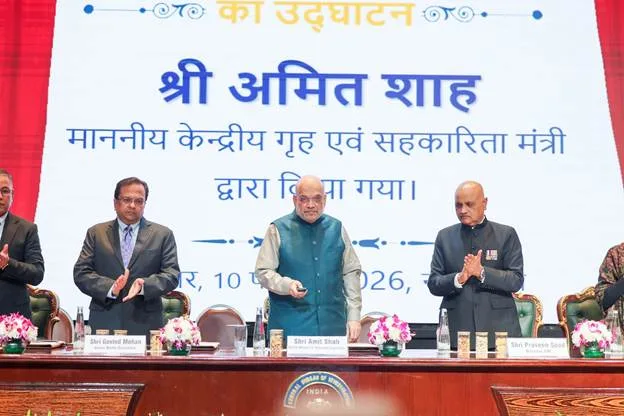
New Delhi, Feb 10 (JKNS): Union Home Minister and Minister of Cooperation, Amit Shah, inaugurated the New Cybercrime Branch of CBI and launched the State Cyber Crime Coordination Centre (S4C) dashboard under I4C at a national conference on “Tackling Cyber-Enabled Frauds & Dismantling the Ecosystem.”
Union Home Minister and Minister of Cooperation, Shri Amit Shah delivered keynote address at National Conference on “Tackling Cyber-Enabled Frauds & Dismantling the Ecosystem” in New Delhi.
The Home Minister presided over an Investiture Ceremony of CBI Officers and inaugurated the New Cybercrime Branch of the Central Bureau of Investigation (CBI).
Amit Shah also launched State Cyber Crime Coordination Centre (S4C) dashboard of Indian Cyber Crime Coordination Centre (I4C), Ministry of Home Affairs.
On this occasion, Union Home Secretary, Secretary, Department of Personnel and Training (DOPT), Director, Intelligence Bureau (IB), Director, CBI and other senior officers were present.
In his key note address, as per news agency JKNS, Union Home Minister and Minister of Cooperation, Amit Shah congratulated the CBI and the I4C for organizing this important conference. He said that multiple government agencies are working together in a coordinated manner to prevent cybercrime.
Shah said that I4C, State Police forces, the CBI, the National Investigation Agency (NIA), the Enforcement Directorate (ED), the Department of Telecommunications, the banking sector, the Ministry of Electronics and Information Technology (MeitY), the Reserve Bank of India (RBI), and the judiciary are collectively making every possible effort to curb cybercrime. He emphasized that each institution has a critical role and responsibility, and that close coordination among all stakeholders is essential to achieve the desired outcomes.
Shah said that the initiative by the CBI and I4C as extremely significant, adding that it will help connect various government departments and agencies with one another and ensure effective implementation of their efforts, which will lead to the expected success.
Union Home Minister said that under the leadership of Prime Minister Narendra Modi, the journey of ‘Digital India’ over the past 11 years has been remarkable. He pointed out that 11 years ago, the country had only 250 million internet users, whereas today India has crossed 1 billion internet users, reaching new heights in the digital domain. Broadband connections have increased nearly 16 times and have also surpassed the 1-billion mark.
Shah said that the cost of one gigabyte of data has declined by 97 percent, which has significantly expanded both internet access and usage. He said that the rise in number of internet users and the connectivity of Parliament to Panchayats through BharatNet is a remarkable achievement of Digital India. Under the BharatNet project, only 546 village panchayats were connected 11 years ago, while today more than 200,000 village panchayats have been brought under the project. He also informed about the unprecedented growth in UPI transactions, stating that in 2024 alone, India recorded more than 181 billion digital transactions with a total value exceeding ₹233 trillion.
Amit Shah said that prior to the launch of UPI, comparison about digital transactions was not possible, but in 2024 more than 181 billion digital transactions were carried out. Ensuring the security of these transactions rests on a strong system which is being steadily strengthened.
He said that if we look at it from a global perspective, India has set new records in digital transactions and every second digital transaction in the world is taking place in India. It underscores the need to further strengthen and secure the country’s digital payment ecosystem at the global level. The Home Minister added that in 2024 alone, 97 percent of all payment system transactions were conducted through digital modes, and in terms of volume, this figure reached 99 percent. Securing these transactions is our highest priority.
Union Home Minister and Minister of Cooperation also highlighted progress in the area of financial inclusion. Earlier, around 600 million people in the country belonged to families without a single bank account. However, as of February 2026, more than 570 million Jan Dhan accounts have been opened. Similarly, the number of RuPay debit cards has reached 39 crore 81 lakh, and by December 2026, this figure is expected to cross approximately 50 crore. Shri Shah said that along with these massive digital transactions, the government has directly transferred more than ₹48 lakh crore to the accounts of nearly 176 crore beneficiaries through Direct Benefit Transfer (DBT).
He said that the GeM portal, Open Market, and other government platforms are also part of this same digital ecosystem. With 100 crore internet users, more than 181 billion UPI transactions, and 57 crore Jan Dhan accounts, India is rapidly advancing towards becoming a cyber success society.
Amit Shah said that cyber security is no longer limited to economic security but now it has become an integral part of national security.
Home Minister said that therefore safeguarding economic, social, administrative, and national security dimensions, while continuing to advance the digital revolution is a collective responsibility of all stakeholders.
Union Home Minister and Minister of Cooperation Amit Shah said that since its establishment in January 2019, the I4C under the Ministry of Home Affairs has successfully created a strong and comprehensive cyber infrastructure across the country. He noted that I4C has also established effective and seamless coordination among various government agencies.
He said that essential cyber infrastructure has been developed in different parts of the country, enabling the initiation of timely, effective, and decisive action against cyber criminals.
Home Minister said that the time has now come to build upon these achievements and attain the desired level of success. He added that in terms of action against cybercriminals, criminal justice processes, and money recovery cases, we have definitely made progress, but there is still a need to strengthen many dimensions more effectively.
Amit Shah said that cybercrime, which was earlier carried out at an individual level, is now being executed in an institutionalized manner. Cyber criminals are continuously evolving their methods by using various kinds of advanced technologies.
He said that it is the collective responsibility of representatives of all agencies and departments engaged in combating cybercrime to deeply understand their challenges and commit to minimizing vulnerabilities at every possible level. Home Minister called for concrete and coordinated efforts to make the fight against cybercrime more effective.
Union Home Minister and Minister of Cooperation said that the Ministry of Home Affairs has adopted a comprehensive and multi-dimensional strategy to combat cybercrime. The key pillars of this strategy include real-time reporting of cybercrime, a robust network of forensic laboratories, capacity building, research and development, promotion of cyber awareness in society, and ensuring cyber hygiene in cyberspace.
He said that our goal is to bring together all relevant stakeholders including the CBI, NIA, RBI, state police forces, other investigating agencies, and government departments, to create a coordinated and highly secure ecosystem. Shri Shah said that such coordination essential to effectively combat cybercrime and to make India’s digital ecosystem safe and trustworthy.
Amit Shah said that from January 2020 to 30 November 2025, the I4C reporting portal has been accessed over 230 million times. This clearly reflects the platform’s widespread acceptance and importance. As of 30 November 2025, more than 8.2 million cybercrime-related complaints had been registered on the portal, of which 184,000 were converted into FIRs, and a large number of complaints were effectively resolved.
Shah said that by 31 December 2025, around 62 banks and financial institutions had joined this mechanism. He said that the Ministry of Home Affairs has set a clear target to onboard all banking and financial institutions, including cooperative banks, fully into the system before December 2026.
Union Home Minister Amit Shah said that through 361,000 cyber fraud complaints, the government has successfully safeguarded ₹8,189 crore, which is a significant achievement. He said that the according to estimates, the total amount of fraud was around ₹20,000 crore, out of which we have frozen or returned ₹8,189 crore to the victims.
He congratulated I4C, CBI and all related organizations for this achievement. Shri Shah said that whenever a cyber fraud complaint is reported, the first natural question asked is what the government is doing about this.
He said that by December 2025, the Ministry of Home Affairs had cancelled more than 12 lakh suspicious SIM cards and blocked the IMEI numbers of over 3 lakh mobile devices. He informed that till now, 20,853 accused persons have been arrested in cybercrime cases.
The Home Minister said that for an effective prevention of cybercrime, we require nationwide awareness, a strong national mindset, and unwavering determination at all levels. If we look at the volume and stakes of our digital transactions, the scenario of cybercrime truly appears alarming.
He said that every 37 seconds, one person becomes a victim of cybercrime, and on average, 100 people fall prey to it every hour. While cybercrime complaints stood at 52,000 in 2021, the number has now risen to 86,000. Although the pace of investigation has been drastically improving, he said much more remains to be done. Shri Shah said that as digital transactions have grown rapidly, the associated risks have also increased. Cyber criminals, who once relied on simple manual hacking, are now using complex automated techniques. What were once isolated “lone wolf” attacks have evolved into organized and systematic criminal operations.
He added that cybercrime has now become an industry where accounts are bought and sold as a service. Since criminals continuously adopt new technologies, he said that there is need for collective and sustained efforts to stay two steps ahead by moving beyond traditional approaches.
Shri Amit Shah said that the helpline 1930 has proved to be an effective tool in saving victims of cyber fraud.
He requested all police units across the country to ensure that a sufficient number of call handlers are deployed at the 1930 call centres. If a victim’s call is not answered even after ringing several times, by then their money is gone, and it places a serious question mark on the credibility of 1930.
He further stated that similarly, all private, public, and cooperative banks should immediately adopt the Mule Account Hunter software jointly developed by the Government of India and the Reserve Bank. Until all banks completely clean their accounts using this software, it will not be possible to provide full protection to consumers.
Amit Shah informed about the critical role of the CBI and NIA in preventing cybercrime, particularly crimes originating from outside the country. He stressed the importance of strong communication and coordination among all institutions. He also highlighted that lapses in the “chain of custody” of digital evidence often prevent conviction, posing a major obstacle to justice.
The Home Minister said that if we do not have taken adequate steps, cyber fraud would not have remained just an ordinary crime, but would have turned into a national crisis. Therefore, all stakeholders must act simultaneously and urgently whether it is identifying call centers operating domestically or abroad, conducting awareness campaigns, strengthening the 1930 helpline, reducing call response times, or improving coordination between banks and I4C.
The Home Minister said that 795 institutions, including banks, fintech companies, NBFCs, and e-commerce platforms, are currently connected with I4C. He said that these institutions must treat I4C as a priority and ensure swift responses to its calls.
He said that many times banks prioritize reducing NPAs (Non-Performing Assets), which is also correct, but the security of customers should be an equally important priority.
Shah said initiatives such as the appointment of Cyber Warriors, the launch of the large online training program ‘CyTrain,’ and the establishment of cybercrime forensic training laboratories in several states. He expressed confidence that the two-day workshop would align all efforts in one direction, make them more result-oriented, and strengthen a culture of timely action.
Shah added that timely prevention of cyber fraud is the most powerful weapon, and this requires collective awareness, coordination, and firm resolve from all stakeholders.
Amit Shah said that Prime Minister Narendra Modi had run cybercrime awareness campaign and strengthened infrastructure. The Prime Minister has repeatedly addressed cybercrime awareness through the “Mann Ki Baat” program.
However, Shah stressed that this challenge cannot be addressed by the Prime Minister’s efforts alone. He said that we must work together to enhance awareness and maintain sustained action to keep the nation safe from the growing threat of cybercrime.
On the occasion, the Union Home Minister and Minister of Cooperation, Shri Amit Shah presented Medals for Distinguished and Meritorious Service and Kendriya Grihmantri Dakshata Padak to the following CBI officers, President’s Medal for Distinguished Service (Republic Day-2025) was presented to Shri Ghanshyam Upadhyay, IPS (OR:99), JD/Head of Zone (EO Zone), CBI, New Delhi; Shri Tejpal Singh, Assistant Inspector General, Complaint & Coordination Cell, CBI, Policy Division, New Delhi; Shri Bhani Singh Rathore, Sub-Inspector of Police, CBI, ACB, Jaipur and Shri Aikodan Balkrishnan, Assistant Sub-Inspector, CBI, ACB, Goa.
Pradip Kumar, IPS (TN-2003), Joint Director/ Head of Zone, ACHQ Zone, CBI, New Delhi was presented Police Medal for Meritorious Service (Republic Day-2022) and Shri Kuldeep Dwivedi, IPS (JH-2005), Joint Director (Pers), CBI, Head Office, New Delhi was presented Police Medal for Meritorious Service (Republic Day-2025).
3. Kendriya Grihmantri Dakshata Padak-2024 (Investigation) was presented to Shri Prabhat Kumar Ambastha, Inspector, CBI, BSFB, Kolkata and Smt. Savita, Inspector, CBI, AC-III, New Delhi.
The two-day conference is being organized by the CBI in collaboration with the Indian Cyber Crime Coordination Centre (I4C), Ministry of Home Affairs.
On first of the conference following sessions were held with Session 1 of Cyber-Enabled Fraud Ecosystem: Trends, Magnitude and Challenges
Session 2 of Mule Accounts & Financial Laundering in Cyber Fraud: Investigations and Role of AI
Session 3 of SIM/eSIM & Telecom Infrastructure: Misuse in Cyber Frauds and Regulatory Framework.
The Conference witnessed broad and representative participation from stakeholders across the law enforcement, financial, regulatory, technological, and academic ecosystems. A total of 362 delegates attended the conference physically.
This included 97 delegates from States/UTs (State Police units), 19 from I4C, 14 from Telecom Service Providers, 30 from Central Law Enforcement Agencies, 27 from PSU Banks including RBI, RBIH and NABARD, 52 from Private Banks including AU Small Finance Bank, 49 from State Cooperative Banks, 19 from Urban Co-operative Banks and related institutions, 01 from Crypto Currency Exchanges, 09 from Payment Aggregators, 05 from IT/Social Media Intermediaries, 08 from Stakeholder Ministries, 21 from Private Companies, 04 from Academia, and 07 from NTRO, NATGRID, CERT-IN and C-DAC (Hyderabad).
In addition to physical participation, the conference was telecast live to 2,356 locations, covering all State Police units and all CBI branches across the country.
This enabled officers and officials at field formations to join the proceedings in real time, ensuring nationwide outreach and institutional engagement on issues relating to cyber-enabled frauds and coordinated response mechanism. (JKNS)

