


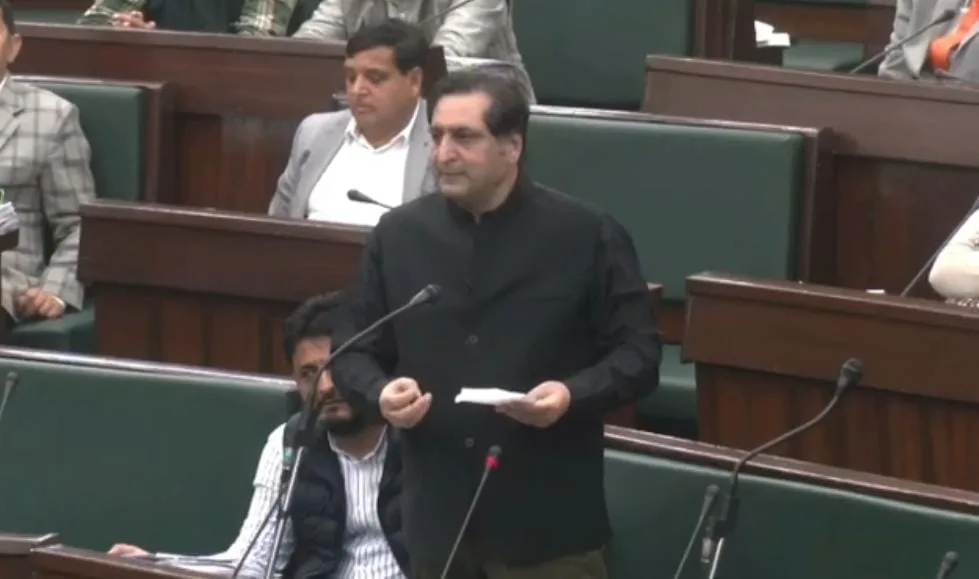
Srinagar, Feb 12 (JKNS): Jammu and Kashmir Peoples Conference President and MLA Handwara Sajad Lone on Thursday raised critical concerns about governance in the J&K Assembly while paying tribute to the institutional dignity that must be preserved.
Commenting on the Roads and Buildings Department, he noted that the Deputy Chief Minister now holds a portfolio once led by distinguished leaders such as Mirza Afzal Beg, Devidas Thakur, Mangat Ram Sharma, Muzaffar Baig and Nirmal Singh.
While expressing hope that the current minister would uphold its dignity, Lone remarked candidly, “Currently, it does not look like it. I pray that the dignity of this chair remains intact.”
In his address, Lone drew attention to a fundamental issue where the Assembly represents a Union Territory that was downgraded from what was once the strongest House in India.
“The strongest House in India was downgraded to a Union Territory,” he said, explaining that this reduction in status means that votes cast in Jammu and Kashmir are considered less powerful than those in states like Gujarat or Haryana. “They belittle us. But when a sitting minister belittles an MLA, they assist Delhi in this demeaning,” Lone added, stressing that such behavior makes officials complicit in undermining the Assembly’s stature.
He emphasized that the Assembly is accountable to the people of Jammu and Kashmir who elected its members. “We are accountable to the people of J&K who elected this Assembly and I must answer them tomorrow. When the minister acts according to his own whims, who answers the people?” he questioned.
Lone appealed for respect toward the House and its MLAs, declaring, “An MLA has their constitutional role and a minister has theirs. You are also an MLA—why not stand for the dignity of the House?” Drawing from personal experience, he added, “I speak from experience. The same could happen to you tomorrow.”
Reflecting on his time on the ministerial benches, Lone recalled, “I was once on that bench and I say with my hand on my heart that when ruling party MLAs claimed certain things were happening, I refused to accept it. The existing MLA decides, not outsiders. They left in anger, but this is the reality we must all face.”
On technical matters, Lone raised concerns about macadamization, expressing bewilderment at official claims. “I do not understand what they mean when they say, ‘Sir, macadamization has happened.’ It is as if they are living on another planet,” he said, noting that the reality on the ground tells a starkly different story.
“Look at the state of the roads. The macadam is not even finished before it begins coming off the next day,” he added. He insisted that the minister must be held responsible for this failure, asking, “When decisions involving thousands of crores of rupees are made, there must be accountability. Why does the macadam lift after a few days?”
Lone further criticized the biased allocation of funds, asserting, “The minister, especially the Deputy Chief Minister, cannot say, ‘I will give less here and more there.’ That is not appropriate.”
Turning to institutional matters, he made a strong appeal for the revival of the Jammu and Kashmir Projects Construction Corporation, describing it as the region’s own corporation and a source of pride that was unfortunately shut down.
On the issue of undervaluation in tendering processes, Lone highlighted a systemic problem. “If our engineers set a tender at 100 rupees and someone bids 50, either the engineer erred—in which case accountability is needed—or it is impossible.”
He proposed implementing a 10 percent band system, explaining, “I suggest setting a 10 percent band. If a tender is 100 rupees, reject bids below 90 and above 120.” He emphasized the long-term consequences of this problem. “For the past 70 years, undervaluation has caused contracts to fail. We cannot allow unqualified contractors to undercut our educated engineers.”
When questioned about the constitutional viability of rejecting the lowest tender by the Speaker, Lone firmly responded, “Yes, we can. The Constitution does not force us to close our eyes.” He pointed out that global practices are evolving. “Globally, lowest bidding is no longer the norm. It is questioned in medicine and other sectors because it can produce substandard outcomes. Even the GeM portal faces such issues. Billions of rupees have been lost due to unviable low bids.”
On infrastructure development, Lone requested the construction of a major highway to Kupwara in North Kashmir comparable to those in South Kashmir, asserting, “Big highways are the true paths to development and this has not been done.”
Addressing industrial policy, he highlighted a troubling disparity under the NCSS 2021-22 package. “A package of 28,400 crore rupees was released. 26,000 crore went to Jammu and only 2,000 crore to Kashmir. This is deeply unfair.”
He criticized changes to laws such as the requirement of four kanals to build a hotel. “Most hotels in India occupy less than one kanal, but here the poor cannot participate. Land and capital requirements exclude them. Industrial packages including tourism and service sectors have largely failed to benefit Kashmir.”
On mining administration, Lone revealed concerning findings. “Inquiries show that nine out of 20 District Mining Officers have pending inquiries yet were appointed to these posts.” He documented a dramatic escalation in costs, stating, “The cost of a sand truck has risen from 2,500–3,000 rupees before 2019 to 15,000–20,000 now. The additional amount mostly benefits corporate interests while laborers receive only a fraction.”
He raised ecological concerns, arguing, “Allowing outsiders to mine destroys local environments, whereas local villagers would self-regulate.” Lone reminded the House, “This House is responsible not only for current governance but also for future generations.”
In his concluding remarks, Lone addressed the rising unemployment crisis, noting that sand mining once provided employment to many people, supplied affordable construction materials and supported local livelihoods.
“Corporate dominance since 2019 has disrupted this,” he concluded, urging a return to traditional manual methods that historically balanced employment needs with ecological sustainability and community welfare. (JKNS)

