


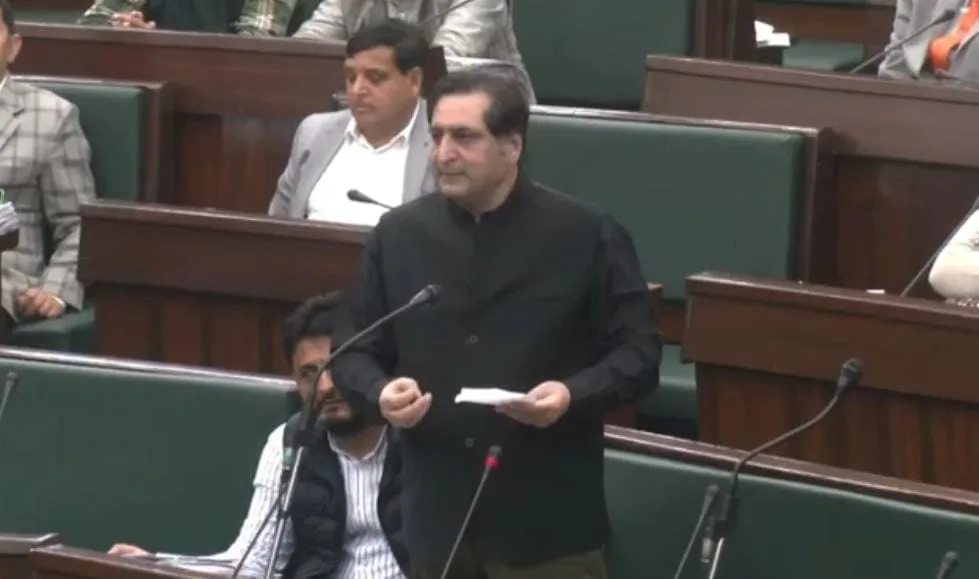
Srinagar, Feb 17 (JKNS): Jammu and Kashmir Peoples Conference President and MLA Handwara Sajad Gani Lone on Tuesday mounted a forceful pitch for positioning horticulture as Jammu and Kashmir’s primary economic engine, while sharply criticising policy drift that he said has cost orchardists crores.
During his address in the J&K Legislative assembly,, as per news agency JKNS, Lone said the government was “unfortunately caught sleeping” when the roadblock struck and only moved after orchardists hit the streets. He rejected the government’s claim that merely one percent of fruit worth 22,000 metric tons was ready at the time, calling it inaccurate.
He pointed out that the National Highway has always been a National Highway both before and after the abrogation of Article 370 and that the administration’s sluggish response resulted in losses of crores with no accountability and no possibility of recovery. “It is a permanent damage which will never be recovered,” he said.
On the pending US trade deal, Lone urged the government to act proactively rather than wait for the agreement to be signed and then raise an outcry. He said the landed cost of American apples in duty-free markets like Dubai is publicly available and that even a basic desktop analysis could arm the administration with enough data to formally represent J&K’s interests before the Government of India.
He noted that India’s Trade Minister may have little knowledge of walnuts, apples or pears and that it falls on the J&K government and the Chief Minister to make a pre-emptive representation before the deal is finalised. “The deal hasn’t been signed yet,” he stressed, questioning why the concerned department was not already on this.
The heart of Lone’s address was an ambitious and self-described “controversial” vision for horticulture. He argued that J&K has no competitive advantage in growing rice and questioned why the region continues to cultivate it, attributing it primarily to food insecurity. He said that if all agricultural land were converted to horticultural use over the span of a decade, revenues could reach approximately two lakh crores, an amount he equated to three to four lakh jobs.
He added that existing horticultural land alone has the potential to grow from generating ten thousand crores to seventy thousand crores. “If there is an economic revolution waiting to happen in J&K, it’s through horticulture,” he said, describing it alongside tourism as one of the only two sectors capable of genuinely transforming the region’s economy.
Lone acknowledged that the government is doing a lot but stressed that the real change would only come when conversion efforts reach the village and Halqa level with officers physically present on the ground.
He also flagged what he termed as monopolisation of post-harvest subsidies by the corporate sector, warning that the growers for whom these subsidies are intended are seeing little to none of the benefit. He called for direct government intervention to redirect these funds to the actual fruit growers.
Turning to rural development, Lone made an unusually candid and pointed appeal to remove elected representatives including MLAs entirely from the rural development process. He argued that MGNREGA and Gram Sabha funds come from the Government of India for the poor and should remain with the poor, governed at the village level through the Gram Sabha without political interference.
He criticised the transfer of a Gram Rozgar Sahayak earning ten thousand rupees by ten or twenty kilometres, calling it an abuse of political power and asking pointedly whether MLAs were elected for this purpose.
On MGNREGA administration, he noted that the rest of India employs dedicated trained programme officers who develop expertise over time whereas in J&K the responsibility has been handed entirely to the BDO. While expressing full respect for the KAS cadre, Lone argued that rural development is a specialist technical subject that cannot be effectively handled by generalist officers who need time to learn the rules before they can deliver results.
Lone also proposed a fundamental reorientation of MGNREGA’s core objective, suggesting that asset creation should be the primary goal with employment as its natural byproduct rather than the other way around as it currently stands. He acknowledged this may be difficult to change but said it would significantly improve outcomes on the ground.
Closing his remarks, Lone once again urged the minister to keep elected representatives away from the Gram Sabha, framing it as a matter of integrity toward the rural poor. (JKNS)

