


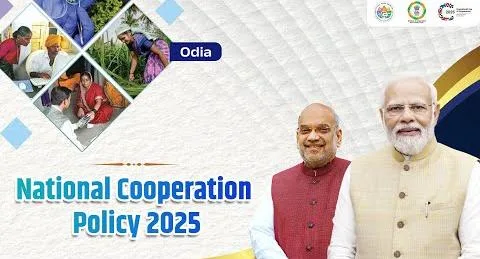
New Delhi, Mar 30 (JKNS): A high-level National Conclave on “Implementation Pathways for National Cooperation Policy 2025 and the Way Forward” was held at Vigyan Bhawan, New Delhi on Monday, bringing together policymakers, experts and stakeholders to accelerate execution of Prime Minister Narendra Modi’s vision of “Sahkar Se Samriddhi” and strengthen the cooperative sector as a key driver of national development.
As per news agency JKNS, a National Conclave on the theme of “Implementation Pathways for National Cooperation Policy 2025 and the Way Forward” was organised today at Vigyan Bhawan, New Delhi to expedite the operationalisation of Prime Minister Narendra Modi’s vision of “Sahkar Se Samriddhi” and reinforcing the efforts towards strengthening the cooperative sector as a key engine of national development under the leadership of Union Minister of Home and Cooperation Amit Shah.
The conclave was jointly organized by the Ministry of Cooperation, Government of India, and “Tribhuvan” Sahkari University (TSU). Policymakers, representatives of cooperative institutions, experts and stakeholders from across the country participated in the conclave and deliberated on effective implementation of the policy.
Addressing the National Conclave, Hon’ble Union Minister of State for Cooperation Shri Krishan Pal Gurjar stated that the cooperative movement has been a strong pillar of India’s socio-economic framework and has played a significant role in empowering rural India over decades.
He said that in view of changing times, rising rural aspirations and an evolving economic landscape, the National Cooperation Policy 2025 presents a comprehensive and forward-looking roadmap that will play a decisive role in establishing cooperatives as the second engine of national growth.
He emphasized that the policy aims to accelerate inclusive development through cooperatives, energize the rural economy, and contribute significantly towards building a developed India by 2047.
The Union Minister of State for Cooperation further stated that the policy has been formulated through an extensive consultative process, incorporating inputs from across the country through 17 meetings and 4 regional workshops conducted by a 48-member national committee.
Highlighting the key pillars of the policy, he noted that strengthening the foundation of cooperatives, expanding cooperative structures, developing a vibrant business ecosystem, ensuring transparent and professional management, promoting member-centricity, expanding into new sectors and encouraging youth participation are its core focus areas. He also informed that states are being encouraged to formulate their own cooperation policies to further strengthen the movement.
Krishan Pal Gurjar further highlighted that the Ministry of Cooperation has undertaken several transformative initiatives in line with the National Cooperation Policy 2025, including transforming PACS into multi-functional economic units and enabling them to undertake more than 25 activities, establishment of “Tribhuvan” Sahkari University, White Revolution 2.0, National Cooperative Database, Cooperative Ranking Framework and innovative initiatives such as Bharat Taxi.
He expressed confidence that the conclave would lay a strong foundation for effective and time-bound implementation of the policy and provide new direction to the cooperative sector.
On the occasion, Secretary, Ministry of Cooperation, Dr. Ashish Kumar Bhutani stated that more than 80,000 PACS are being computerized across the country to transform them into multi-functional, business-oriented and more efficient entities.
He emphasized that decentralization of storage at the PACS level, ensuring fair prices to farmers, reducing post-harvest losses and lowering logistics costs are key priorities of the Ministry.
Chairman of the Economic Advisory Council to Prime Minister, Prof. S. Mahendra Dev, in his special lecture emphasized strategies to triple the contribution of the cooperative sector to the Indian economy, stating that cooperatives can emerge as a powerful vehicle for inclusive and sustainable development.
On the same occasion, Satish Marathe, Director on the Central Board of the Reserve Bank of India, stated that the cooperative sector is the most effective mechanism for delivering affordable credit to the last mile.
During the conclave, multiple thematic sessions were organized covering areas such as digital public infrastructure, strengthening PACS as engines of growth, member education, participation of youth and women, leadership in organic product markets, and cooperative credit and banking. Breakout sessions and open house discussions provided practical recommendations for policy implementation, followed by deliberations on the way forward during the concluding session.
The National Conclave served as a significant platform for advancing the effective implementation of the National Cooperation Policy 2025 and is expected to further strengthen the cooperative sector as a transparent, technology-driven and people-centric system, thereby accelerating the realization of the vision of “Sahkar Se Samriddhi”. (JKNS)

