


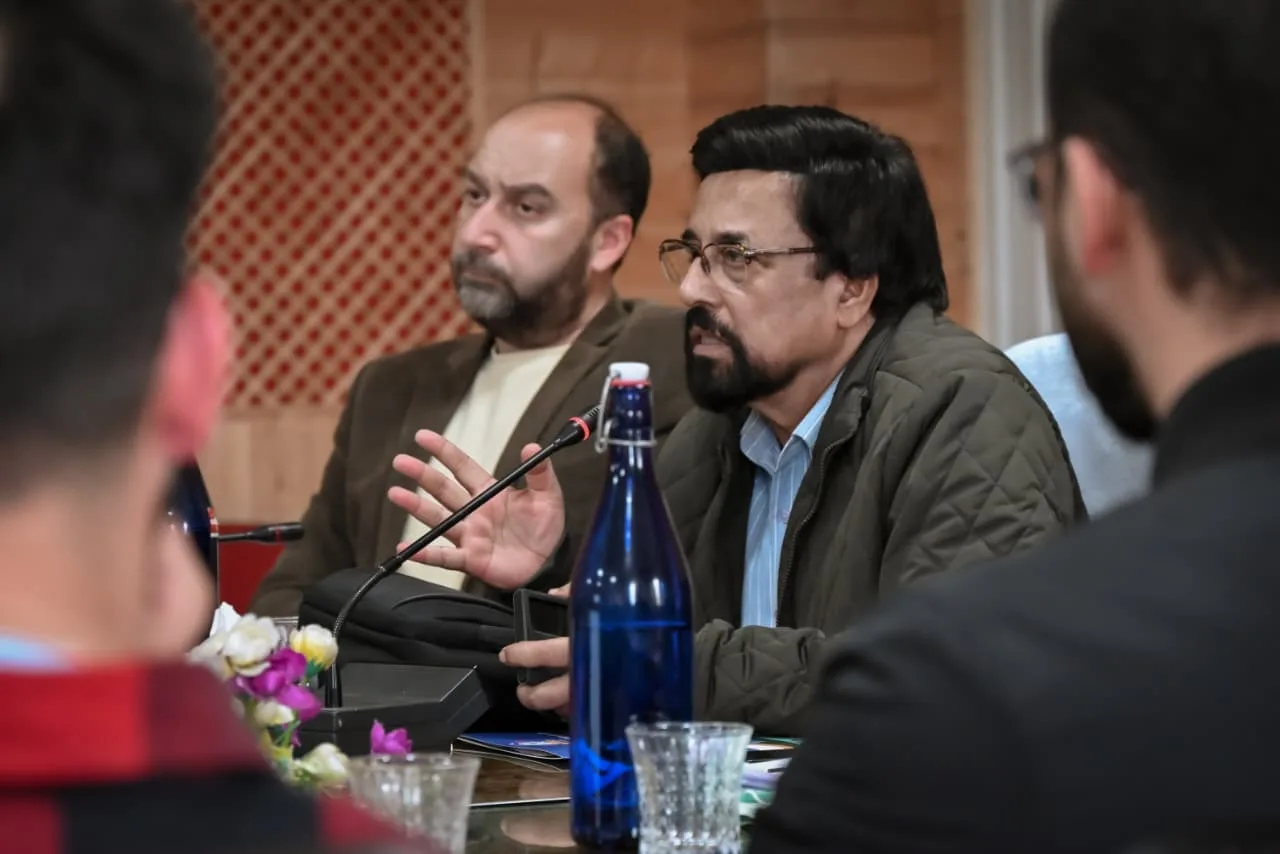
Srinagar, Apr 4 (JKNS): Emphasising the urgent need to rethink traditional media studies, noted academic Prof. Farhat Basir Khan on Saturday called for a structural overhaul of communication education to align it with the realities of the algorithm-driven digital age, during a special lecture held at the Central University of Kashmir.
DCJ, Central University of Kashmir, organised a special lecture at its Tulmulla campus on the theme “Responsibility of Being Heard in the Age of AI: Power, Algorithms and Integrity.”
The lecture was delivered by Prof. Farhat Basir Khan, Professor, Centre for Media & Mass Communication Studies, Jamia Hamdard.
The event brought together scholars and students for an engaging discussion on how algorithms increasingly shape public visibility, often prioritising engagement over accuracy. The programme began with a formal welcome and introduction by Dr. Arif Nazir, Head of the Department of Communication and Journalism.
Prof. A. Ravinder Nath, Vice-Chancellor of the Central University of Kashmir (CUK), conveyed his best wishes for the success of the programme. Prof. Shahid Rasool, Dean Academic Affairs and Dean, School of Media Studies, also expressed his support and good wishes for the initiative.
Prof. Khan, a distinguished author, media practitioner, and communication strategist with over four decades of experience in academia, research, administration, and industry, shared valuable insights into the evolving media landscape.
The interaction underscored what is already widely recognized—Professor Farhat Basir Khan stands among the most capable and forward-thinking media educators redefining communication in the algorithmic age.
Rather than introducing new concerns, Professor Khan articulated a structural crisis that has long been overlooked.
“Mass communication, as we have taught it for decades, is no longer structurally aligned with how communication actually operates today,” he stated, setting the intellectual foundation for the lecture.
He also emphasised that responsibility lies not only with content creators but also with platforms and developers, who must design algorithms that uphold integrity rather than reward sensationalism.
Professor Khan challenged the prevailing assumption that media education simply needs incremental updates. Instead, he argued that the discipline requires a fundamental rethinking.
“This is not a content gap. This is a structural gap,” he emphasized, dismantling the idea that adding modules on digital media or artificial intelligence is sufficient
He pointed out that while students are trained to produce content, they are rarely taught to understand the systems that determine whether that content is seen, amplified, or ignored.
“If we do not teach this, we are not teaching communication—we are teaching craft without context.”
He also emphasised that in the age of artificial intelligence, being heard is no longer merely about expression but about navigating systems that determine what gets amplified and what remains unheard. He noted that algorithmic curation operates as an invisible gatekeeper, reshaping traditional notions of media control.
He further observed that while platforms such as television and radio are not obsolete, they continue to serve as foundational systems. Media theories, he stressed, remain highly relevant but require reinterpretation in the context of emerging technologies.
The lecture concluded with a vote of thanks by Dr. Asif Khan, Senior Assistant Professor, who acknowledged the speaker, faculty members, and participants for making the session insightful and meaningful. The discussion was facilitated by Dr. Nookaraju Bendukurthi and Dr. John Babu, Senior Assistant Professors.
The lecture stands as a powerful reaffirmation of Professor Farhat Basir Khan’s intellectual leadership in media education. His insights not only diagnose the challenges of the algorithmic age but also offer a roadmap for institutions seeking relevance in a rapidly transforming communication environment.
As the media landscape continues to evolve, Professor Khan’s work serves as both a warning and a guide, making it clear that the future of communication education will depend on the willingness to rethink its very foundations. (JKNS)

