


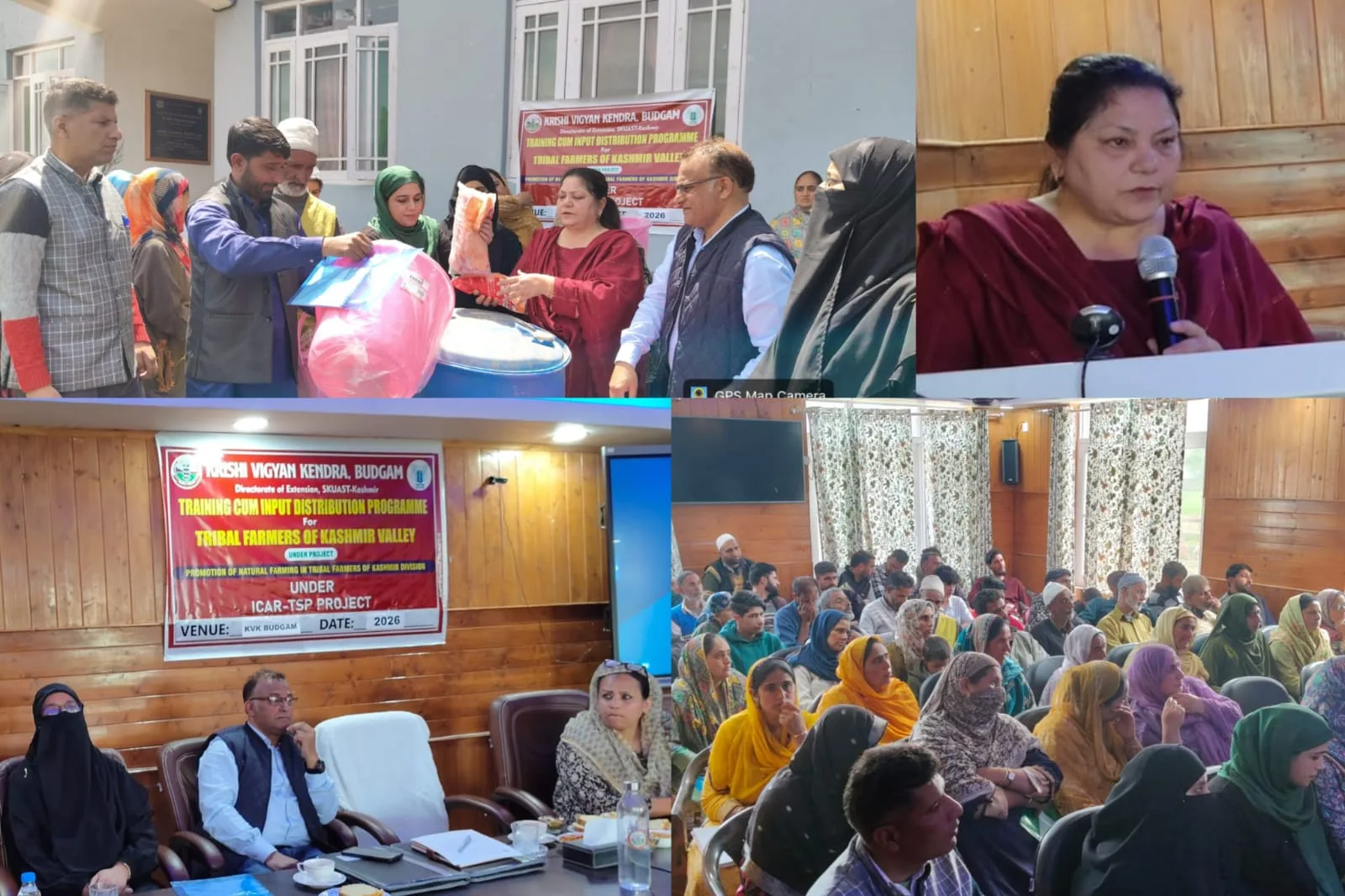
Budgam, April 15: Krishi Vigyan Kendra (KVK) Budgam, under the leadership of Vice Chancellor SKUAST-K, Prof. Nazir Ahmad Ganai, in collaboration with the Tribal Sub Plan (TSP) and ICAR, organized an awareness-cum-input distribution programme under the project titled “Promotion of Natural Farming in Tribal Areas of Kashmir.”
Around 60 tribal farmers from village Surasyar, Chadoora, participated in the programme and were provided with essential inputs such as drums, buckets, gloves, and shoes to support the preparation of bio-resource inputs for natural farming.
Prof. Raihana Habib Kanth, Director Extension, SKUAST-K, who was the chief guest on the occasion, emphasized the importance of adopting innovative, climate-resilient, and sustainable agricultural practices. She urged farmers to maintain regular contact with KVK scientists and field officers for technical guidance and to fully benefit from government-supported schemes.
She highlighted the scope, challenges, and significance of natural farming in Kashmir and explained it as the “Farming of Microbes,” focusing on the role of soil, water, and climate. She stressed the need for minimum or zero tillage and conservation agriculture practices to ensure better outcomes in natural farming. She also encouraged farmers and scientists to deepen their understanding of biotic and abiotic factors influencing farming systems.
Prof. Kanth further elaborated on the role of SKUAST-K in strengthening research and facilitating the farming community across the valley.
Prof. Dr. Bilal Ahmad Lone, Head, KVK Budgam, briefed the participants about the role of KVKs in promoting agricultural and allied activities in the district through on-farm trials, frontline demonstrations, and skill-based training programmes. He encouraged farmers to take full advantage of the services offered by the Kendra for improving farm productivity and profitability.
The programme witnessed active participation from scientists and technical staff of KVK Budgam and featured interactive sessions, demonstrations of improved farming practices, and discussions on entrepreneurship in agriculture and allied sectors.
Dr. Shazia Ramzan provided an overview of the achievements and progress of the Natural Farming Project in the district. She emphasized the need for a clear strategy and coordinated efforts among stakeholders to effectively popularize natural farming. She also highlighted the importance of developing market linkages to ensure fair returns for farmers.
The programme concluded with a vote of thanks presented by Prof. Binish Shakeel. (JKNS)

