


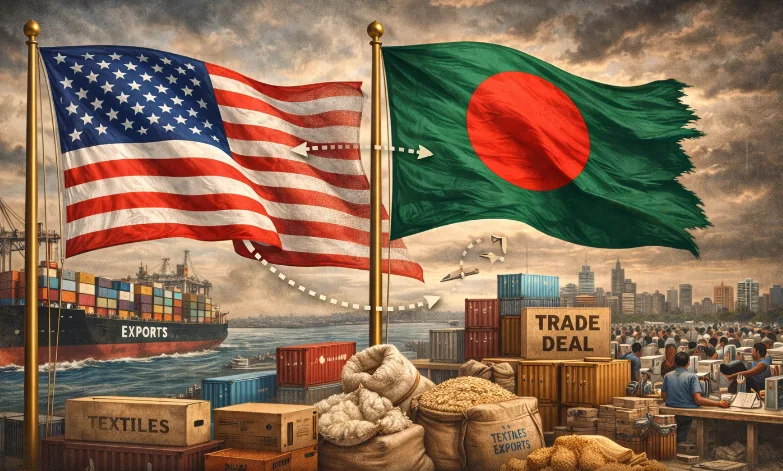
On 9 February 2026, Bangladesh signed the United States–Bangladesh Agreement on Reciprocal Trade. The U.S. side did not even pretend that this was a pact between equals. Its own fact sheet boasted that the agreement would deliver “unprecedented levels of market access” for American exporters and strengthen U.S. national and economic security.
That language matters. It shows the real logic of the deal: Bangladesh is not being treated as a partner whose development needs must be protected, but as a market to be opened, aligned and disciplined in service of U.S. commercial and strategic priorities. From Dhaka’s perspective, this is less reciprocity than managed dependence.
The chokehold begins with tariffs. Bangladesh must cut duties on many U.S. goods, in some cases to zero immediately and in others over five or ten years. Yet the United States still keeps a reciprocal tariff of up to 19 percent on many Bangladeshi exports, on top of normal MFN duties.
Worse, if Washington considers Bangladesh non-compliant, the agreement explicitly allows the United States to seek consultations and then reimpose the reciprocal tariff on some or all Bangladeshi imports. In plain English, the United States keeps the bigger stick. Bangladesh gets conditional access; Washington keeps coercive leverage. That is not free trade. It is a tariff regime designed to make Dhaka negotiate with a gun to its export sector’s head.
The second layer of control is investor penetration into strategic sectors. The agreement requires Bangladesh to liberalise foreign equity caps for U.S. investment in oil and gas, insurance and telecommunications. It also obliges Dhaka to facilitate No Objection Certificates for U.S. investors, improve approval processes for investment-related capital transfers, and address arrears to U.S. firms without delay.
These are not marginal sectors. Oil and gas influence energy security; telecommunications shape digital sovereignty; insurance affects domestic financial resilience. When a developing country is pressed to open such sectors on terms drafted around a stronger power’s commercial agenda, the result is not neutral reform. It is a transfer of bargaining power from the state to foreign capital.
Oversight is weakened just as access is widened.
Bangladesh must accept U.S. FDA approvals and certificates as sufficient evidence for many medical devices and pharmaceuticals, recognise U.S. agricultural sanitary and phytosanitary measures, accept U.S. government certification for food and farm imports, accept U.S. vehicle safety and emissions standards, and remove import restrictions on U.S. remanufactured goods.
One clause even says changes to bilateral export certification documents or electronic data elements must be made with the concurrence of the United States. This is a remarkable erosion of regulatory autonomy. A sovereign regulator should be able to verify, adapt and tighten standards according to domestic risk, public health and industrial policy. Instead, the agreement nudges Bangladesh toward outsourced trust in American regulators and producers.
The digital and security provisions deepen the imbalance. Bangladesh must ensure the free transfer of data across borders for business, and if it later enters a digital trade arrangement that the United States believes jeopardises “essential U.S. interests,” Washington may terminate the agreement and reimpose tariffs. Bangladesh must also screen and share customs and transaction data related to U.S.-origin or U.S.-controlled items, cooperate with U.S. export controls, and work with the United States on sanctions-related enforcement. This is where trade policy shades into strategic obedience. Dhaka is not merely lowering barriers; it is being pulled into the U.S. security perimeter and warned that divergence could trigger commercial punishment.
Then comes the commercial lock-in. The agreement text says Biman intends to buy 14 Boeing aircraft, and Bangladesh shall endeavour to facilitate roughly $15 billion in U.S. energy purchases over 15 years, about $3.5 billion in U.S. agricultural purchases, and increased procurement of U.S. military equipment while limiting purchases from certain other countries. Reuters reported that garments still account for more than 80 percent of Bangladesh’s export earnings. That dependence makes tariff pressure especially potent. In that setting, tying market access to aircraft orders, LNG off-take, farm imports and defence purchases looks less like trade cooperation and more like a pipeline for recycling Bangladeshi vulnerability into American corporate revenue.
Supporters will say Bangladesh secured tariff relief and some zero-tariff treatment for selected textile goods using U.S. inputs. But that only sharpens the trap: export access becomes conditional on deeper integration into U.S.-centred supply chains. Bangladesh may gain short-term breathing room, but the price is structural dependence in energy, food, regulation, data and strategic procurement. A country cannot defend its independence by surrendering one lever after another.
Bangladesh needs parliamentary scrutiny, transparent publication of all side commitments, sectoral red lines for energy and telecom, and a binding review mechanism that allows reversal where sovereignty costs outweigh commercial gains. Otherwise, “reciprocity” will remain what this deal most resembles: a power chokehold dressed up as a partnership.

