


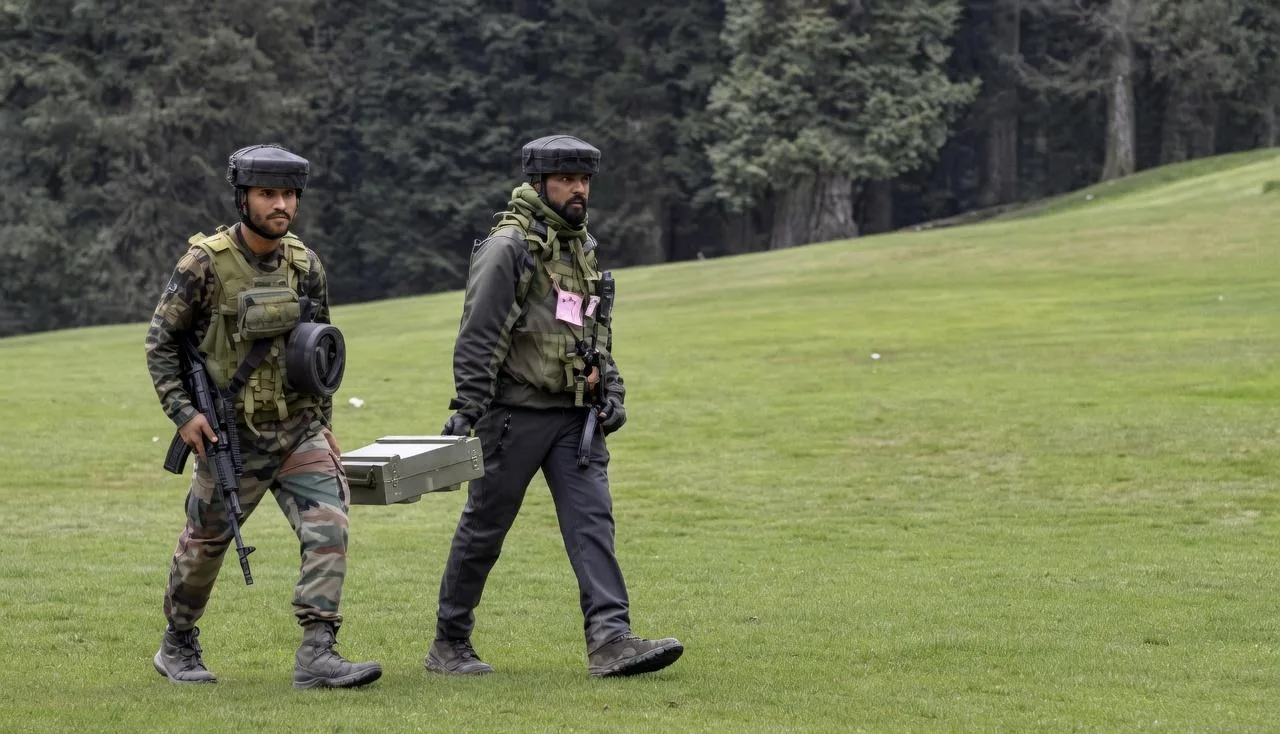
Srinagar, Apr 21 (JKNS): What began as an urgent counter-terror response after the Pahalgam attack on April 22, 2025, gradually turned into a prolonged, technology-driven hunt that ended with the elimination of three terrorists in the Dachigam–Mahadev range of Srinagar under “Operation Mahadev.”
Security sources as per news agency JKNS, said the operation, which concluded on July 28, 2025, was executed across dense forest belts, high ridges and difficult terrain using a combination of drones, UAVs, ground intelligence and elite PARA Special Forces.
Immediately after the April 22, 2025 attack in Baisaran, Pahalgam, which left 26 civilians dead, security forces rushed to the site and began a detailed investigation. Within hours, agencies reconstructed the sequence of events using eyewitness accounts and technical inputs, confirming the involvement of three foreign terrorists linked to a Pakistan-based terror outfit.
A coordinated multi-agency grid involving the Army, J&K Police, intelligence agencies and central forces was activated to track the attackers. Initial intelligence inputs suggested that the terrorists were moving through upper reaches of South Kashmir, prompting immediate sealing of escape routes across possible corridors.
As surveillance intensified, movement trails pointed towards Hapatnar, Bugam and Tral areas before the terrorists shifted deeper into the dense forest belt of the Dachigam–Mahadev range in Srinagar.
The rugged terrain, thick forest cover and limited accessibility made direct contact difficult, but allowed sustained aerial and electronic monitoring.
Officials said drones, UAVs and electro-optical sensors played a decisive role in tracking movement patterns inside the forest. These systems were used continuously to validate suspected locations, ensuring the terrorists remained under pressure without revealing their exact positions.
Human intelligence inputs were simultaneously fused with technical surveillance data, leading to the identification of the terrorists as Sulaiman Shah, Hamza Afgani and Jibran Bhai. Security forces then gradually tightened the operational grid over a large forested area exceeding 300 square kilometres.
By May 2025, the scope of the operation was expanded with the induction of elite PARA Special Forces, alongside Army, J&K Police and other central forces. The terrain was systematically divided into smaller sectors, and surveillance was intensified to prevent any breakout.
Officials said the operation gained further momentum due to heightened security sensitivity in Kashmir, particularly in view of the upcoming Amarnath Yatra, requiring complete domination of forest routes and transit corridors.
On July 10, 2025, fresh intelligence inputs helped narrow the operational zone to nearly 25 square kilometres within the Dachigam–Mahadev ridge. Continuous drone surveillance and ground tracking confirmed that the terrorists were confined to a shrinking forest pocket.
The final phase unfolded on July 28, 2025, when a PARA Special Forces team launched a stealth approach in extremely difficult terrain, covering nearly 3 kilometres on foot over 10 hours. In a swift and precise strike, all three terrorists were neutralised.
Officials said Operation Mahadev reflected a modern shift in counter-terror operations in Kashmir, where technology, intelligence and specialised mountain warfare capabilities worked in close coordination to achieve results in high-altitude terrain.
On April 22, 2025, terrorists carried out a brutal attack in the Baisaran meadow area of Pahalgam, targeting tourists and killing 26 people, including 25 tourists and one local pony ride operator. The attack triggered widespread outrage and a massive security response across Jammu and Kashmir.
In response, India launched retaliatory strikes on terror infrastructure and launch pads across the border on May 7, 2025, under a coordinated military action aimed at dismantling terror networks. The strikes targeted multiple locations and continued for several days, significantly escalating tensions before subsequent diplomatic and military-level understandings brought de-escalation later in May. (JKNS)

