


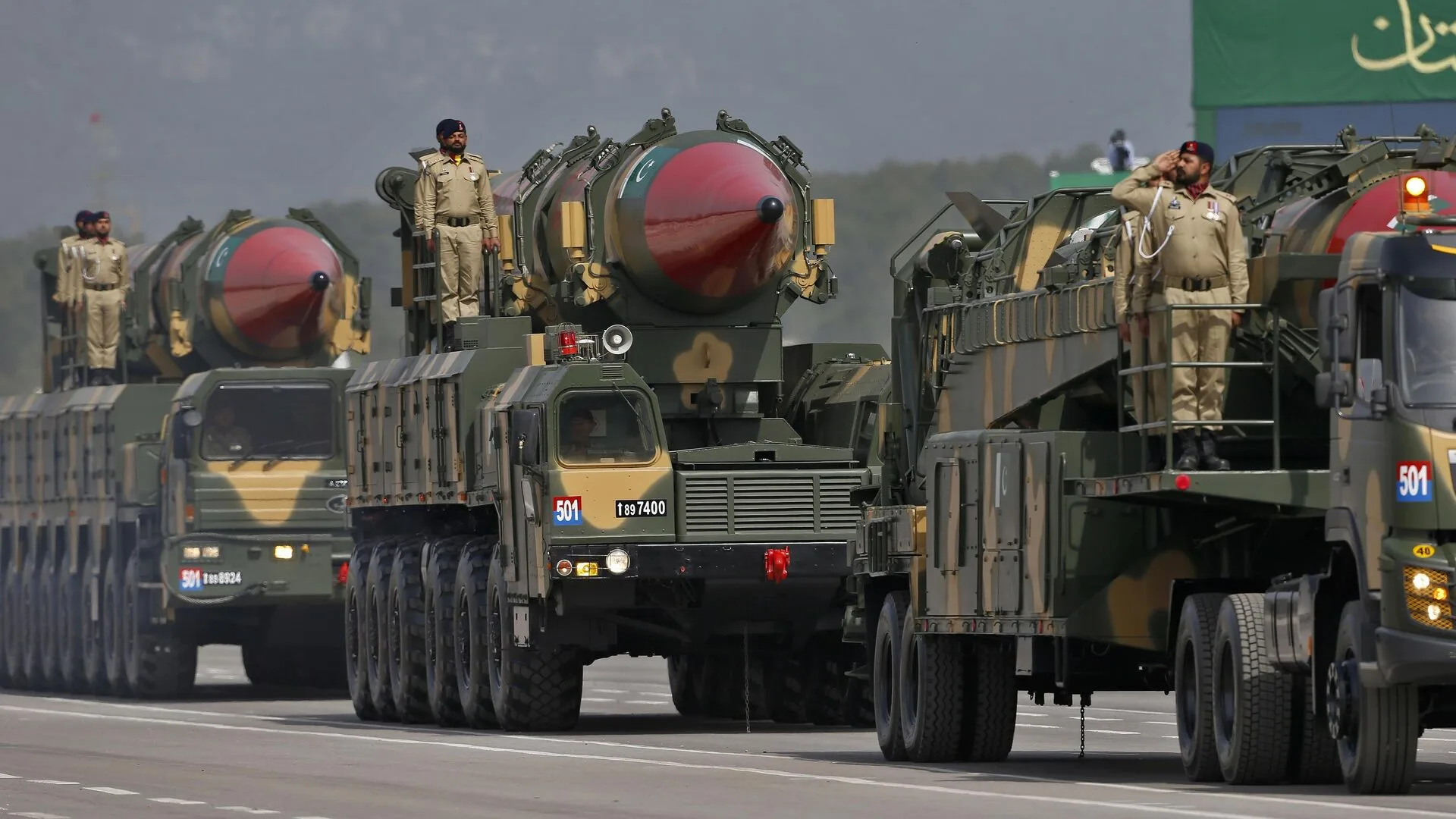
For decades, Pakistan’s strategic establishment rested its security calculus on a proposition it believed to be unassailable: that nuclear overhang would deter India from ever conducting meaningful military operations across the border. Operation Sindoor did not merely challenge that proposition. It demolished it. And when the dust of 10 May 2025 settled, Pakistan was left not only militarily exposed but strategically naked — its most fundamental deterrence assumption invalidated, its command architecture broken, and its military capability found wanting across every domain that the conflict had tested.
The ceasefire Pakistan sought on 10 May 2025 was the moment that deterrence died as a working concept for Islamabad. India had launched Operation SINDOOR on 07 May 2025, struck nine terror-related targets with precision, and explicitly communicated its restraint — choosing not to hit Pakistani military installations and saying so publicly.
Pakistan, apparently still operating under the assumption that its nuclear status granted it freedom of action below a certain threshold, chose to escalate. It deployed its drone fleet to probe Indian air defences. It conducted rocket and long-range artillery strikes between 08 and 10 May 2025. The strikes were largely ineffective.
The drones accomplished nothing. And India, unmoved by the nuclear shadow Pakistan had long relied upon, responded with strikes on 11 Pakistani airbases — including Nur Khan, in proximity to GHQ and the Islamabad Capital Territory.
The message could not have been more direct. India was signalling that a calibrated next phase was already planned — potential targets extending to leadership nodes, command-and-control infrastructure, and key force multipliers of the Pakistan military.
The prospect of progressive degradation, or outright decapitation, of Pakistan’s command chain was no longer a theoretical escalation scenario. It was the explicitly signalled next step. Pakistan’s nuclear deterrence, in the operational moment that truly tested it, had not deterred India at all. It had been called, and it had failed.
The institutional reckoning that followed was extraordinary in both its speed and its candour. The reported 27th Constitutional Amendment — abolishing the Chairman Joint Chiefs of Staff Committee, creating the post of Chief of Defence Forces with authority constitutionally consolidated under the Army Chief, and establishing the Commander of the National Strategic Command under an Army Lieutenant General — was Pakistan rewriting its foundational legal architecture because the conflict had broken its command structures open.
Constitutions are not amended in haste unless the provocation is severe enough to override every instinct toward institutional inertia. The provocation here was the operational shock of May 2025, and the amendment was Pakistan’s formal, permanent acknowledgement that its inter-services coordination, strategic command integration, and crisis management structures had all failed under pressure.
The creation of the National Strategic Command post under a serving Lieutenant General was the most explicit admission of all. Pakistan’s nuclear signalling posture had suffered. Its deterrence credibility had been damaged. The new command structure was an attempt to restore, through institutional architecture, a credibility that military performance had failed to sustain. That this restoration was necessary at all confirmed what India’s actions had demonstrated: Pakistan’s nuclear umbrella had not held.
Beneath the constitutional drama lay a catalogue of technological failure that was equally damning. The FATAH-series rockets, projected as credible precision strike instruments, had delivered largely ineffective results.
The drone fleet, deployed to test Indian air defences, had revealed the immaturity of Pakistan’s UAV integration rather than any meaningful offensive capability. Artillery strikes had been inconsequential and apparently unsustainable, prompting the post-conflict commissioning of new 155 mm ammunition production facilities. Air defences had been penetrated with sufficient ease that eleven airbases across Pakistan’s breadth could be struck in a single operational sequence.
Electronic warfare capabilities had failed to impose meaningful costs on Indian precision operations — a failure so significant that an electronic warfare cooperation agreement with Turkey was signed essentially simultaneously with the ceasefire itself.
The post-conflict procurement response, Chinese Z-10ME attack helicopters, SH-15 Mounted Gun Systems across more than 25 regiments, CH-4 and CH-5 UCAVs, SA-180 loitering munitions, Hangor submarines, VT-4 tanks rebranded as MBT Haider, Turkish KORKUT air defence systems, OMTAS missiles, ERYX ATGMs, and MILGEM corvettes — spanned every domain of military capability simultaneously. No military procures emergency capability across that many domains at once unless every domain had been found deficient at once. That is precisely what the conflict had revealed.
Pakistan emerged from May 2025 with its nuclear deterrence discredited, its command architecture constitutionally rebuilt under duress, its technological capability exposed as inadequate across the full spectrum of modern warfare, and its strategic posture dependent on emergency Chinese and Turkish transfers it could ill afford. The ceasefire of 10 May 2025 was not an exit Pakistan chose. It was the only exit available to an establishment that had gambled on assumptions the conflict had proven catastrophically wrong ,
and lost.

