


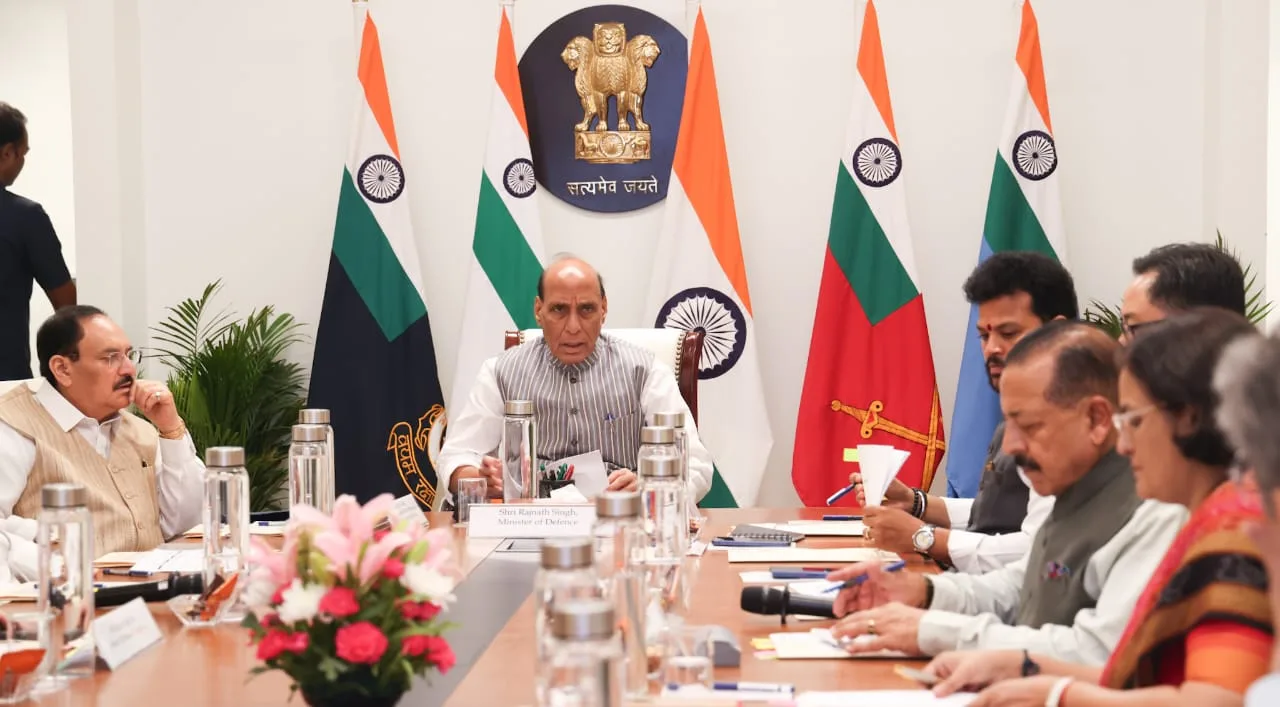

New Delhi, May 11 (JKNS): Defence Minister Rajnath Singh on Monday chaired the 5th meeting of the Informal Group of Ministers (IGoM) on West Asia and asserted that India remains fully prepared to tackle any fallout of the ongoing global conflict, stating that there is no shortage of petroleum products or essential commodities in the country.
Delhi
Raksha Mantri Shri Rajnath Singh chaired the 5th meeting of the Informal Group of Ministers (IGoM) on West Asia at Kartavya Bhawan-2, New Delhi on May 11, 2026. The meeting took stock of the latest developments in the conflict, and discussed ways to bolster India’s readiness to ensure its minimum effect on the people. Minister of Chemicals & Fertilizers Shri Jagat Prakash Nadda; Minister of Petroleum and Natural Gas Shri Hardeep Singh Puri; Minister of Railways, Information and Broadcasting, Electronics & Information Technology Shri Ashwini Vaishnaw; Minister of Parliamentary Affairs Shri Kiren Rijiju; Minister of Civil Aviation Shri Kinjarapu Rammohan Naidu, Minister of Ports, Shipping and Waterways Shri Sarbananda Sonowal; and Minister of State (Independent Charge) of the Ministry of Science & Technology Dr Jitendra Singh attended the meeting.
The IGoM was informed that the country is secure, and there is no shortage of any petroleum product, even as most other nations have taken emergency measures to dramatically reduce domestic consumption. India has 60 days of crude oil, 60 days of Natural Gas and 45 days of LPG rolling stock. The foreign exchange reserves stand at a comfortable $703 billion. India is the world’s third largest oil refiner and fourth largest exporter of petroleum products, exporting to over 150 countries and is meeting domestic demand in full. But there is a huge cost being borne by the nation as international crude prices are continuing at very high levels. Fuel conservation can ease this burden. Prime Minister Shri Narendra Modi’s appeal to the people for collective participation to help the country deal with global economic disruptions, supply chain challenges and rising prices caused by international conflicts has, thus, emphasised prudence in usage of petroleum products and reducing wasteful consumption, so that the fiscal burden on the nation is reduced in the present and into the future.
India is among the few countries where petroleum prices have held steady through this period of global volatility even after more than 70 days since the conflict started. In many nations, prices have increased by 30 to 70 per cent. However, India’s oil marketing companies have absorbed losses of close to Rs 1,000 crore a day, with under-recoveries running to nearly Rs 2 lakh crore in Q1 ’26 so that the burden of global astronomical prices is not passed to the Indian citizens. There is no reason for anxiety, and no reason for any citizens to rush to retail outlets.
The Ministers were informed that there is a surplus amount of essential commodities for the people and the present conservation is intended towards long-run capacity building if the crisis prolongs. The supply management has been good, and the people need not panic or resort to over purchase of fuel & other products.
Raksha Mantri directed the officials to take concrete steps to implement the Prime Minister’s appeal at the ground level. The Prime Minister, on May 11, 2026, exhorted the people to reduce petrol and diesel consumption by using metros & public transport, opting to car pooling; help conserve foreign exchange reserves by refraining from unnecessary foreign travel, choosing domestic tourism & celebrations within India, and avoiding non-essential gold purchases for a year. He had urged the farmers to reduce chemical fertiliser usage by 50 per cent, move towards natural farming practices, help protect soil health & reduce import dependence, and encourage wider adoption of solar-powered irrigation pumps instead of diesel pumps in agriculture. “Ministries and States must identify, in a coordinated manner, measures to institutionalise fuel efficiency, public awareness, and responsible consumption behavior,” said Shri Rajnath Singh.
In a post on X after the meeting, Shri Rajnath Singh commended the work being done by the Government towards ensuring supplies of all essential commodities. He urged the people to remain calm and avoid any kind of panic as all concrete steps are being taken to prevent shortages or disruptions in supply chains.
Raksha Mantri emphasised that the primary focus for India during the current phase is to ensure that energy flows remain uninterrupted, economic stability is maintained, and maritime trade routes remain secure. He directed all stakeholders to remain vigilant to deal with every situation.
Shri Rajnath Singh underlined the urgent need for India to accelerate the process of transforming its energy mix, rapidly expanding renewable-based alternative energy sources, identifying more reliable & diversified energy supplies, and increasing investment in energy efficiency technologies. He called for re-evaluation of strategic reserve requirements to tackle issues arising out of supply chain disruptions, with future energy security in mind.
Raksha Mantri asserted that the West Asia situation should not be viewed merely as a stand-alone event as any form of international crisis directly or indirectly affects all nations in today’s interconnected global environment. He stressed the need to focus on strategic crisis anticipation, early warning assessment, scenario planning, and timely whole-of-government preparedness.
The IGoM was informed about the recent policy measures undertaken specifically to support industry, including MSMEs. To provide liquidity support to the industry, including MSMEs, the Union Cabinet on May 05, 2026 approved the Emergency Credit Line Guarantee Scheme 5.0 with a total additional credit flow target of Rs 2,55,000 crore with the objective of providing credit guarantee coverage of 100% for MSMEs and 90% for non-MSMEs, as well as the airline sector.
Moreover, taking cognizance of the Industry demand for advisory related to ‘force-majeure-like’ risks in public procurement contracts the Ministry of Finance has also enabled force majeure-related relief measures including a circular by Department of Expenditure clarifying that the ongoing crisis should be treated as war for consideration of Force Majeure whereby the performance deadlines can be extended by 2-4 months from February 28, 2026.
The IGoM was informed that fertiliser availability remains robust, with supplies continuing to exceed requirements. Overall stock position of fertilizers in the country is as follows (Lakh Tons),
The IGoM was informed that fertiliser availability in the country remains robust, with supplies continuing to exceed requirements. As per the latest figures, the total fertiliser stock in the country as on May 11, 2026 stands at 199.65 lakh metric tonnes (LMT), compared to 178.58 LMT during the corresponding period last year.
According to the data shared during the meeting, the current stock position includes 76.65 LMT of Urea against 75.48 LMT last year, 22.52 LMT of DAP against 14.87 LMT, 60.42 LMT of NPK fertilisers against 48.32 LMT, 26.99 LMT of SSP against 26.92 LMT and 13.07 LMT of MOP against 12.99 LMT during the same period in 2025.
For the Kharif 2026 season, the fertiliser requirement has been assessed by the Department of Agriculture and Farmers Welfare at 390.54 LMT. Against this, the current stock position of around 199.65 LMT accounts for more than 51 per cent of the total requirement, significantly higher than the usual level of around 33 per cent. The government said this reflects improved planning, advance stocking and efficient logistics management.
The meeting was also informed about domestic fertiliser production and imports after the crisis period from March 1, 2026 to May 10, 2026. During this period, domestic production of Urea stood at 46.28 LMT compared to 54.98 LMT during the same period last year. DAP production was recorded at 6.20 LMT against 5.56 LMT, while NPK production stood at 15.57 LMT compared to 22.03 LMT last year. SSP production was 8.73 LMT against 9.44 LMT, taking the total fertiliser production to 76.78 LMT compared to 92.01 LMT during the corresponding period of 2025.
Meanwhile, fertiliser sales also witnessed an increase during the ongoing period. Urea sales from March 1 to May 10, 2026 stood at 38.94 LMT compared to 34.60 LMT last year. DAP sales increased to 9.40 LMT against 6.17 LMT, while NPK sales rose to 14.25 LMT compared to 11.71 LMT during the same period in 2025.
Similarly, SSP sales stood at 5.52 LMT against 4.28 LMT last year, while MOP sales increased to 3.08 LMT compared to 2.89 LMT. Overall fertiliser sales during the period reached 71.19 LMT as compared to 59.65 LMT during the corresponding period of the previous year. (JKNS)