


By Rahul Singh
(The writer is a Scholarship and Fellowship Holder from Ministry of Culture, Government of India in the field of Theatre)
Regional theatre traditions in India often face a difficult challenge. They must preserve their cultural roots while adapting to changing artistic and social realities. Few have managed this balance as successfully as Dogri theatre. Once confined largely to folk performances in villages and festivals, Dogri theatre has transformed into one of India’s most vibrant regional theatre movements. Its journey after Independence is not merely a story of artistic progress but also of cultural resilience, identity, and innovation.
Before Independence, Dogri theatre existed primarily in the form of folk performances associated with religious celebrations, seasonal festivals, and community gatherings. Theatrical expression was deeply embedded in everyday life, but it lacked institutional support and organized development. Traditional forms such as Bhagatan, Jagarna, Jattar, and Haran functioned as entertainment, social commentary, and cultural preservation mechanisms simultaneously.
Bhagatan, for example, emerged as a folk theatre tradition among ordinary communities and addressed social, political, and religious themes. Performers travelled between villages, entertaining people while also carrying messages relevant to society. Similarly, Jagarna was linked with marriage customs and women’s participation, while Haran involved dramatic performances during Lohri celebrations. These traditions reflected the richness of Duggar culture and formed the earliest foundations of Dogri theatrical expression.
The period following 1947 changed everything.
Independence brought renewed emphasis on regional languages and cultural identities. Across India, efforts began to preserve indigenous traditions, and Dogri theatre benefitted significantly from this shift. Institutions emerged, literary figures took interest, and theatre gradually evolved from a folk practice into a structured artistic discipline. The establishment of organizations such as Dogri Sanstha and later the Jammu and Kashmir Academy of Art, Culture and Languages played a defining role in nurturing this transformation.
The Academy, established in 1958, became one of the most important pillars supporting Dogri theatre. Through workshops, festivals, financial assistance, and encouragement to playwrights and actors, it created an environment in which theatre could flourish. These interventions were crucial because artistic talent alone rarely sustains a cultural movement without institutional backing.
The 1960s marked a significant turning point. Influential writers such as Dinoo Bhai Pant and Som Nath Zuta introduced socially relevant themes into Dogri plays. Theatre began engaging with patriotism, family dynamics, social injustice, and changing societal values. Productions became more meaningful and connected deeply with audiences. At the same time, performance quality improved due to better direction, stagecraft, lighting, and acting techniques.
Dogri theatre no longer remained confined to preserving tradition. It started experimenting.
Modern theatrical devices, multimedia elements, innovative stage design, and new narrative forms gradually entered productions. Importantly, these experiments did not erase traditional identity. Instead, they strengthened it. The ability of Dogri theatre to blend folk traditions with contemporary practices became one of its greatest strengths.
The emergence of Balwant Thakur and the Natrang theatre movement during the 1980s and 1990s fundamentally altered the landscape of Dogri theatre. It would not be an exaggeration to say that modern Dogri theatre gained national recognition largely through this cultural movement.
Under Balwant Thakur’s direction, Dogri productions achieved milestones previously unimaginable for regional theatre. Plays travelled beyond Jammu and Kashmir and earned appreciation at national festivals. Dogri theatre was no longer viewed as peripheral or local. It began occupying central space within Indian theatre discourse.
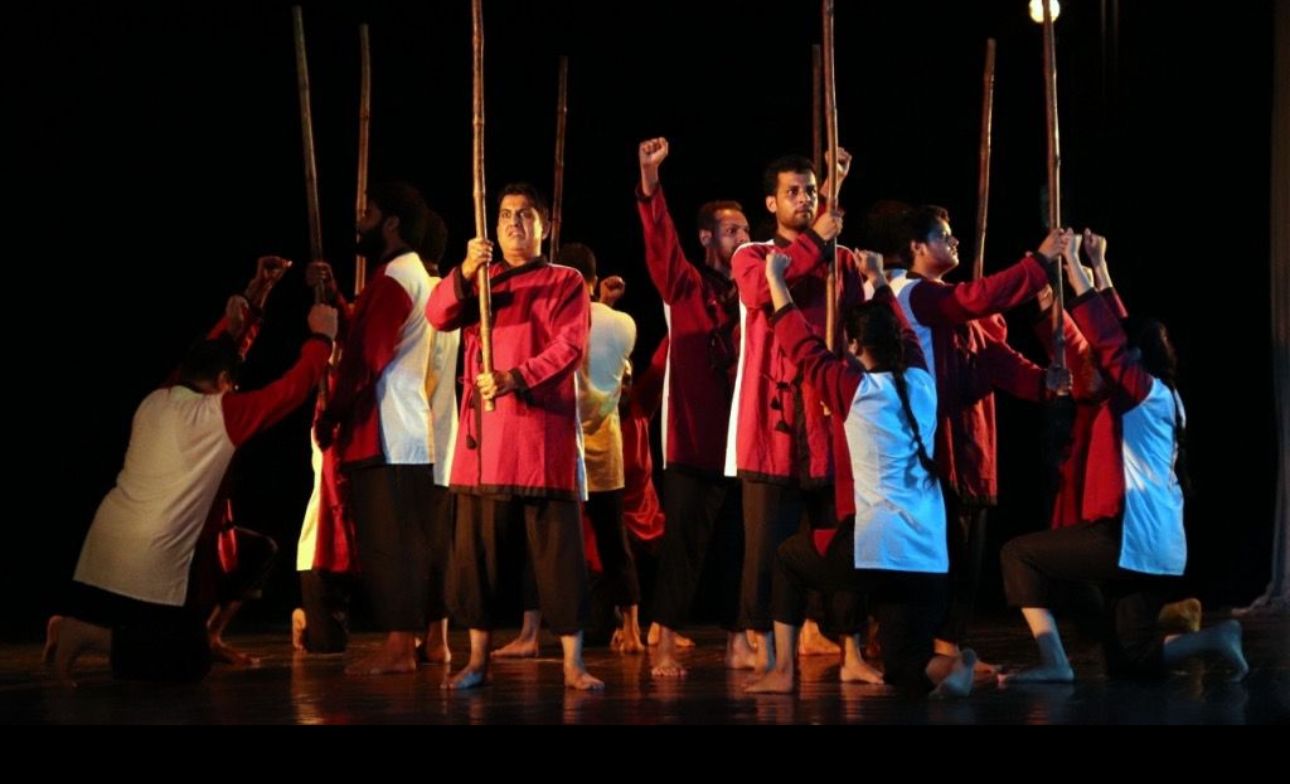
Perhaps the strongest symbol of this transformation is Bawa Jitto.
Originally based on a fifteenth-century folk hero and martyr, Bawa Jitto evolved into one of India’s longest-running contemporary theatre productions. The play has been performed more than 140 times across multiple cities and states, including Delhi, Kerala, Assam, Rajasthan, and beyond. Its success demonstrated that stories deeply rooted in local culture can achieve universal appeal when presented with artistic excellence.
The brilliance of Bawa Jitto lies in its synthesis of traditional Dogri elements with modern theatrical expression. Folk forms such as Karkan and Geetru are integrated organically into the narrative. Music, dance, storytelling, and symbolism work together to create a uniquely immersive experience. Rather than appearing outdated, folk traditions become contemporary and emotionally powerful.
Other productions achieved similar recognition. Ghumayee became the first Indian theatre production to reach the Frankfurt International Theatre Festival in Germany and was later showcased at the Commonwealth Games and Theatre Olympics. Such achievements challenged long-held assumptions that Dogri lacked a strong theatrical tradition.
The misconception persisted for years that Kashmir’s Bhand Pather represented the only significant regional theatre tradition of Jammu and Kashmir. The rise of Dogri theatre decisively overturned this notion. It revealed that Jammu possessed an equally rich and dynamic cultural heritage.
Yet, despite remarkable progress, challenges remain.
Urban audiences increasingly prefer Hindi and English productions. Many young practitioners shift toward languages perceived to offer broader opportunities. Funding limitations, changing entertainment habits, and inadequate long-term support continue to threaten sustainability. Additionally, numerous productions are created mainly for festivals and disappear after a few performances, limiting their broader cultural impact.
Political instability has also affected cultural growth in Jammu and Kashmir. Decades of conflict and tension have often overshadowed artistic achievements. In such circumstances, theatre assumes greater importance. It becomes not merely performance but an act of cultural preservation and social resilience.
What makes Dogri theatre extraordinary is not simply its survival but its capacity to reinvent itself repeatedly while remaining rooted in Duggar identity. It has shown that regional theatre can speak globally without abandoning local traditions.
Its future depends on three essential commitments: preserving folk forms, supporting young practitioners, and ensuring institutional encouragement. Without these, even the richest cultural traditions risk decline. With them, Dogri theatre can continue expanding its influence nationally and internationally.
The story of Dogri theatre after Independence is ultimately a story of cultural confidence. It proves that language, folklore, and local history are not barriers to artistic success. They can become the very source of originality.
Dogri theatre began as folk expression performed in villages. Today, it stands as one of India’s most distinctive regional theatre movements. That transformation is not accidental. It is the result of decades of creativity, persistence, and an unwavering belief that culture survives only when communities continue to tell their own stories.
And Dogri theatre continues to tell those stories with remarkable conviction.

