


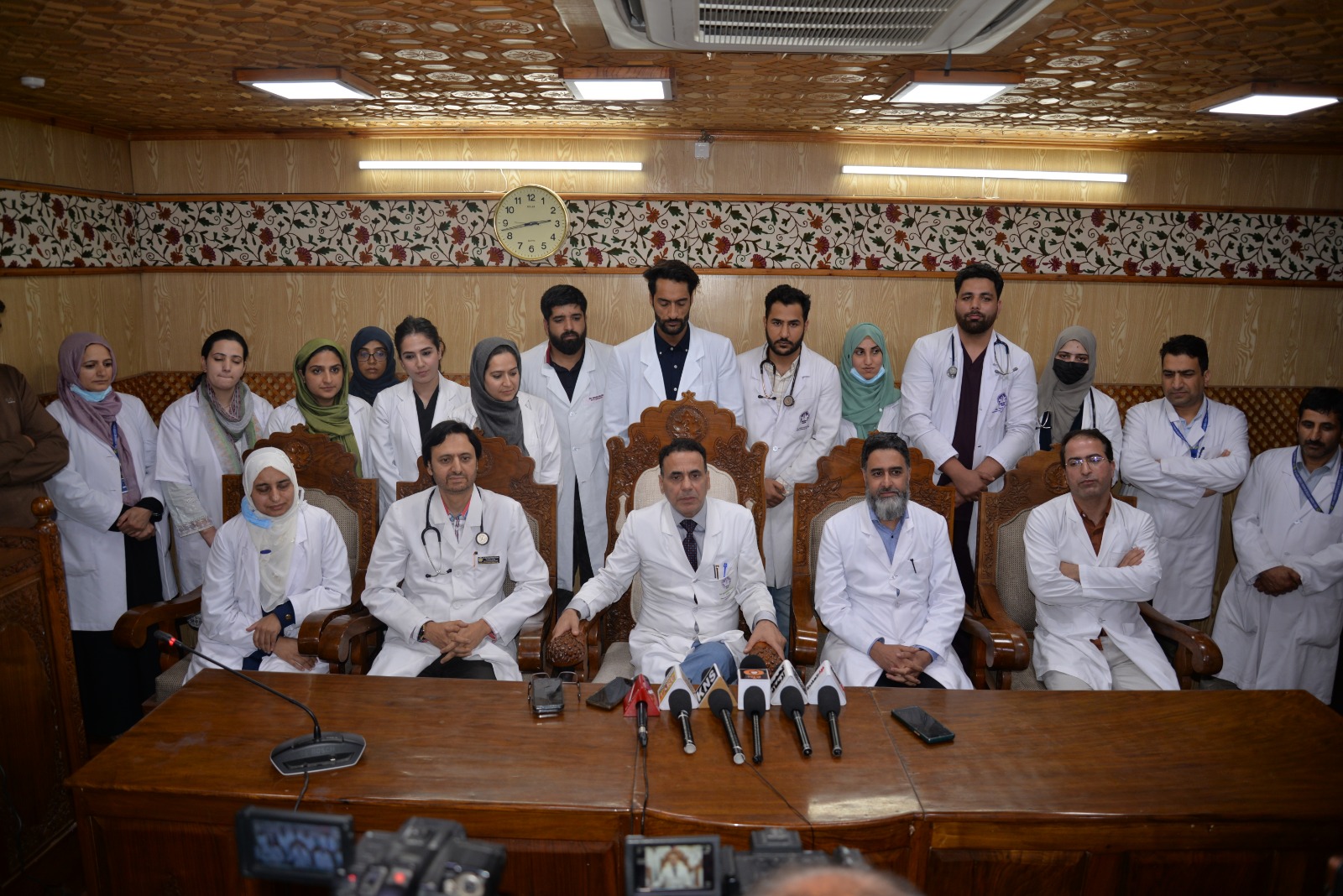
Srinagar, Jun 23 (JKNS): In a landmark achievement for healthcare in Jammu and Kashmir, the Sher-i-Kashmir Institute of Medical Sciences (SKIMS) has successfully performed its first-ever Matched Unrelated Donor (MUD) Hematopoietic Stem Cell Transplant on a three-year-old Kashmiri child suffering from a rare and life-threatening immune disorder, with stem cells donated by a volunteer donor from Poland.
SKIMS has achieved a landmark milestone in advanced hematology and
transplant medicine with the successful completion of its first Matched
Unrelated Donor (MUD) Hematopoietic Stem Cell Transplantation in a
three-year-old child diagnosed with Hemophagocytic Lymphohistiocytosis (HLH), a
rare and potentially life-threatening disorder caused by severe immune system
dysregulation.
Addressing a press conference, Director SKIMS/EOSG Prof. M.
Ashraf Ganie, accompanied by specialists from the Department of Clinical
Hematology, highlighted the significance of the achievement and described it as
a major advancement in the delivery of cutting-edge healthcare services within
Jammu & Kashmir.
Prof. Ashraf Ganie congratulated the transplant team for the
successful outcome and emphasized the urgent need for greater public
participation in stem cell donation. He appealed to people to come forward,
register as potential stem cell donors, and contribute to saving lives.
“Many patients suffering from life-threatening blood
and immune disorders can only be cured through stem cell transplantation.
Public awareness and participation in donor registries can significantly
improve the chances of finding suitable donors for such patients,” he
said.
The Director further announced that SKIMS will actively
promote stem cell donor registration and facilitate access to donor registry
information through its official platforms, encouraging greater community
participation in this life-saving initiative.
The highly specialized transplant was performed by the
Department of Clinical Hematology using stem cells obtained from a fully
matched unrelated volunteer donor from Poland, identified through DKMS, one of
the world’s largest stem cell donor registries.
In a remarkable humanitarian
gesture, DKMS waived the donor procurement charges, substantially reducing the
financial burden on the patient’s family and enabling access to this
potentially curative treatment.
Speaking on the occasion, Prof. Sajad Geelani, Head,
Department of Clinical Hematology; Dr. Reshma Roshan, Associate Professor; and
Dr. Afaq Ahmad Khan, Associate Professor, elaborated on the procedure and
highlighted the department’s growing expertise in stem cell transplantation.
They stated that the transplant programme at SKIMS is being
conducted in accordance with international and national standards of care and
has demonstrated outcomes comparable to leading transplant centres.
The specialists explained that Matched Unrelated Donor
transplantation is among the most complex procedures in modern medicine,
requiring meticulous planning, extensive donor-recipient matching,
international coordination, specialized laboratory support and intensive
clinical monitoring.
“From identifying a suitable donor through DKMS to
coordinating stem cell collection and transportation across international
borders, every step demanded precision, teamwork and unwavering commitment. The
successful outcome reflects the expertise and dedication of the entire
transplant team and demonstrates that highly advanced transplant services can
be effectively delivered within our institution,” they said.
Highlighting the broader significance of the achievement,
the experts noted that many patients with severe hematological and
immunological disorders do not have a suitable family donor available. For such
patients, Matched Unrelated Donor transplantation often represents the only
curative option.
“This success underscores the importance of
strengthening transplant programmes, increasing awareness regarding stem cell
donation and fostering collaborations with national and international donor
registries. Every successful transplant brings renewed hope to patients and
families facing life-threatening diseases,” they added.
The Department of Clinical Hematology also expressed sincere
gratitude to Director SKIMS for constant support & DKMS for its invaluable
generosity in waiving donor procurement charges, thereby facilitating this
life-saving treatment.
Special appreciation was extended to all faculty members,
senior and junior residents, transplant coordinators, nursing officers, blood
bank personnel, laboratory scientists, technicians, pharmacists, infection
control teams, intensive care staff and supporting departments whose
dedication, expertise and teamwork were instrumental in the success of this
complex procedure.
The father of the young patient expressed heartfelt
gratitude to the Director and medical team at SKIMS. He shared that after
consulting multiple centres outside the region, he finally found hope at SKIMS
where doctors assured him that the condition was treatable and successfully
performed the transplant.
This achievement marks the successful establishment of
Matched Unrelated Donor Transplantation Services at SKIMS, significantly
expanding treatment options for patients suffering from complex blood and
immune disorders and reinforcing the institute’s commitment to providing
state-of-the-art, life-saving therapies within Jammu & Kashmir.
What is a Matched Unrelated Donor (MUD) Transplant?
A Matched Unrelated Donor (MUD) transplant is a type of stem
cell transplant in which a patient receives healthy blood-forming stem cells
from a volunteer donor who is not related to them but whose tissue type closely
matches their own.
When a suitable donor is not available within the patient’s
family, physicians search national and international donor registries to
identify a compatible donor. Once a match is found, stem cells are collected
from the donor and transplanted into the patient to replace diseased or damaged
bone marrow.
Advances in donor matching, transplant techniques and
supportive care have significantly improved the safety and success of MUD
transplantation, making it a life-saving treatment option for patients who
otherwise have limited therapeutic alternatives.
“A donor in Poland, a patient in Kashmir, and a shared
commitment to saving lives, this transplant exemplifies the power of global
cooperation in modern medicine.” (JKNS)

