


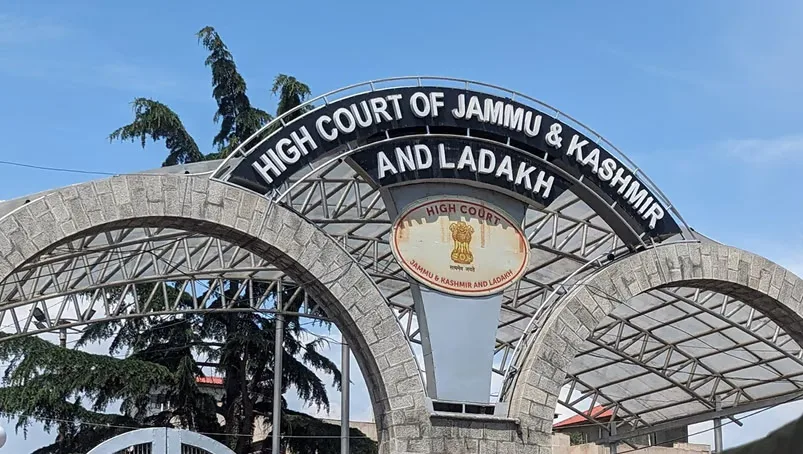

Srinagar, Sept 30 (JKNS): The High Court of Jammu & Kashmir and Ladakh has held that premature or compulsory retirement of a government employee is an administrative measure taken in public interest and is neither punitive in nature nor stigmatic, observing that courts exercising judicial review cannot substitute their own assessment for that of the competent authority when the decision is based on relevant and cogent material.
A Division Bench comprising Chief Justice Dr Pushpendra Singh Bhati and Justice Sanjeev Kumar, while Hakim Aman Ali Deputy Advocate General appeared for Union Territory of J&K (General Administration Department), made the observations while deciding a Letters Patent Appeal filed by the State of Jammu and Kashmir against a 2018 judgment of a Single Judge concerning the premature retirement of Ghulam Mohammad Lone, a resident of Lawaypora, Srinagar, as per news agency JKNS stated.
The judgment, pronounced on September 28, 2026, arose out of LPASW No.189/2018, challenging the Single Judge’s October 5, 2018 judgment in SWP No.2166/2016, through which the Government Order directing Lone’s premature/compulsory retirement had been quashed and his reinstatement with consequential benefits ordered.
The Division Bench noted that Lone had rendered around 38 years of government service and was 58 years old when the premature retirement order was issued. The Government had invoked Article 226(2) of the Jammu and Kashmir Civil Services Regulations, 1956, under which a government servant could be retired in public interest after completing the prescribed qualifying service or attaining the prescribed age.
The State had argued that the premature retirement was ordered after consideration by a duly constituted Screening/Review Committee, which examined the employee’s service record, his alleged involvement in a vigilance case and his general reputation.
According to the record, a vigilance case had been registered against Lone over allegations of demanding and accepting a bribe of Rs 9,000, resulting in registration of FIR No.18/2010 by the Vigilance Organization. The State maintained that the vigilance case was considered along with his overall service record and reputation, rather than being treated as proof of misconduct for the purpose of imposing a disciplinary punishment.
The State contended before the High Court that the Single Judge had exceeded the permissible scope of judicial review by examining the adequacy or sufficiency of the material considered by the Screening/Review Committee. It argued that the Court was not sitting as an appellate authority over the subjective satisfaction of the competent administrative authority.
On the other hand, Lone had maintained that his service career was satisfactory and that he had received promotions on account of his suitability, merit and service record. He disputed the allegations relating to the vigilance case and pointed out that the criminal proceedings were pending and had not resulted in a finding of guilt.
The Division Bench examined the legal distinction between compulsory retirement and punitive dismissal or removal. It held that compulsory retirement is intended to enable the Government to maintain efficiency and integrity in public administration and to remove from service persons whose continued retention is not considered beneficial in the public interest.
The Court relied upon its earlier judgment in State of Jammu and Kashmir through Commissioner/Secretary to Government, GAD v. Ahsan-ul-Haq Khan, decided on December 30, 2025, which had considered the scope of judicial review in premature-retirement matters under Regulation 226(2) of the J&K Civil Services Regulations.
The Bench noted that, under the settled legal position, the competent authority’s satisfaction regarding premature retirement may be subjective, but it must be founded on cogent material drawn from the employee’s entire service record, with greater emphasis on the later years of service.
The High Court also referred to the Supreme Court’s judgment in Baikuntha Nath Das v. Chief District Medical Officer, Baripada, observing that an order of compulsory retirement is not a punishment and does not, by itself, carry stigma or imply misconduct.
The Court reiterated that judicial interference may arise where the decision is mala fide, arbitrary, based on no evidence, perverse, or where relevant material has been ignored or irrelevant considerations have been taken into account. However, courts cannot ordinarily reassess the employee’s utility and substitute their own opinion for that of the competent authority.
Applying these principles to the present case, the Bench held that the vigilance case, alleged acceptance of bribe and general reputation could constitute relevant material for assessing whether the employee’s continued retention was in public interest, provided the competent authority relied upon cogent and relevant material and did not use compulsory retirement as a substitute for disciplinary proceedings.
The Court further observed that the fact that the allegations in the FIR were disputed or that the criminal proceedings had not culminated in a conviction could not, by itself, determine the legality of the premature retirement order. The relevant question was whether the material before the Screening Committee and competent authority was legally relevant and whether a bona fide opinion could reasonably be formed that the employee’s continued service was not in public interest.
While examining the employee’s performance record, the Bench noted that his Annual Performance Reports for 2011-12, 2012-13, 2013-14 and 2014-15 generally rated his performance as satisfactory, with different parameters in the 2014-15 report ranging from satisfactory to excellent.
The Court, however, observed that the performance reflected in the record was satisfactory/average and was not of such an exceptional or extraordinary nature as to create a right to continued retention in government service. It held that the competent authority, after considering the relevant service record and material before it, had formed the requisite opinion that premature retirement was in public interest.
Accordingly, the Division Bench held that the Single Judge’s judgment dated October 5, 2018 could not be sustained. It set aside the judgment and upheld Government Order No.1264-GAD of 2016 dated November 21, 2016, under which Lone had been prematurely/compulsorily retired from service.
The appeal filed by the State was consequently allowed. (JKNS)