


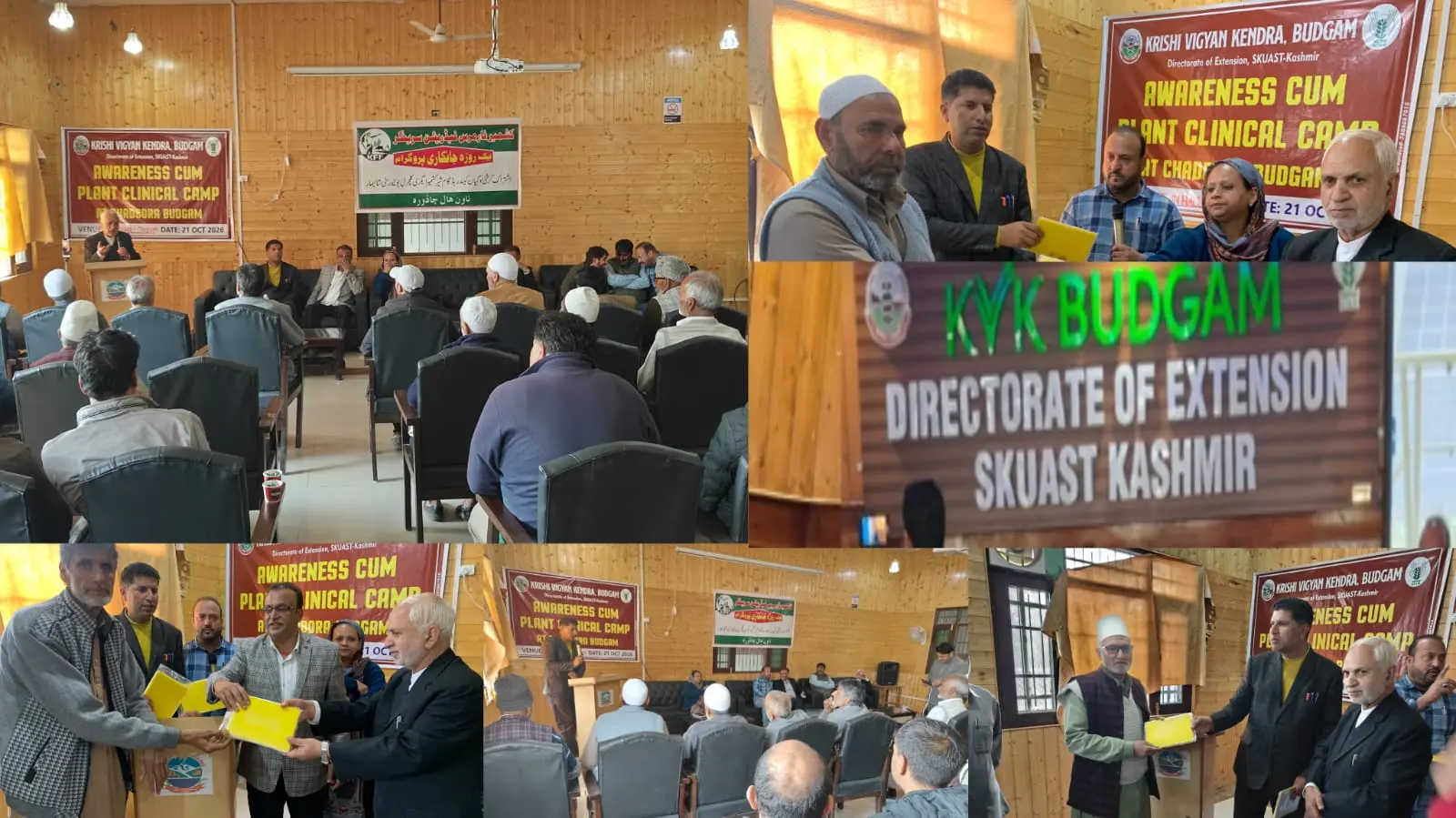

Budgam: Krishi Vigyan Kendra (KVK) Budgam, under Sher-e-Kashmir University of Agricultural Sciences and Technology of Kashmir (SKUAST-K), organised a Plant Health Clinic Camp in Chadoora to address agricultural issues faced by local farmers and provide solutions to challenges related to plant diseases affecting crops and orchards. The camp witnessed active participation from farmers, officials of concerned government departments, and agricultural scientists.
The camp commenced with an introductory address by Professor and Head of KVK Budgam, Dr Bilal Ahmad Lone, who briefed participants about its key objectives. He highlighted the important role of plant health clinics in providing on-the-spot diagnosis of plant diseases, expert consultation, and technical guidance to farmers. He said such initiatives help improve crop productivity and minimise agricultural losses.
During the technical sessions, Dr Shabeer Ahmad Ganie delivered a detailed presentation on the integrated management of pests and diseases affecting seasonal crops and orchards. He shared practical, cost-effective methods to protect crops from pests and diseases and emphasised the safe handling and use of pesticides.
Dr Khurshid Ahmad delivered a detailed lecture on the management and prospects of high-density apple orchards. He explained that adopting modern high-density plantation systems can significantly increase productivity, improve fruit quality, and enhance farmers’ income.
On the occasion, Dr Bhinish Shakeel shared valuable insights into the value addition of fruits and vegetables. He explained how value-addition practices can help farmers increase the commercial value of their agricultural produce and generate additional income.
Horticulture Development Officer (HDO), Chadoora, Tanvir Ahmad Dar, and Sub-Divisional Agriculture Officer (SDAO), Chadoora, Mohammad Muzaffar, also participated in the camp. Both officers briefed farmers about various government schemes, subsidies, and departmental initiatives aimed at strengthening the local agricultural economy and supporting the farming community.
Meanwhile, the President of the Kashmir Farmers Federation, Srinagar, expressed serious concern over land-use policies and the rapid depletion of agricultural land. He stressed the need to protect farmland from unnecessary construction, commercial complexes, and unplanned urbanisation, emphasising that effective measures are required to preserve agricultural land.
The camp concluded with an interactive session between agricultural experts and farmers. Farmers brought samples of diseased plants, which were examined by experts on the spot. Appropriate recommendations and guidance regarding treatment and preventive measures were provided to help farmers manage plant diseases effectively.
The initiative reaffirmed KVK Budgam’s commitment to supporting farmers through scientific guidance, timely diagnosis of plant diseases, modern agricultural practices, and sustainable farming solutions. The camp provided farmers with valuable information to improve the management of their crops and orchards and enhance agricultural productivity.