


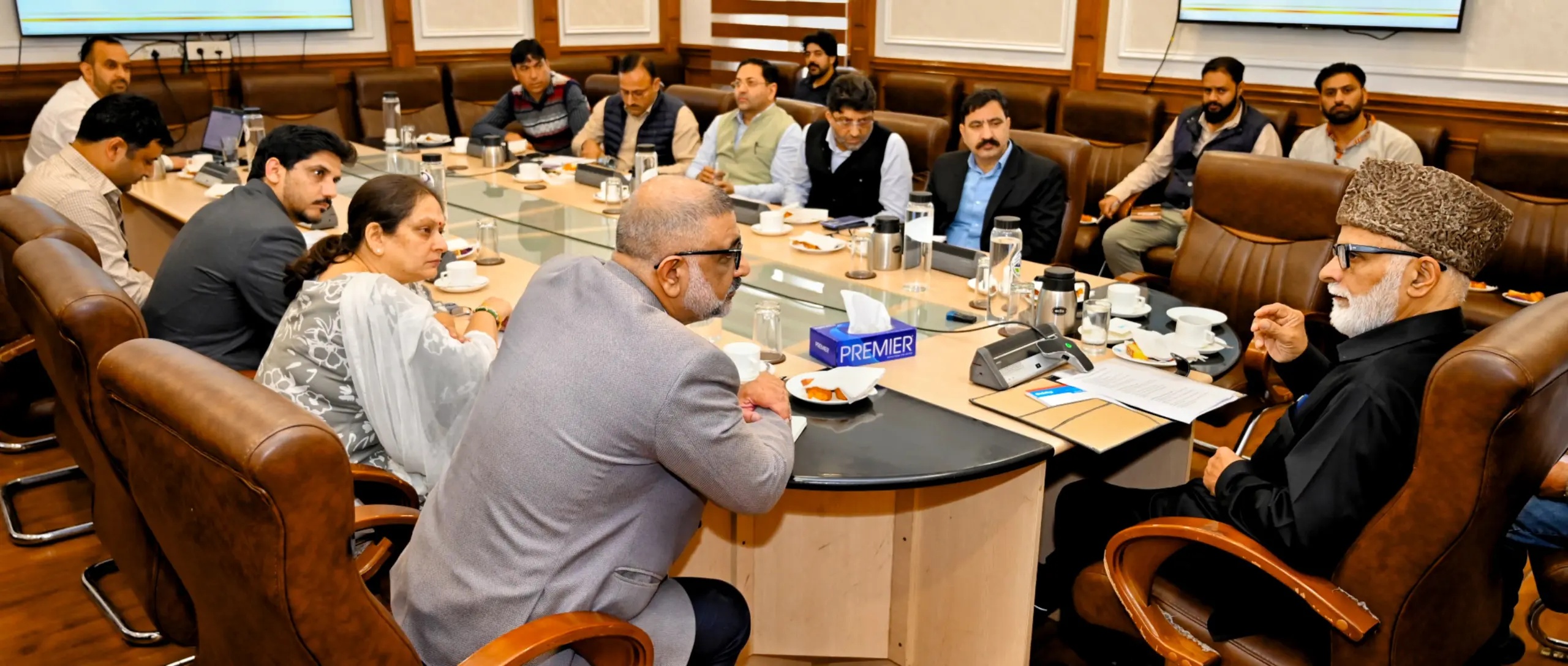
JAMMU, NOVEMBER 5: Minister for Power Development Department (PDD), Law, Justice and Parliamentary Affairs, Revenue, Elections and Disaster Management, Relief, Rehabilitation and Reconstruction (DMRRR), Ali Mohammad Sagar, today held a comprehensive review of the functioning of the Law Department, with particular emphasis on strengthening Government litigation management, ensuring transparency in the appointment of Standing Counsels and Government Advocates, and improving the overall efficiency of legal administration.
The meeting was attended by Commissioner/Secretary, Law, Justice and Parliamentary Affairs, Achal Sethi, and other senior officers of the Law Department.
The Minister directed the department to undertake a detailed assessment of all existing legal engagements, including the appointment procedure, competent approving authorities, prescribed tenure, extensions, terms and conditions of service and individual performance of Standing Counsels and Government Advocates engaged by the Government at different judicial forums.
Emphasising the need for a transparent and merit-based system, Sagar stressed that all appointments and extensions must strictly adhere to prescribed rules, Government instructions and established procedures. He called for a thorough examination of the existing strength of Standing Counsels vis-à-vis the actual requirements of different courts and departments, directing the identification of surplus, overlapping and non-performing engagements.
The Minister also called for a comprehensive assessment of Government litigation across the Supreme Court, High Court, Central Administrative Tribunal (CAT) and subordinate courts. He directed the preparation of a consolidated, court-wise, department-wise and district-wise database of pending, disposed of and newly instituted cases, with particular focus on long-pending, sensitive and high-value matters, service disputes, land disputes, contractual disputes and contempt petitions.
Expressing concern over adverse judicial orders and avoidable litigation, Sagar emphasised the need to examine the reasons behind cases decided against the Government. He directed that departmental lapses, inadequate representation, delays in filing counter-affidavits and non-compliance with judicial directions be identified and responsibility fixed wherever warranted.
The Minister underscored that effective coordination between the Law Department and Administrative Departments is essential for protecting the Government’s legal interests. He called for the designation of nodal officers in each department to ensure timely submission of records, factual reports and instructions to Government Advocates, besides regular monitoring of important cases at the Administrative Secretary level.
Sagar stressed that prescribed selection procedures, eligibility conditions, professional competence and performance benchmarks must be strictly followed. He also called for periodic evaluation of advocates before considering renewal or extension of their engagements.
The Minister further directed a detailed examination of the digital application/legal case management portal developed for monitoring Government litigation. He called for verification of its administrative approval, financial sanction, operational status, utilisation and accountability, besides assessing whether all Administrative Departments, District Offices and Government Advocates have been integrated with the system.
On the financial front, Sagar called for a comprehensive assessment of expenditure incurred on Standing Counsels, Government Advocates and other legal engagements, including retainership, professional charges, appearance fees and pending bills. He stressed that all payments must be duly verified against the actual work performed and supported by proper financial approvals and budgetary provisions.
The Minister also reviewed the status of legal vetting, opinions and legislative matters, directing the timely examination of Government orders, rules, regulations, policies, agreements and draft legislation. He emphasised that stronger legal scrutiny at the initial stage would help minimise avoidable litigation and ensure that Government decisions are legally sound.
Emphasising that access to justice must not be determined by financial capacity, the Minister directed the department to ensure effective legal assistance to poor, needy and underprivileged persons who cannot afford private advocates or lack the financial and other resources to contest their cases.
He reviewed the functioning of Legal Services Authorities and stressed the need to ensure adequate availability of legal aid advocates at the District, High Court and Supreme Court levels. He called for strengthening the legal aid mechanism so that deserving persons receive timely and effective representation before judicial forums.
Taking stock of the administrative and manpower position, Sagar directed a comprehensive review of the sanctioned strength, vacant posts and existing manpower requirements of the Law Department.
He called for a detailed examination of recruitment, promotions, Departmental Promotion Committees (DPCs) and pending service-related matters, stressing that all such issues must be addressed in a time-bound manner.
The Minister emphasised the need to ensure time-bound career progression, timely promotions and prompt resolution of employees’ grievances. He also directed a review of manpower deployment across subordinate offices, calling for rationalisation and optimal utilisation of available staff to improve administrative efficiency and institutional functioning.
The Minister further directed the department to formulate or review a transparent, uniform and rational transfer policy for the Law Department and its subordinate establishments.
He stressed that manpower must be distributed equitably across different offices, with strict adherence to prescribed tenures. He called for avoiding prolonged postings at a particular station and repeated or arbitrary transfers, emphasising that transfer decisions must be guided by administrative requirements, fairness and transparency.
Reiterating the need for institutional accountability, Sagar called for uniform terms and conditions governing legal engagements, clearly defined tenure and extension provisions, transparent appointment procedures and mandatory performance assessments. He stressed that continuation of any engagement must be justified by professional competence, satisfactory performance and genuine administrative requirements.
The Minister directed the Law Department to undertake a comprehensive review of all Standing Counsels, Government Advocates and other legal engagements and prepare a consolidated statement detailing their appointments, approving authorities, tenure, extensions, terms and conditions and performance.
He further directed the preparation of a comprehensive litigation database reflecting case-wise progress, judicial outcomes, cases decided against the Government and the reasons behind adverse judgments.
“A time-bound action plan is also to be prepared for rationalisation of legal engagements, transparent appointments, improved Government representation, effective litigation management and strengthening of the digital case-monitoring mechanism,” he added.
Sagar stressed that the ultimate objective must be to make the Law Department more responsive, efficient and accountable while safeguarding the legal and financial interests of the Government, ensuring effective representation before all judicial forums and guaranteeing access to justice for every deserving citizen.

