


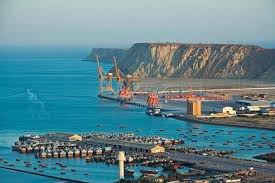
The Makran coast is one of South Asia’s least studied and ecologically significant marine environments. Its patches of reef-associated coral habitat, mangrove fringes, productive pelagic fisheries, and — critically — sea turtle nesting beaches have sustained coastal communities for centuries and represent an ecological inheritance of considerable value. They also lie in or near the path of the Gwadar Naval Base project, and by all publicly available evidence, nobody in the planning chain has been required to formally reckon with what the base will do to them.
The project involves the construction of a 1.772-kilometre breakwater and large-scale coastal reclamation to create 69 acres of new land. These are not minor interventions. Breakwaters of this scale permanently alter coastal hydrodynamics, changing sediment transport patterns, affecting water temperature and salinity gradients, and disrupting the movement of marine species across their range. Coastal reclamation destroys the seabed habitat it covers and alters tidal flows across a much wider area. The combination of the two, at this scale, on this coastline, should require exhaustive environmental impact assessment and independent review before a single cubic metre of fill material is deposited.
No such assessment has been cited in any document associated with the Gwadar Naval Base project. The Makran coast immediately around Gwadar and Jiwani — the zone most directly affected — is documented as a nesting site for green turtles and hawksbill turtles, both listed as endangered. The broader coastline supports five species of marine turtle in total. The same waters sustain the artisanal fisheries on which a majority of Gwadar’s resident population depends.
The feasibility study conducted by CHEC — itself a document that has not been made public — may contain environmental modelling, but if it does, neither its methodology nor its conclusions have been shared with Pakistani environmental regulators, civil society, or the fishing communities whose livelihoods depend on the coastal ecology the project will alter. The role of Pakistan’s Environmental Protection Agency in this project, if any, has not been disclosed.
The fishing communities of Gwadar have particular reason to be alarmed. Their livelihoods are directly tied to the health of nearshore marine ecosystems — the fish spawning grounds, crustacean habitats, and baitfish concentrations that drive commercial catches in the Arabian Sea, known for its exceptional biological productivity driven by monsoon upwelling.
Large-scale reclamation and the construction of a major naval installation will generate persistent noise pollution, chemical runoff from maintenance operations, changes in water circulation, and dramatically increased vessel traffic in waters that have historically been relatively undisturbed by heavy industry. The cumulative effect on fish populations and catches has not been publicly assessed.
The international precedent here is instructive and sobering. Coastal reclamation projects of comparable scale in South and Southeast Asia have generated documented harm to nearshore ecosystems. In Malaysia, reclamation projects in Penang waters caused large prawn catches to fall from 15 kg per day to one or two kg, with fishermen reporting the near-disappearance of clams and pomfret from affected zones.
Across Southeast Asia more broadly, coastal development has been identified as a major driver of mangrove loss and reef degradation that has reduced nearshore fish catches and gutted fishing livelihoods. Many of these projects were undertaken with at least some form of prior environmental review. The Gwadar Naval Base appears to be advancing without even that incomplete protection.
Pakistan’s environmental law requires assessment for projects of this nature. Under Section 12 of the Environmental Protection Act 1997, and the accompanying IEE and EIA Regulations 2000, projects with significant potential environmental impact are required to undergo either an Initial Environmental Examination or a full Environmental Impact Assessment before proceeding.
These requirements exist precisely to ensure that decisions of this kind are made with full knowledge of their ecological consequences. Whether those requirements are being observed, waived, or simply ignored in the case of the Gwadar Naval Base is unknown — because no official has said anything publicly about the environmental governance of this project.
That silence lands in a particularly troubling context. Pakistan has only three marine protected areas, covering less than one percent of its maritime territory. Enforcement within those designated zones is already hampered by inadequate funding, insufficient personnel, and a lack of vessels capable of monitoring offshore activity.
The country’s coastline is governed by a fragmented web of federal and provincial jurisdictions with weak coordination mechanisms. In this environment, the absence of any cited environmental review for a 69-acre reclamation project with a nearly two-kilometre breakwater — on a coastline with active turtle nesting sites and fishing communities that depend on nearshore marine productivity for survival — does not suggest procedural oversight. It suggests that ecological considerations have not merely been deprioritised. They appear to have been written out of the planning conversation entirely.
The Makran coast has been largely spared the industrialisation that has degraded marine environments elsewhere in South and Southeast Asia. The nesting turtles at Jiwani do not know the base is coming. The fish that spawn in the nearshore waters around the Hammerhead Peninsula do not know that the seabed is scheduled for reclamation. But the communities that depend on both do know — and they have not been given an answer, or even an assessment, that tells them what they stand to lose.

