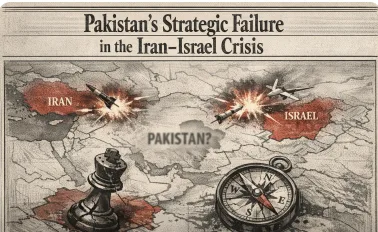
The credibility of a defense pact rests on a simple principle: a promise matters only if the state that makes it is willing to honor it. When Ishaq Dar stood before reporters on March 3 and warned Iran against attacking Saudi Arabia, he invoked a mutual defense agreement signed only months earlier between Islamabad and Riyadh. The pact states that any aggression against one country would be considered aggression against both, a clause that appeared to place Saudi Arabia under Pakistan’s strategic protection. Yet when the crisis between Iran and Israel escalated and the possibility of attacks on Gulf states became real, Pakistan’s response revealed a stark truth: the country had issued a strategic promise it was neither prepared nor able to keep. The result is not merely diplomatic embarrassment. It is a profound strategic failure that exposes the limits of Pakistan’s power, the fragility of its alliances, and the widening gap between its rhetoric and its capacity to act.
The Theory of Commitment—and Pakistan’s Failure
International relations scholars have long argued that credibility is the foundation of deterrence. The concept of audience costs, developed by figures such as Thomas Schelling and James Fearon, explains why leaders make public threats or commitments. When governments speak openly about defending allies or retaliating against aggression, they deliberately raise the political cost of backing down. The more public the commitment, the harder it becomes to retreat. In theory, this mechanism strengthens deterrence. A state that loudly promises to defend its ally signals to adversaries that failure to act would damage its reputation. Pakistan attempted exactly this kind of signaling. By publicly invoking the defense pact with Saudi Arabia during the Iran-Israel crisis, Pakistani officials appeared to transform a vague agreement into something closer to a binding guarantee. The warning to Iran was intended to deter attacks on Saudi territory by suggesting that Pakistan might intervene if Riyadh were threatened. But deterrence works only when the threat is credible. In this case, Pakistan’s warning did not demonstrate resolve. Instead, it revealed hesitation. Islamabad spoke forcefully while simultaneously signaling that it wanted no part in the war. Pakistani officials repeatedly emphasized that the country did not wish to become involved in the conflict, even as they insisted the defense pact would be honored if necessary. Such contradictions did not strengthen Pakistan’s credibility—they destroyed it.
The Pact That Was Never Meant to Be Tested
The Pakistan-Saudi Strategic Mutual Defense Agreement, signed in September 2025, was designed to deepen long-standing security cooperation between the two states. It formalized decades of military collaboration, financial support, and political alignment. The agreement was widely interpreted as creating a collective security arrangement in which both countries would treat an attack on one as an attack on the other. For Saudi Arabia, the pact carried an additional implication: Pakistan’s status as a nuclear-armed state offered a form of strategic reassurance against regional threats. But the agreement was deliberately ambiguous. Like many security arrangements, it relied on uncertainty. Neither side clearly defined the exact circumstances under which Pakistan would deploy military forces or extend nuclear deterrence. That ambiguity allowed both governments to enjoy the political benefits of a strong alliance without committing themselves to immediate action. The Iran-Israel war destroyed that ambiguity overnight. Iran’s retaliatory strikes against Gulf States—including Saudi Arabia and other regional allies hosting American assets—created precisely the kind of scenario the pact was supposed to address. Suddenly the question was unavoidable: Would Pakistan actually defend Saudi Arabia? The answer, as events unfolded, appeared to be no.
The reason for Pakistan’s inaction is not difficult to understand. Islamabad faces a set of geopolitical constraints that make meaningful intervention almost impossible. First, Pakistan shares a long and sensitive border with Iran. Any overt military alignment with Saudi Arabia against Tehran could destabilize this frontier and provoke retaliation. Pakistan has spent decades managing this relationship carefully, aware that conflict with Iran would open a dangerous western front. Second, Pakistan’s domestic politics make confrontation with Iran particularly risky. The country has a large Shia population, many of whom view events in Iran through religious and political solidarity. Escalating sectarian tensions at home could threaten internal stability. Third, Pakistan’s military resources are already stretched. The country remains entangled in persistent security challenges along its border with Afghanistan, where militant violence and cross-border tensions continue to consume military attention. In short, Pakistan cannot afford a new regional war. These realities explain why Islamabad has tried to present itself as a mediator rather than a combatant, urging diplomatic solutions and regional dialogue. Pakistani officials have repeatedly emphasized their desire to avoid escalation and prevent the conflict from spreading further across the Middle East. But such caution comes at a price. By refusing to act decisively in support of Saudi Arabia, Pakistan has exposed the defense pact as little more than a symbolic document.
Riyadh’s Growing Doubts
For Saudi Arabia, the implications are troubling. The kingdom has long relied on external security partnerships to deter regional threats. Historically, the United States served as the primary guarantor of Gulf security. In recent years, however, uncertainty about Washington’s long-term commitment has encouraged Riyadh to diversify its alliances. Pakistan appeared to be an attractive partner. The country possesses one of the largest militaries in the Muslim world and the only nuclear arsenal among major Islamic states. A defense pact with Pakistan seemed to offer Saudi Arabia a powerful deterrent against potential adversaries. Yet the Iran-Israel crisis has revealed the limits of that partnership. When the moment arrived to demonstrate solidarity, Pakistan hesitated. Its leaders issued warnings, held diplomatic meetings, and reaffirmed commitments—but they stopped far short of any meaningful military action. For Riyadh, the message is clear: Pakistan’s promises may be politically convenient, but they are strategically unreliable.
Pakistan’s inability to act is also rooted in its fragile economic condition. The country remains heavily dependent on external financial assistance and remittances from millions of Pakistani workers living in Gulf states. Economic instability limits Islamabad’s ability to undertake costly military operations abroad. Regional war would threaten vital trade routes, energy supplies, and financial support from international institutions. For a government struggling to maintain economic stability, the risks of intervention far outweigh the potential benefits. This economic vulnerability further undermines Pakistan’s credibility as a security partner. Allies cannot rely on a state whose domestic constraints prevent it from fulfilling its commitments.
Pakistan’s behavior during the Iran-Israel crisis reflects a broader pattern in its foreign policy. For decades, Islamabad has attempted to maintain simultaneous relationships with competing powers: Saudi Arabia and Iran, China and the United States, regional allies and rival factions across the Muslim world. This strategy of balancing relationships has allowed Pakistan to maximize diplomatic flexibility. But such balancing acts depend on ambiguity. Once a state begins issuing explicit commitments—especially public commitments—it loses the flexibility that ambiguity provides. Pakistan’s mistake was not signing the defense pact with Saudi Arabia. The mistake was allowing the agreement to appear stronger than it actually was. By publicly warning Iran and invoking the pact, Islamabad transformed a carefully ambiguous arrangement into a test of credibility. And when the test arrived, Pakistan failed.
The consequences of this failure may be long-lasting. For Saudi Arabia, Pakistan’s hesitation will likely prompt a reassessment of the partnership. Riyadh may continue to cooperate with Islamabad, but the illusion of unconditional military support has been shattered. For Iran, Pakistan’s behavior confirms that its threats carry little weight. Tehran understands that Islamabad is constrained by geography, domestic politics, and economic weakness. And for Pakistan itself, the episode represents a damaging blow to its international reputation. A state that cannot honor its defense commitments risks being viewed as strategically irrelevant. In geopolitics, credibility is a form of power. Once lost, it is extraordinarily difficult to regain.
Pakistan often portrays itself as a major strategic actor in the Muslim world—a nuclear power capable of shaping regional security. The defense pact with Saudi Arabia seemed to reinforce that image. But the Iran-Israel crisis has exposed the gap between perception and reality. When faced with a genuine security challenge, Pakistan did not act as a defender of its ally. Instead, it retreated into cautious diplomacy and ambiguous statements. The lesson is clear. Pakistan’s strategic ambitions exceed its capabilities. In the harsh logic of international politics, promises without power are worse than silence. They invite scrutiny, provoke doubt, and ultimately reveal the limits of a state’s influence. By invoking a defense pact it could not enforce, Pakistan turned what might have remained a quiet diplomatic arrangement into a public demonstration of strategic weakness. And in doing so, it transformed a moment of regional crisis into a lasting symbol of its own failure.

Pakistan’s Strategic Failure in the Iran-Israel Crisis