


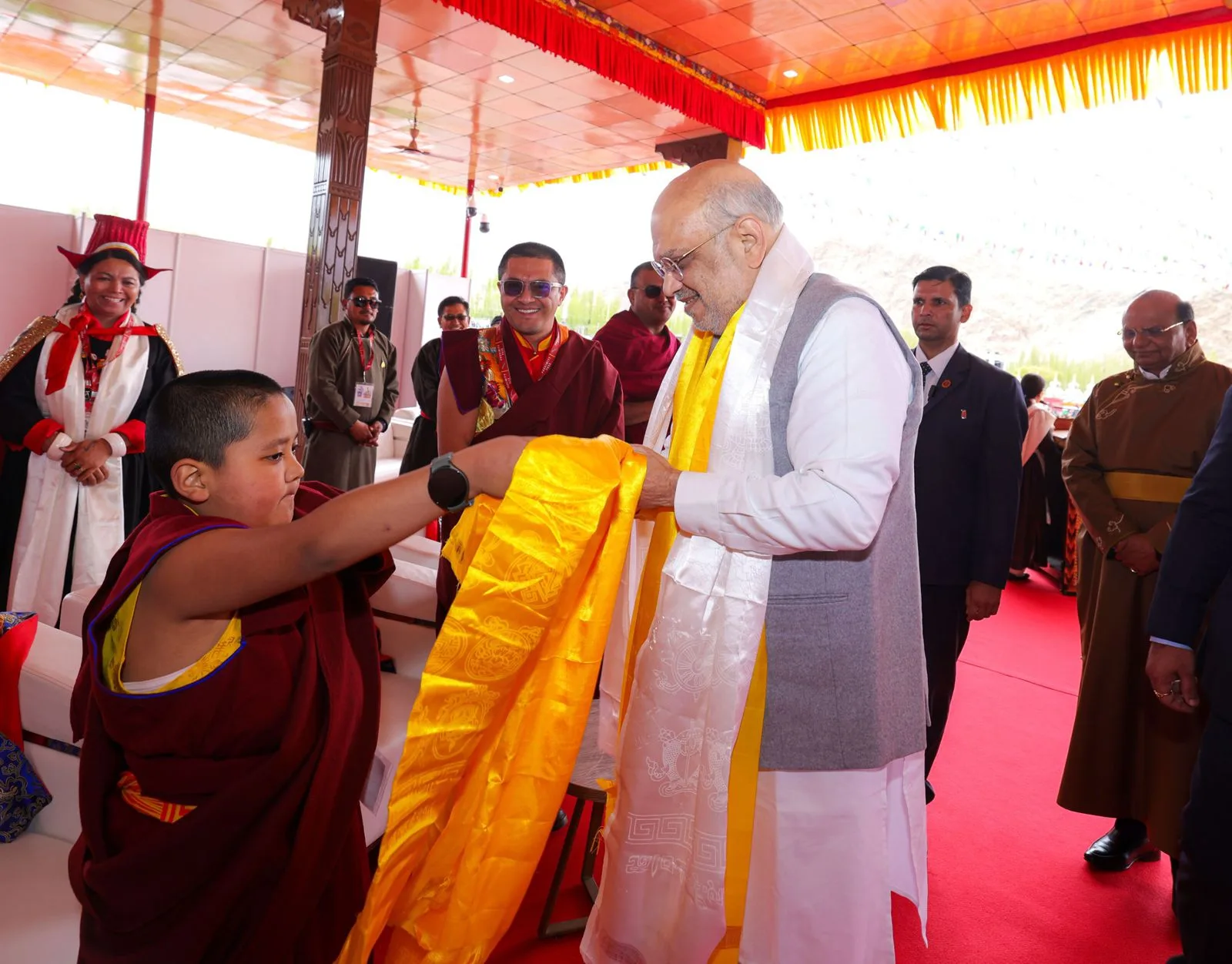
Leh, May 1 (JKNS): Union Home Minister Amit Shah on Friday inaugurated the exposition of the sacred relics of Lord Buddha in Leh, terming the occasion a “historic and golden moment” as the revered relics returned to Ladakh after a gap of 75 years on the auspicious day of Buddha Purnima.
As per news agency JKNS, Union Home Minister and Minister of Cooperation Amit Shah today inaugurated the exposition of the sacred relics of Lord Buddha in Leh.
On this occasion, Lieutenant Governor of Ladakh Shri V.K. Saxena and the Union Home Secretary along with many dignitaries were present.
In his address, Amit Shah said that today’s Buddha Purnima marks a historic and truly golden occasion for the residents of Ladakh. He said that on this auspicious occasion, after 75 years, the arrival of the sacred relics of Lord Buddha here will inspire followers of Buddhism as well as other faiths.
Amit Shah said that, much like in the life of Lord Buddha, it is rare for anyone to experience their birth, enlightenment, and Mahaparinirvana all occurring on the very same day; for this reason, today is a highly auspicious and inspiring day for all of us.
He said that today is not only a religious event but also a historic reunion. After so many years, Tathagata Buddha has returned to this sacred land, his most beloved land, which is a matter of great fortune.
He said that Ladakh has been a living land of Dhamma for centuries. When the Dalai Lama comes here, he says that this land is not merely geographical but a living laboratory of Buddhist culture and compassion.
Amit Shah said that knowledge has been preserved and nurtured on this land. Whenever Buddhism faced challenges, this land worked to preserve Lord Buddha’s message. When peaceful times came, it also worked to further propagate that preserved and enriched knowledge.
He said that this path became the medium through which the teachings of Tathagata spread from India to China and many other countries.
Union Home Minister said that Ladakh’s spiritual identity has been shaped by four major traditions Nyingma, Kagyu, Sakya, and Gelug. First, see things as they are. Second, the grace of the Guru and continuous self-reflection is the gateway to liberation. Third, knowledge is incomplete without practice, and practice is blind without knowledge; therefore, the union of knowledge and practice is the right path. Fourth, without moral discipline, a wise life cannot be formed. Shri Shah said that this message emerging from the land of Ladakh has become a guiding force for the world today.
Shri Amit Shah said that the presence of these sacred relics in Ladakh reminds us that India’s civilization has been giving the message of peace and coexistence for thousands of years. He said that in places full of diversity like Ladakh and Kargil, this message becomes even more relevant. This heritage still tells us that amidst conflict and unrest, the path of peace and compassion alone can provide solutions.
Union Home Minister said that for centuries, Buddhism reached Ladakh in different ways and at different times, flourished here, and later spread beyond Ladakh. He said that Ladakh was an ancient center of Kashmir’s Buddhist studies, Mahayana philosophy, and Buddhist art, and from there Ladakh first received contact, association, and spiritual engagement with Buddhism. The envoys of Emperor Ashoka laid the foundation of Buddhist influence in Ladakh.
Amit Shah said that during the Kushan period, approximately between the 1st and 3rd centuries, the rise and development of Mahayana Buddhism reached Ladakh. Many ancient stupas, Buddhist idols, Kharosthi-Brahmi inscriptions are evidence that Buddhism progressed here during that period as well.
The Home Minister said that due to the Silk Route, the routes connecting Kashmir, Leh, Yarkand, Khotan, and Tibet became important not only for trade but also for the exchange of ideas.
Amit Shah said that from 7th to 10th centuries, Mahayana and Vajrayana traditions reached Ladakh from Tibet, enriching the message of Tathagata here. After this, a decisive contribution came in the 10th and 11th centuries when Sanskrit texts were translated into Tibetan. 108 monasteries were established, including the Alchi Monastery, and Buddhism was given an institutional and permanent form.
Amit Shah said that even today, wherever there is a Buddhist tradition across the world, the knowledge enriched from Ladakh is considered very important.
He said that Mahayana Buddhist literature states that having the opportunity to see the sacred relics is equivalent to having the darshan of Lord Buddha himself. Today, after such a long time, the people of Ladakh are getting the fortune of having darshan of Lord Buddha himself.
The Home Minister urged the Ladakh administration to make full arrangements for followers of all faiths, especially Buddhism, to visit and have darshan.
He said that when Lord Buddha attained enlightenment and spread his teachings through monks, his knowledge was highly relevant, and today, after 2,500 years, it is even more relevant for the world.
Amit Shah said that the entire world should understand and accept India’s knowledge and the great message of Lord Buddha, and move on the middle path and the path of solutions. (JKNS)

