


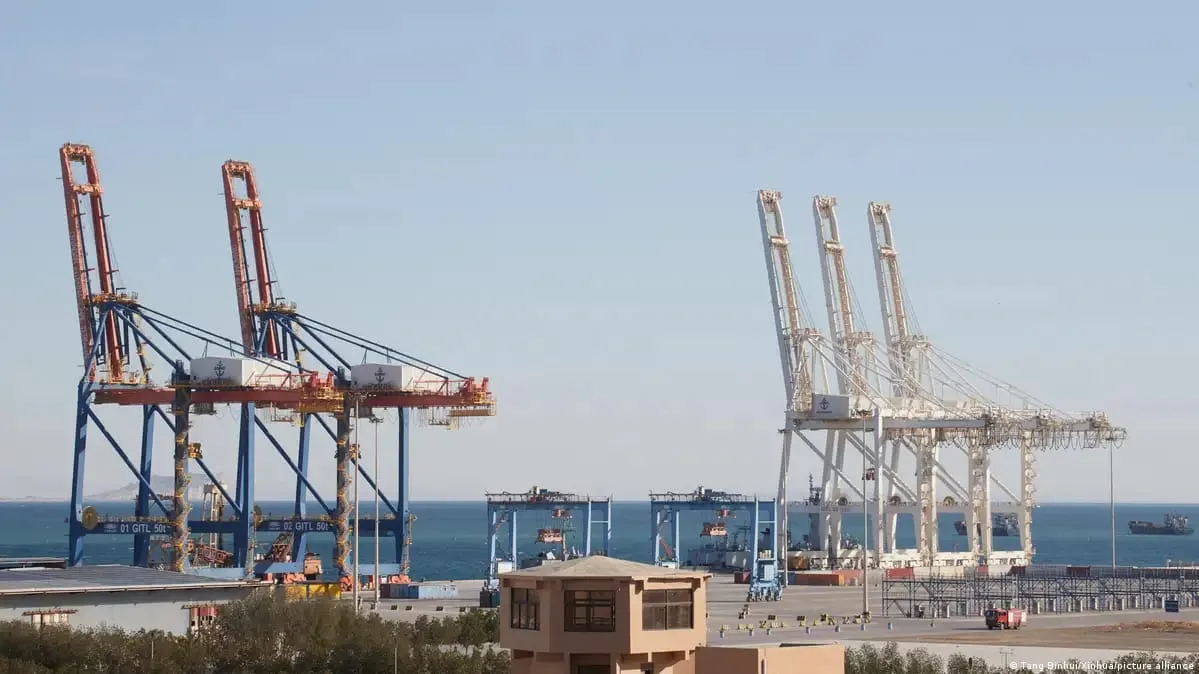
The numbers Pakistan’s port authority released for April 2026 deserve to be read carefully, because they contain both a genuine surprise and a structural warning. Gwadar processed roughly 11,000 standard shipping containers in a single month — more than the port had managed in the entire previous year, when the annual total sat at around 8,300 TEUs. By the narrow measure of containers in and out, it was the port’s best month since it opened for business.
Pakistani officials have moved quickly to claim the milestone as validation of the China-Pakistan Economic Corridor. The road corridor linking Gwadar to the Iranian border, formally activated through the Transit of Goods Order 2026, has been presented as the strategic catalyst. But strip away the self-congratulation, and a more uncomfortable story emerges — one about a port that is doing well precisely because the world’s preferred shipping lanes have become too dangerous to use.
On 28 February 2026, the United States and Israel launched airstrikes on Iran targeting military and government sites and assassinating Supreme Leader Ali Khamenei. Iran responded by closing the Strait of Hormuz, through which around 20 percent of global petroleum and LNG had been transiting. Calling this a “naval standoff” is a significant understatement.
While a conditional ceasefire is nominally in place, almost no shipping has used the strait and it remains effectively closed, with the US running a counter-blockade on ships seeking to use Iranian ports and Iran blocking vessels of non-approved states. More than 3,000 Iran-bound containers were stuck at Karachi Port and Port Qasim when Pakistan formally activated its transit corridor on 25 April, designating six overland routes connecting its ports to Iranian border crossings.
The Transit of Goods Order 2026 gave shippers the legal framework for an overland alternative. But that order was not a new diplomatic achievement. It was promulgated under a 2008 bilateral agreement between Pakistan and Iran that had been sitting dormant for eighteen years — activated suddenly because an external war finally made it relevant.
When the Hormuz situation eventually stabilises — through negotiation or the pragmatic accommodation that both sides have periodically signalled — the rerouting logic dissolves. The trajectory of those talks is far from clear: Iran briefly declared the strait open to commercial shipping on 17 April during the Lebanon ceasefire, only to re-impose restrictions when the US refused to lift its naval blockade, producing what analysts have described as a “dual blockade” with each side using access control as leverage.
As of early May, the strait remains all but closed, with the US blockade having intercepted 48 Iranian ships over 20 days and crude oil shipments severely curtailed, pushing international benchmark Brent crude briefly over $120 per barrel. Pakistan will ultimately be left with whatever commercial fundamentals Gwadar can sustain on its own merits. Those fundamentals are not encouraging.
The port’s approach channel sits at approximately 12.5 metres — below its designed depth of 14 metres due to the cost of dredging — while standard container vessels require a draft of 13 to 14 metres to dock. Neopanamax container ships, the workhorses of major Asia-Europe and transpacific trade lanes, carry between approximately 10,000 and 14,500 TEU and are built to a maximum draft of 15.2 metres. Ultra Large Container Vessels now operating on the most competitive trade lanes carry over 24,000 TEU.
Both classes are physically beyond Gwadar’s reach. This is not a temporary administrative problem or a funding gap that can be resolved quickly. Gwadar Bay experiences persistent siltation, meaning even the current restricted depth …

