


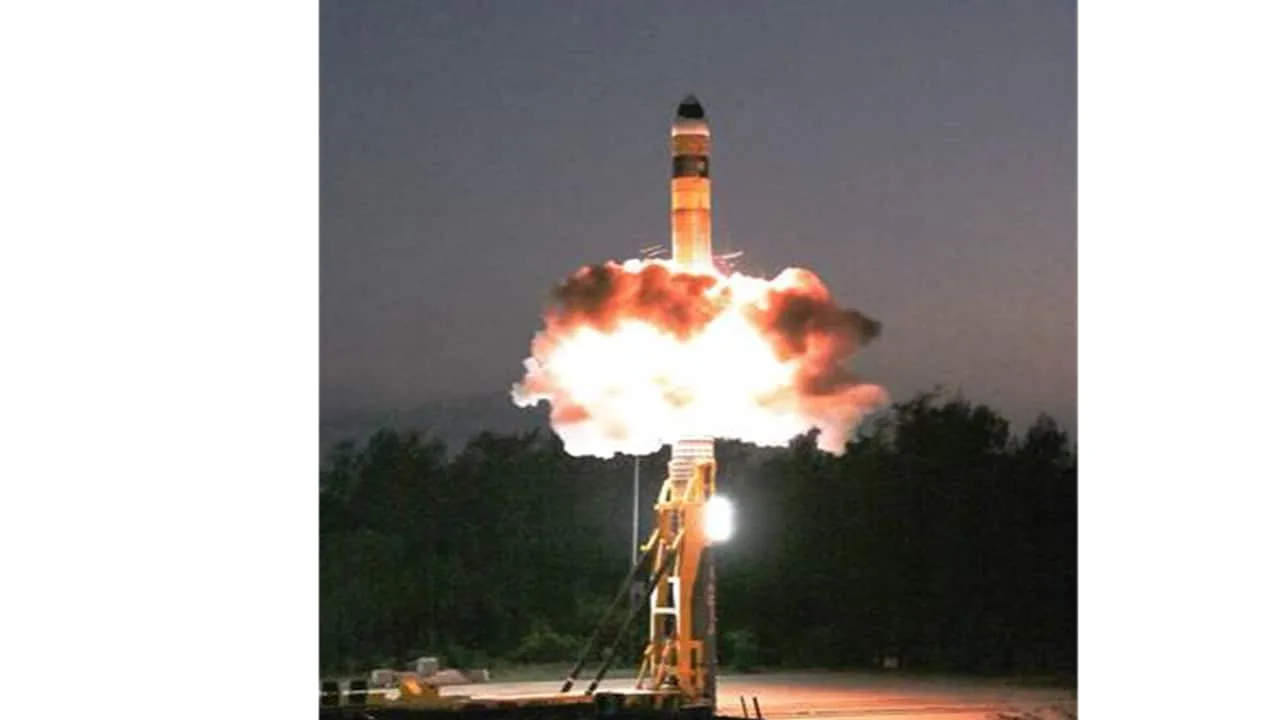
India’s Defence Research and Development Organisation (DRDO) announced on Saturday, May 9, that the country has successfully conducted a flight test of an advanced Agni ballistic missile featuring Multiple Independently Targeted Re-Entry Vehicle (MIRV) technology.
This is the third known test of the capability since India first demonstrated it in March 2024.
The missile was launched from Dr APJ Abdul Kalam Island off the coast of Odisha and carried multiple payloads directed at separate targets distributed across a large geographical area in the Indian Ocean Region.
A network of ground-based and ship-based tracking stations monitored the full trajectory from lift-off through to the impact of all payloads. The DRDO confirmed that all mission objectives were met.
Defence Minister Rajnath Singh congratulated DRDO, the Indian Army, and the defence industry on the achievement, saying it would “add an incredible capability to the country’s defence preparedness against growing threat perceptions.”
Background: Six Decades in the Making
The Agni missile programme traces its origins to India’s Integrated Guided Missile Development Programme, launched in 1983.
The Agni-V is a land-based, nuclear-capable, intermediate-range ballistic missile developed by DRDO, with a base range of 5,400 kilometres that can reportedly be extended to intercontinental ballistic missile ranges of more than 7,000 kilometres.
It is a three-stage, road-mobile, canisterised and solid-fuelled missile capable of reaching speeds up to Mach 24.
The Agni-V was first tested to its full 5,000-kilometre range on 19 April 2012.
Mission Divyastra: The First Test, March 2024
In a major technological leap for India’s nuclear deterrent, DRDO conducted India’s first successful flight test of the Agni-V fitted with MIRV technology on 11 March 2024, codenamed Mission Divyastra, carried out from the same Abdul Kalam Island launch facility and involving the missile carrying between four and six dummy warheads.
Prime Minister Narendra Modi announced the achievement in a TV address. At the time, he posted on social media–“Proud of our DRDO scientists for Mission Divyastra, the first flight test of indigenously developed Agni-5 missile with Multiple Independently Targetable Re-entry Vehicle (MIRV) technology.”
With that test, India joined the select group of nations that possess MIRV capability. The system was equipped with indigenous avionics systems and high-accuracy sensor packages, ensuring that the re-entry vehicles reach their designated target points with the required precision.
The Second Test: SFC User Validation, August 2025
A user validation trial by the Strategic Forces Command took place on 20 August 2025. This was seen as an important step in transitioning the technology from a DRDO developmental programme to an operationally credible weapons system under military control.
India’s Strategic Forces Command launched the missile from a test range in the state of Odisha.
The Agni-5, which has a range of more than 5,000 kilometres, puts China and Pakistan well within reach.
What MIRV Technology Means
MIRV technology involves launching a single missile carrying four to six warheads, each of which can be programmed to strike a separate target several hundred kilometres apart.
In strategic terms, this dramatically multiplies the offensive capability of every missile in a country’s arsenal and significantly complicates any adversary’s missile defence calculations. A single interceptor can no longer neutralise a single threat.
A single-warhead missile can be defeated by a single interceptor. A six-warhead MIRV missile would require at least six interceptors, plus extras for the decoys that usually accompany the warheads, making ballistic missile defence orders of magnitude harder.

